
Speech and communication are important for learning, confidence, socializing, relationships and everyday life. Where a child or adult has difficulties with speech or language, the right therapy can help to address communication issues in a structured and meaningful way. We don’t see speech therapy as a one-size-fits-all service here at Soft Hear. The emphasis is on getting to know each person individually, identifying their communication needs, and developing a customized speech therapy plan based on their age, condition, skills, and aspirations.
Soft Hear provides speech therapy support to both children and adults with a variety of speech and communication problems. Children with speech delay or communication difficulties can receive age-appropriate intervention and adults can receive support for their individual speech and communication needs. The approach is to acknowledge that every patient is an individual and may need a different pathway to achieve meaningful improvement.
An important part of the Soft Hear approach is to look beyond the speech difficulty itself. The assessment takes into account the overall clinical context if a patient has a related condition or a particular underlying issue. Soft Hear works with patients with problems such as Down syndrome, autism, cleft palate, speech delay and other speech and communication difficulties. Soft Hear believes in understanding the full spectrum of the individual’s needs before planning therapy.
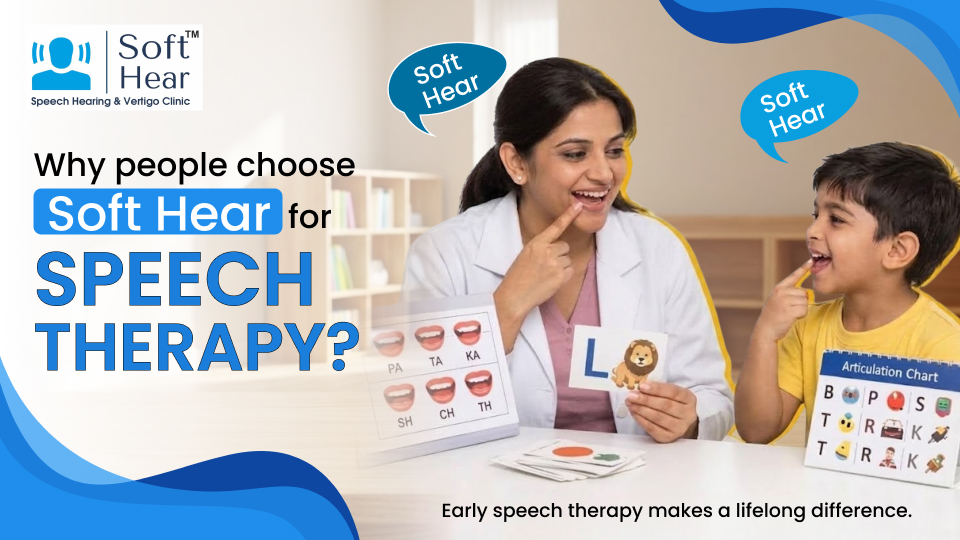
For children, Soft Hear also incorporates scientifically designed, goal-oriented activities into therapy. These activities are not simply games for entertainment; they are thoughtfully planned to encourage communication, participation, language development, and other targeted skills in an engaging and child-friendly manner. This can make therapy more comfortable and motivating while keeping the activities connected to specific therapeutic objectives.
The first step in the process is to understand the patient and their communication needs. This information is then used to create an individualized therapy plan, and intervention is tailored to the person’s age, abilities, condition and progress. When associated concerns like cleft palate, autism, Down syndrome, or a significant speech delay are present, the rehabilitation approach also takes into account the overall needs of the individual.
This reflects Soft Hear’s wider philosophy of treating the patient, not just the problem or the test. Its clinical model emphasizes understanding the individual, interpreting relevant findings, guiding personalized rehabilitation, providing counselling, and continuing support through follow-up.
By adopting this patient-centred approach, Soft Hear aims to make Speech Therapy a more personalized and purposeful journey – beginning with understanding the individual, moving through scientifically guided intervention, and staying focused on supporting meaningful communication outcomes for children and adults.
A Patient-Centred Approach to Speech Therapy
One of the main reasons people choose Soft Hear is that it concentrates on understanding each person’s needs, rather than following a generic path. Communication problems can manifest themselves in different ways for different people. Therefore, the assessment and rehabilitation process should take into account the individual’s concerns, communication needs, clinical findings and functional needs.
Assessment is the first step in the Soft Hear approach to a broader rehabilitation journey. Rather than seeing the evaluation as the final step, the information gathered is analyzed and linked to the individual’s needs prior to addressing management. This is reflected in the wide clinical pathway of assessment, interpretation, management, rehabilitation and follow-up.
Professional Assessment Before Intervention
Understanding the communication problem is the first step to effective speech therapy. Soft Hear’s more comprehensive clinical model is not concerned with the delivery of a report but with professional assessment and interpretation. This includes understanding relevant history, carrying out appropriate assessments, checking findings where necessary and interpreting the information within context in hearing and communication care.
This is particularly useful as problems with communication may not be fully understood with one isolated measure. The available findings gain more meaning when considered together and in relation to the person’s everyday communicative needs. The philosophy behind Soft Hear is thus more than just a test-and-report model, leading to a more connected rehabilitation path.
Individualized Therapy Instead of a Standard Routine
Everyone communicates differently and the needs for therapy can shift based on a person’s age, presenting concerns, communication environment, and individual goals. Soft Hear’s clinical philosophy is to select the correct assessments and interventions for the correct person and not everyone will necessarily follow the same pathway.
This principle is reflected in its whole assessment model. Tests are selected based on clinical indication, age, presenting complaint and applicable professional standards. It’s
not about doing more tests, but about choosing the tests that can help understand the individual in a meaningful way.This patient-specific philosophy sets the stage for rehabilitation that is focused on meaningful communication, rather than just completing a set number of sessions.
Connecting Hearing and Speech for Better Communication
Speech and hearing are closely related features of communication. The person may hear the sounds, but have difficulty understanding speech, especially in difficult listening environments. Soft Hear’s assessment model therefore concentrates on speech recognition, speech discrimination and speech-in-noise testing where clinically indicated.
With this broader perspective, Soft Hear is able to see communication from a functional point of view. Instead of treating hearing sensitivity and speech understanding as entirely separate issues, relevant findings can be integrated to form a more complete picture of the individual’s communication needs.
This method may be especially useful in the case of speech as well as hearing problems, since rehabilitation of communication may require an understanding of both auditory and speech factors.
Clinical Interpretation Makes the Difference
Information is given by assessment but it is interpretation that gives that information meaning. Soft Hear is about audiological and clinical interpretation, not just numbers or reports. The model incorporates findings such as pure tone audiometry, impedance, speech results and clinical observation where relevant.
This principle is important in rehabilitation, as the intervention should be guided by the knowledge of the overall clinical picture of the individual. Soft Hear’s approach therefore places professional interpretation between assessment and rehabilitation, helping to make sure that clinical findings are used with purpose rather than just recorded.
Speech Therapy as a Rehabilitation Journey
People often enter therapy with a simple goal in mind: to improve their communication. This may require more than one intervention. Soft Hear considers rehabilitation as a process that is ongoing and may include assessment, interpretation, individualized rehabilitation, counselling, verification where applicable, rehabilitation support and follow-up.
This makes the journey more integrated. The follow up becomes part of the process, not the first appointment being the whole solution. Progress can be reviewed, guidance can be given and the rehabilitation pathway supported as required.
Personalized Counselling and Guidance
Another reason why people choose Soft Hear is because of the focus on professional, patient specific and evidence-based counseling. “Communication difficulties can naturally lead to questions about what the evaluation means, whether rehabilitation is needed, and what the next steps are.
Soft Hear's counseling approach is based on the assessment findings of the individual and the clinical situation, not on the same explanation for every patient. This helps to make the care journey easier to understand and enables patients and families to participate more confidently in decisions about rehabilitation.
Follow-Up Beyond the First Session
Speech and communication rehabilitation is not a single visit affair. Ongoing supervision and review is often a key part of someone’s rehabilitation journey. The wider model of Soft Hear includes clinical guidance, verification, rehabilitation support and follow-up, with an outcome-oriented rather than one-off service.
One of the things that sets the Soft Hear model apart is its focus on monitored and outcome-focused care. The goal is not to carry out an assessment or to write a report, but to understand the needs of the patient and facilitate proper rehabilitation.
Soft Hear vs Other Approaches
| Area | Soft Hear | Other / Limited Approaches |
|---|---|---|
| Approach to care | Patient-centred and rehabilitation-focused | Often test- or service-centred |
| Assessment | Comprehensive and clinically connected | May rely on limited or isolated assessments |
| Interpretation | Findings are clinically interpreted and correlated | May focus mainly on reports or numbers |
| Speech assessment | Speech recognition, discrimination and speech-in-noise assessment where clinically indicated | Speech assessment may be limited |
| Individualization | Assessment and management are adapted to individual needs | May follow a more standardized pathway |
| Clinical correlation | Relevant findings are considered together | Findings may remain fragmented |
| Counselling | Professional, patient-specific and evidence-based | May be basic or limited |
| Rehabilitation | Assessment findings help guide individualized rehabilitation | May be primarily test- or device-based |
| Follow-up | Ongoing guidance, rehabilitation support and follow-up | Follow-up may be limited or inconsistent |
| Outcome focus | Personalized, monitored and outcome-focused | Outcomes may be more variable |
The distinction is not simply about how many services are available. It is about how those services are connected. Soft Hear's model brings assessment, interpretation, rehabilitation, counselling, and follow-up into a broader clinical pathway.
A More Meaningful Communication Journey
Choosing the right speech therapy provider can be an important decision for people seeking speech therapy. Soft Hear’s approach is based on understanding the person first, then using relevant clinical information to inform rehabilitation. The philosophy moves away from the question of which tests can be done to what the individual needs and which appropriate assessments can help build a clearer clinical picture.
It is this patient-centred approach that has Soft Hear on the radar for individuals and families looking for structured speech and communication care. Soft Hear’s unique approach combines professional assessment and clinical interpretation, individualized rehabilitation, counseling and ongoing follow-up to make the rehabilitation journey more purposeful, informed and focused on meaningful communication outcomes.
Conclusion: Why Soft Hear Stands Apart for Speech Therapy
Selecting the right speech therapy provider is more than simply finding a place to go for therapy sessions, it’s about finding a clinical approach that understands the individual, identifies the underlying communication needs and supports meaningful progress. Soft Hear is unique in its patient centered philosophy, assessment, interpretation, personalized rehabilitation, counseling and follow up all forming part of one connected journey.
Soft Hear is a more thorough comprehension of what the findings mean for the individual, not the test or report as the answer. Relevant clinical information is evaluated, interpreted and used to guide an appropriate rehabilitation pathway. This is consistent with the central philosophy of “Treat the Patient, Not the Test” where the focus of care is on the person and their communicative goals.
Soft Hear is a more reflective, structured approach to communication care through professional assessment, clinically-guided decision making, individualized rehabilitation and ongoing support. It focuses on rehabilitation that is personalized, monitored and outcome-based, which allows patients and families to move from an understanding of their communication needs to moving confidently toward better everyday interaction.
Soft Hear is more than just assessments and therapy. It is about understanding, guiding, supporting and remaining connected on the rehabilitation journey. That is the patient-first philosophy that makes Soft Hear a trusted choice for those seeking professional, personalized speech therapy care.