
Hearing loss is one of the most common chronic health conditions in the world, occurring in people of all ages. Hearing loss is often associated with ageing, but it can also be caused by exposure to loud noise over time, infections, genetic conditions, certain medications, head injuries or other medical conditions. The World Health Organization (WHO) estimates that more than 1.5 billion people globally have some degree of hearing loss and almost 430 million people require rehabilitation services for disabling hearing loss. In addition, the WHO has projected that more than 700 million people will need hearing rehabilitation by 2050, highlighting the growing significance of hearing healthcare as a global public health priority.
But even with these staggering numbers, many people put off treatment. Some people think hearing loss is just a natural part of ageing, while others are put off by misconceptions about hearing aids. Today’s hearing aids are much more sophisticated than the clunky devices of yesteryear. Today's hearing aids use artificial intelligence (AI), digital signal processing, Bluetooth connectivity, rechargeable batteries and smartphone compatibility to provide a natural listening experience, fitting into everyday life.
One of the most important decisions made after a hearing evaluation is selecting the right style of hearing aid. Audiologists prescribe several different styles of hearing aids, but the two most common are Behind-the-Ear (BTE) and Receiver-in-Canal (RIC) hearing aids. They may look similar from a distance but they are quite different in design, function, performance and suitability. Choosing between these two styles is not simply a matter of preference. But rather it is about a thoughtful look at your hearing loss, your ear structure, your everyday life and your future hearing goals.
In this article, we’ll compare BTE and RIC hearing aids in detail so you can learn how each style works, who they’re best for, and which may be the best fit for your hearing needs and lifestyle.
Why the right type of Hearing Aid is important?
A hearing aid is more than an amplifier of sounds. Today's hearing aids are sophisticated medical devices programmed to an individual's unique hearing loss using detailed diagnostic testing. Wrong Style Could Affect Comfort, Speech Clarity, Maintenance and Overall Satisfaction of the Device.
For example, two people with the same amount of hearing loss may be fitted differently due to differences in the shape of the ear canal, dexterity, cosmetic preferences or daily listening environments. If you spend most of your day in business meetings, you might want to focus on speech clarity and discretion; if you work outside, you probably need a more rugged device that can handle moisture, dust and the elements.
Professional Audiologists therefore take a number of factors into consideration before suggesting a hearing aid style:
- Type and degree of hearing loss
- Age and general health
- Anatomy of the ear canal
- Requirements of occupation and lifestyle
- Cosmetic preferences
- Manual dexterity and sight
- Budget planning and continuous maintenance
- Future progression of hearing impairment
Government health agencies such as the National Institute on Deafness and Other Communication Disorders (NIDCD) emphasize that hearing aids should always be selected on the basis of a complete hearing evaluation by a qualified hearing health care professional, not appearance alone.
Learning about the different types of Hearing Loss
Before comparing BTE and RIC hearing aids, it’s helpful to understand the types of hearing loss each is designed to treat.
1. Sensorineural Hearing Loss
Permanent hearing loss is most commonly sensorineural hearing loss. It occurs when the delicate hair cells in the cochlea (inner ear) or the auditory nerve that sends sound signals to the brain are damaged. Age (presbycusis), long-term exposure to loud noise, medications and heredity are the most common causes of hearing loss.
People with sensorineural hearing loss often say that they hear people talking but have difficulty understanding what is being said, especially in noisy environments like restaurants, malls or family gatherings. Depending on the severity of your hearing loss, BTE and RIC hearing aids are often prescribed for this type of hearing loss.
2. Conductive Hearing Loss
Conductive hearing loss occurs when sound is not conducted efficiently through the outer or middle ear. Blockage by earwax, ear infections, fluid behind the eardrum, perforated eardrums, or abnormalities of the middle ear bones can lead to conductive hearing loss.
Conductive hearing loss is often medically or surgically treatable. However, when surgery is not possible or the condition persists, hearing aids, particularly BTE models with custom earmolds, can offer effective amplification.
3. Mixed Hearing Loss
Mixed hearing loss is a combination of sensorineural and conductive hearing loss. Management usually involves medical treatment of the conductive component if possible, and hearing aids to compensate for the permanent sensorineural component.
Knowing the type and degree of hearing loss allows audiologists to determine whether a BTE or RIC hearing aid will offer the most successful hearing rehabilitation.
What are Behind-the-Ear Hearing Aids?
Behind-the-ear (BTE) hearing devices have been successfully used for decades and continue to be one of the most versatile styles of hearing devices available today. The microphone, digital processor, amplifier, battery and receiver ( all the major electronic components ) are contained in a sturdy housing that fits behind the ear in a BTE hearing aid.
The sound from the hearing aid goes down a hollow tube which connects to either a custom- made earmold or a soft dome that sits inside the ear canal. BTE hearing aids are typically easier to maintain and less susceptible to moisture or earwax damage because the electronics are outside the ear canal.
The modern BTE hearing aids are a world apart from the earlier models. Now they are smaller, lighter and packed with high-tech digital technology. Most models have rechargeable batteries, and many include Bluetooth streaming for phone calls and media, smartphone apps for remote adjustments, artificial intelligence that automatically adjusts the hearing aid for the environment, and directional microphones that help improve understanding of speech in noisy environments.
A major advantage of BTE hearing aids is that they can provide strong amplification. They work for people with mild, moderate, severe and even profound hearing loss, making them one of the most versatile hearing aid options available. They are also highly recommended for children because the earmold can be easily replaced as the child grows without having to change the whole hearing aid.
BTE hearing aids are also often used by people who have chronic ear conditions or narrow ear canals, as the sensitive electronic parts are kept safe outside the ear.
What are Receiver-in-the-Canal (RIC) Hearing Aids?
Receiver-in-Canal (RIC) hearing aids are one of the greatest leaps forward in hearing aid design. They look like BTE hearing aids on the outside but they are very different on the inside.
In a RIC hearing aid, the microphone, processor, and battery remain inside a small housing worn behind the ear. The receiver ( speaker ) is placed directly inside the ear canal and connected with a thin electrical wire. This is instead of putting the speaker inside the hearing aid body.
This apparently simple design modification offers many significant advantages.
The closer sound is to the eardrum, the less distortion is introduced, as it does not have to travel through a long acoustic tube. This often results in clearer, more natural sound quality, particularly for high-frequency sounds such as birds chirping, children's voices, and speech consonants like S, F, T, and Sh, which are essential for speech understanding.
Many RIC hearing aids are open-fit designs with a small dome, allowing natural ambient sounds and airflow to enter the ear canal. This reduces the occlusion effect, the sensation of a blocked ear that many hearing aid users find unpleasant.
Due to their slim profile and nearly invisible connecting wire, RIC hearing aids are also considered one of the most cosmetically appealing hearing aid styles. First time users often appreciate the hearing aid’s discreet look and feel more confident wearing hearing aids at work and in social settings.
Initially designed for mild to moderate hearing loss, modern RIC hearing aids are now available with different receiver strengths, allowing them to support mild, moderate, moderately severe, and even some cases of severe hearing loss. But for those who require very high amplification, traditional BTE hearing aids may still be the better choice.
RIC and BTE
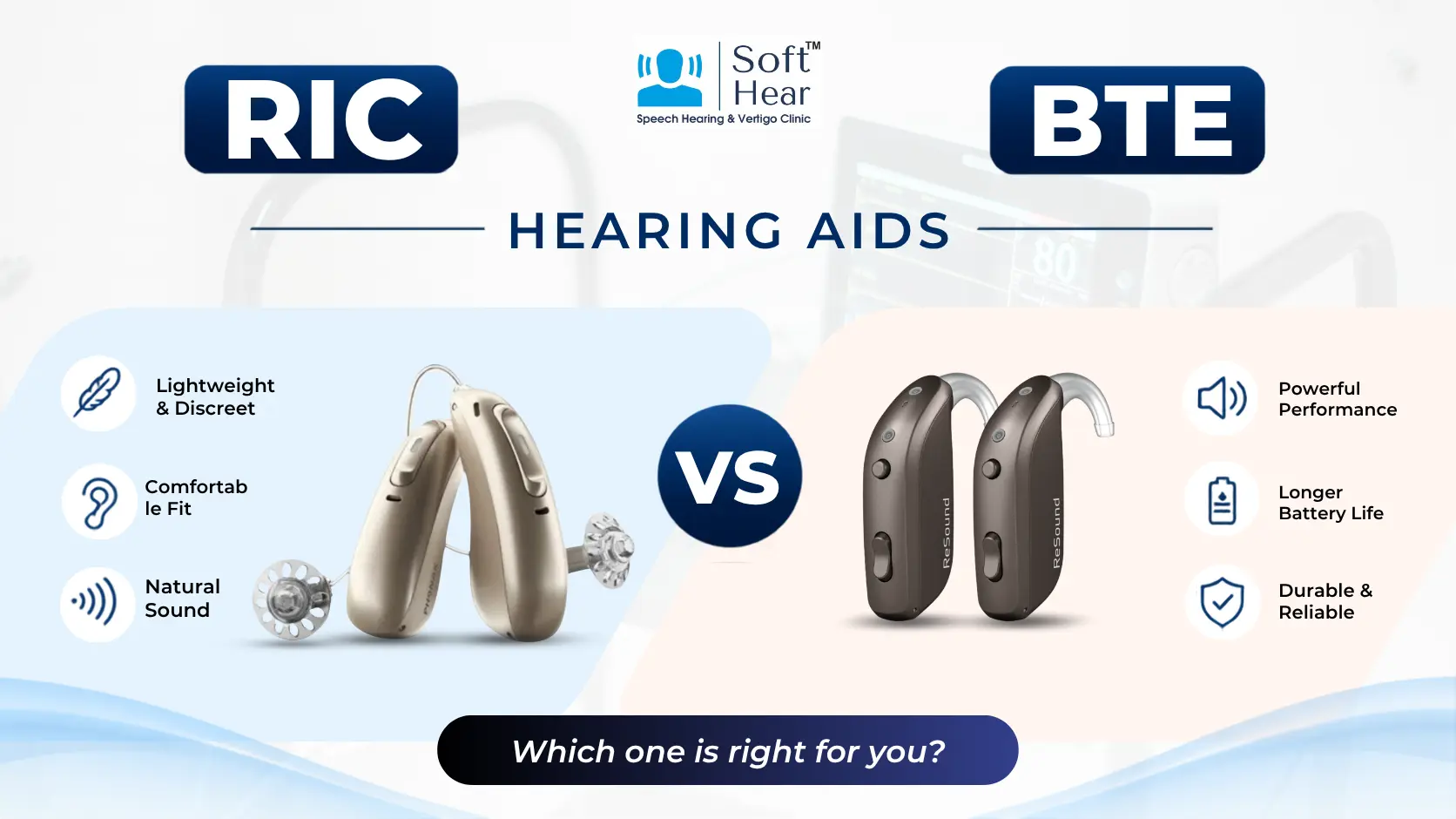
Both BTE and RIC hearing aids are worn behind the ear, and they can look quite similar at first glance. Yet the position of the receiver makes major differences in delivery of sound, comfort, maintenance, durability and suitability to different ways of living.
BTE hearing aids are designed to be powerful, tough and versatile while RIC hearing aids are designed to provide natural sound quality, cosmetic appeal and wearing comfort. Neither of the styles is of a better nature than the other. Instead, they have their own benefits that make them more appropriate for some users and some listening needs.
It is important to be aware of these differences before taking any decision and in the next section these aspects will be explained in more detail.
BTE vs RIC Hearing Aids: Side-by-Side Comparison
Once you’ve learned how BTE (Behind-the-Ear) and RIC (Receiver-in-Canal) hearing aids work, the next thing to do is compare them based on the factors that make the biggest difference in everyday life. While both styles are designed to enhance hearing and communication, their structural differences impact sound quality, comfort, maintenance, durability, and overall user experience.
It’s not just about which hearing aid is newer, more popular, BTE vs. RIC. Instead, it's about how well the hearing aid fits with a person's hearing loss, lifestyle, what they listen to and preferences. The best hearing aid for one person may not be the best hearing aid for someone else.
Here we have discussed the main differences between BTE and RIC hearing aids in detail.
1.Design and Construction
The most noticeable difference between BTE and RIC hearing aids is probably the location of the receiver (speaker).
Behind the Ear (BTE)
A BTE (behind-the-ear) hearing aid has all the main electronic parts, like the microphone, digital processor, amplifier, receiver and battery, in a tough case sitting just behind the ear. The receiver converts the sound and transmits it down a clear plastic tube to an earmold or dome that fits in the ear canal.
The receiver is housed in the hearing aid shell and so is less exposed to moisture, dust and earwax. This design also increases the durability of the device, making BTE hearing aids particularly suitable for those living in humid climates or those working in harsh outdoor environments.
Receiver-in-Canal (RIC)
RIC hearing aids, also worn behind-the-ear, have a different architecture. This receiver is placed right in the ear canal and is connected to the hearing aid body through a thin electrical wire.
The shorter path between the receiver and the eardrum causes less acoustic distortion of the sound to the eardrum. This results in a more natural listening experience particularly for speech and high frequency sounds.
The wire is very thin and therefore the preferred choice of appearance-conscious users, as RIC hearing aids are typically less visible than traditional BTE devices.
2.Sound Quality & Speech Intelligibility
Sound quality is among the most important factors affecting hearing aid satisfaction . The aim of a hearing aid is not simply to turn up the volume, but to enhance clarity and intelligibility of speech.
Why receiver placement is important?
In BTE hearing aids, sound must travel down a plastic tube before entering the ear canal. Modern digital processing minimizes the distortion, but some degradation of sound quality may occur in transmission.
The RIC hearing aid solves this problem by placing the receiver in the ear canal. Users often find that speech sounds clearer and more natural, because the path sound travels is much shorter.
For those with high-frequency sensorineural hearing loss, many audiologists suggest RIC hearing aids because they can more precisely reproduce high-pitched sounds. This is particularly important because consonant sounds such as S, F, TH, K and SH carry much of the information needed to understand speech.
Without these sounds speech sounds muffled, even if the overall volume is loud enough.
3. Performance under noisy environments
One of the biggest complaints of people with hearing loss is difficulty understanding speech in noisy environments such as:
- Restaurants
- Shopping malls
- Business meetings
- Family Get-together
- Places for worship
- Public Transport
To address this challenge, today’s hearing aids utilize state-of-the-art technologies including:
- Directional microphones
- Noise cancellation algorithms
- Environmental recognition based on AI
- Speech enhancement systems
- Automatic listening programs
Both BTE and RIC hearing aids are available with these advanced technologies.
However, RIC hearing aids are generally slightly better at improving speech clarity in noisy environments, particularly for individuals with mild to moderate-severe hearing loss, because the receiver is placed closer to the eardrum.
Keep in mind that hearing aids cannot completely eliminate background noise. Instead they are designed to help improve the balance between speech and background sounds, to help the brain to focus better on conversations.
4.Comfortable for long time wear
Comfort is another important factor, especially since hearing aids are usually worn for 10 to 16 hours a day.
BTE hearing aid comfortable
Today’s BTE hearing aids are smaller and lighter than they used to be. They are comfortable to wear for long periods if fitted properly.
However, many BTE devices are fitted with custom earmolds that occlude the ear canal, and some users report initially having a sensation of their ears being “plugged”. This is called the occlusion effect.
Most users end up living with this feeling over time and an audiologist can adjust the earmolds to be more comfortable if needed.
RIC hearing aid comfortable
RIC hearing aids are generally fitted with an open-fit dome instead of a full earmold.
Its open design allows natural airflow within the ear canal while letting low frequency sounds naturally enter. “Many users report:
- Improved comfort
- Lowered ear fatigue
- Decreased blocked-ear sensation
- More natural perception of their own voice
This often makes it easier for people who are trying hearing aids for the first time to move on to amplification.
5. Cosmetic appearance
The appearance of hearing aids is becoming a more important factor, especially for younger adults and those in the professional sphere.
Fortunately, today's hearing aids are much more discreet than those of the past.
BTE Appearance
Modern BTE hearing aids include:
- Smaller than previous generations
- Colors that match skin tones and hair colors
- Smaller and lighter
- Designed with ergonomics in mind
While these improvements, the tubing is still a bit more visible than the thin wire used in RIC hearing aids.
RIC Appearance
One of the most cosmetically appealing styles of hearing aids is the RIC hearing aids because:
- The wire that connects them is very thin.
- The receiver is placed in the ear canal.
- Only a compact housing behind the ear.
- They are less visible when viewed from the front.
RIC hearing aids often provide more reassurance for those concerned about visibility, or social confidence.
6. Power and Amplifying
Not all hearing losses require the same amplification.
The amount of gain required varies greatly depending on the degree of hearing loss. Individuals with mild hearing loss require relatively little gain, while those with profound hearing loss require significantly more sound amplification.
BTE Hearing Aids
A great advantage of BTE hearing aids is their ability to generate a high output.
They can treat:
- Slight hearing loss
- Mild to moderate hearing loss
- Profound hearing loss
- Severe hearing impairment
Power BTE hearing aids are often recommended for those who need maximum amplification without sacrificing sound quality.
RIC Hearing Aid
Prior RIC models were primarily designed for mild to moderate hearing loss.
Today, manufacturers offer a few strengths for receivers:
- Standard receiver
- Moderate power receivers
- High power receivers
This means many cases of severe hearing loss can be accommodated by RIC hearing aids.
But for profound hearing loss, BTE hearing aids are often still the option of choice, as they can provide more amplification, better stability, and less feedback.
7.Feedback Handling
Feedback is the whistling or squealing sound sometimes produced when amplified sound escapes the ear canal and is re-amplified by the hearing aid microphone.
Modern hearing aids have very sophisticated feedback cancelling systems.
But design still influences feedback performance.
BTE
Sound is carried through the tubing and earmolds. If the tubing is not fitting well or is damaged, the chance of feedback increases.
The good news is that usually the problem can be solved by replacing tubing or changing earmolds.
RIC
RIC hearing aids minimize acoustic feedback by placing the receiver in the ear canal.
Combined with advanced digital feedback suppression technology, they usually offer great feedback management and still sound natural.
8.Connectivity and Smart Features
A common misconception is that the style of hearing aid determines the technology in the hearing aid.
In practice, the more advanced features are more dependent on the manufacturer and model than on whether the hearing aid is BTE or RIC.
Available with premium technologies in both styles:
- Bluetooth streaming for phone calls
- Direct TV link
- Applications for smartphones
- Lithium-ion rechargeable batteries
- Artificial Intelligence (AI)
- Automatic environment adaption
- Motion detectors
- Distant programming
- Virtual visits
- Support for voice assistants
- Drop detection on some premium models
These innovations allow hearing aids to automatically adapt settings as users move from quiet rooms to busy streets, offices, restaurants and outdoor environments.
9.Battery Options
In the last 10 years battery technology has got a lot better.
BTE and RIC hearing aids today are available with:
Zinc-Air Batteries (Disposable)
Advantages are:
- Easily replaceable
- Convenient for travel
- No charging necessary
Disadvantages are:
- In-process battery costs
- Often replacement
10.Lithium-Ion Rechargeable Battery
Rechargeable hearing aids are gaining popularity as they remove the hassle of coping with small batteries.
Benefits:
- Over night charge, full day operation
- Environment Friendly
More accessible for older adults with arthritis or reduced finger dexterity
Both the BTE and RIC styles are available as rechargeable models, offering users the convenience of a rechargeable hearing aid without sacrificing performance.
11.Wind Noise and Outdoor Performance.
Wind noise can affect your hearing, and it’s something that’s often experienced by people who enjoy walking, cycling, gardening or outdoor sports.
Today’s hearing aids come equipped with special wind-noise management systems that automatically sense and reduce wind noise.
Because BTE hearing aids have microphones that are positioned a little farther away from the ear canal, they may be subject to a bit more wind. This is overcome by sophisticated digital processing in high-end BTE devices.
RIC hearing aids also feature wind-noise reduction algorithms, so you can have comfortable listening when you’re out and about.
Choosing Between Performance and Preference
When considering BTE versus RIC hearing aids, it’s easy to get caught up in appearance or sound quality. But the best hearing aid is one that consistently meets your communication needs throughout the day.
BTEs are better in power, durability and versatility. So they are great for children, people with severe to profound hearing loss and for users requiring custom earmolds or working in difficult environments.
The RIC hearing aids are appreciated for their natural sound quality, discreet design and superior comfort. They are a great choice for many adults with mild to severe hearing loss who value both aesthetics and speech clarity.
Crucially, both styles have changed a lot over the years. With advances in digital technology, both options can deliver excellent hearing outcomes when chosen and programmed by a qualified audiologist. Instead of asking yourself which style is better overall, the more relevant question is which style is best for your hearing profile, lifestyle and long-term communication goals.
Deciding between a Behind-the-Ear (BTE) or a Receiver-in-Canal (RIC) hearing aid is not merely a matter of technical specifications. A hearing aid is a long-term investment in your communication, your social well-being and your overall quality of life. Sound quality and looks matter, but so do maintenance, durability, fit with your lifestyle, future hearing needs, and total cost of ownership.
Hearing aids are worn 12 to 16 hours per day in various settings – the quiet of the home, the busy office, outdoor environments, social situations, and public transportation. Choose a hearing aid that fits your daily routine and you will be much more comfortable, satisfied and likely to use it long term.
Maintenance Requirements: Keeping Your Hearing Aids Performing at Their Best
Like all advanced electronic devices hearing aids require regular care and maintenance to ensure optimum performance and longevity. Regular cleaning, proper storage and routine professional servicing can greatly enhance the lifespan of your hearing aids, and help preserve the quality of sound.
Both BTE and RIC hearing aids require regular maintenance. However, due to their different design, the type and frequency of maintenance is different.
Maintenance of BTE Hearing Aids
BTE hearing aids are worn behind your ear, and the electronics are housed in a case to protect them from contact with earwax and moisture. This makes them relatively easy to maintain and clean.
Routine maintenance generally consists of:
- Clean the earmold daily with a soft dry cloth.
- Inspecting tubing for moisture or blockage.
- Change tubing regularly if it becomes stiff, discolored or cracked.
- Dust protection of microphone openings.
- Store the hearing aid in a protective case when it is not in use.
Occasionally the custom earmold will require professional cleaning or replacement to ensure comfort and acoustic performance.
Maintenance of RIC Hearing Aids
RIC hearing aids require a little more care because the receiver sits inside the ear canal, where it’s exposed to ear wax, humidity and body oils.
Users should regularly:
- Clean the dome and receiver with approved cleaning tools.
- Replace wax guards according to the manufacturer’s instructions.
- Inspect thin receiver wire for damage.
- Replace silicone domes regularly for hygiene and comfort.
- Have the receiver serviced regularly by a professional to check performance.
Receiver replacement is usually simple and cheaper than replacing a whole hearing aid, but is more common with RIC devices because of their location inside the ear canal.
Durability: Which is the More Durable Aid?
Durability is a key factor, especially for those who lead active lifestyles or work in demanding environments.
The performance of hearing aids can degrade over time due to exposure to humidity, dust, perspiration, earwax build-up and accidental drops, among other factors.
BTE Hearing Aids
BTE hearing aids usually provide:
- Increased protection against moisture.
- Reduced exposure to earwax.
- Better structural robustness.
- Extended service life in extreme conditions.
These properties are particularly suited to BTE hearing aids for:
- Workers working outside
- Farmers
- Construction professionals
- Industrial workers
- People living in hot and humid climates
- Children and young people
Many modern BTE hearing aids have protective nano-coatings that increase resistance to dust, sweat and water splashes.
RIC Hearing Aids
RIC hearing aids are also made with rugged materials and protective coatings. But because the receiver is still inside the ear canal, it is naturally more exposed to:
- Earwax
- Moisture
- Humidity
- Skin oils
With proper cleaning and routine maintenance, RIC hearing aids remain highly reliable. Nevertheless, users with excessive earwax production may require more frequent servicing compared with BTE users.
Lifestyle is more important than you think
Everyone’s listening situation is different. The hearing needs of someone who works most of the day in a quiet office environment will be different from someone who teaches in classrooms, attends business meetings, travels a lot or enjoys outdoor activities.
And that is why audiologists insist on the importance of knowing about a patient's lifestyle before suggesting a hearing aid.
BTE Hearing Aids Are Often Ideal If You:
- Get plenty of fresh air
- Work in physically demanding conditions
- Need maximum amplification
- Engage in sports or gardening regularly
- Have recurrent ear infections
- Produce too much earwax
- Choosing a hearing aid with less delicate components within the ear canal
These are very solidly built for those who prefer reliability and longevity over looks.
RIC Hearing Aids Are Often Ideal If You:
- Office or corporate environment
- Attend meetings or conferences regularly
- Attend family and social gatherings
- Listen to music regularly
- Enjoy natural sound quality
- Use hearing aids for long periods each day
Because of their light weight and open-fit technology, RIC hearing aids are often very comfortable for everyday use.
Hearing Aid Performance in Various Listening Environments
Modern digital hearing aids are built to adjust automatically to changing sound surroundings. Regardless of whether you opt for a BTE or RIC style, premium devices can recognize the different acoustic environments and adjust settings on the fly.
Examples include:
At Home Quiet Conversations
BTE and RIC hearing aids work very well in quiet places, giving you clear and comfortable speech understanding.
Restaurants & Cafes
There is background chatter, dishes clattering and music, creating difficult listening conditions.
Advanced hearing aids help you better understand speech by:
- Microphones, directional
- Noise reduction algorithms
- Speech enhancement technology
- RIC hearing aids with automatic environmental classification often provide a slightly more natural listening experience due to their open-fit design, although in many situations, premium BTE devices perform just as well.
Watching TV
Bluetooth-enabled hearing aids allow the wearer to stream the television audio directly into both ears, enhancing speech clarity without increasing the television volume for everyone else in the room.
Available in both BTE and RIC styles, depending on manufacturer.
Telephone Calls
Many newer hearing aids are able to stream directly from compatible smartphones, so you can answer calls without having to hold the phone up to the hearing aid microphone.
This technology greatly improves communication in professional and personal situations.
Outdoor Fun
Walking, travelling or spending time in parks brings in wind noise and changing acoustic environments.
Premium hearing aids automatically reduce wind interference, while preserving important environmental sounds, improving comfort during outdoor activities.
Cost Considerations in India
Cost of hearing aids is determined by the level of technology, features, brand and after-sales support, not just style.
Hearing aids in India are broadly classified into three types:
Essential Tech
Great for:
- Quiet Surroundings
- Minimum communication needs
- Budget- Friendly
Advanced Tech
Provides enhanced performance in:
- Cafes
- Family get together
- Workplace conversations
- Some background noise
Premium Tech
Offers advanced features including:
- AI (Artificial Intelligence)
- Machine learning
- Environment automatically adapts
- Improved speech recognition
- Bluetooth streaming
- Rechargeable batteries
- Fine-tuning remotely
- Motion detectors
All these levels of technology provide BTE and RIC hearing aids.
Users should also consider long-term expenses such as batteries, receiver replacement, maintenance, servicing and warranty coverage and not just the initial purchase price in terms of cost.
Common Myths About BTE and RIC Hearing Aids
While hearing healthcare has improved, there are still many misconceptions that affect people’s decisions.
Myth 1: Smaller Hearing Aids are always better
Fact: Performance is about fitting and programming, not the size of the device.
Myth 2: Behind-the-Ear Hearing Aids are Only for Seniors
Fact: BTE hearing aids are often recommended for children, young adults and people with severe hearing loss because they are flexible and durable.
Myth 3: RIC Hearing Aids Don’t Help Severe Hearing Loss
Fact: Many cases of severe hearing loss can be successfully treated with modern RIC hearing aids with power receivers. However, a power BTE device might still be necessary for profound hearing loss.
Myth 4 – Hearing aids cure hearing loss
Fact: Hearing aids make it easier for you to hear sounds and speech but they do not cure hearing loss or restore your hearing to normal. Success relies on consistent application, realistic expectations and auditory rehabilitation.
Myth 5: No need for expert testing in choosing a hearing aid
Fact: Hearing aids are always selected following a detailed hearing assessment by a qualified audiologist. The most benefit from the device is achieved by having it programmed to your audiogram, communication needs and listening environments.
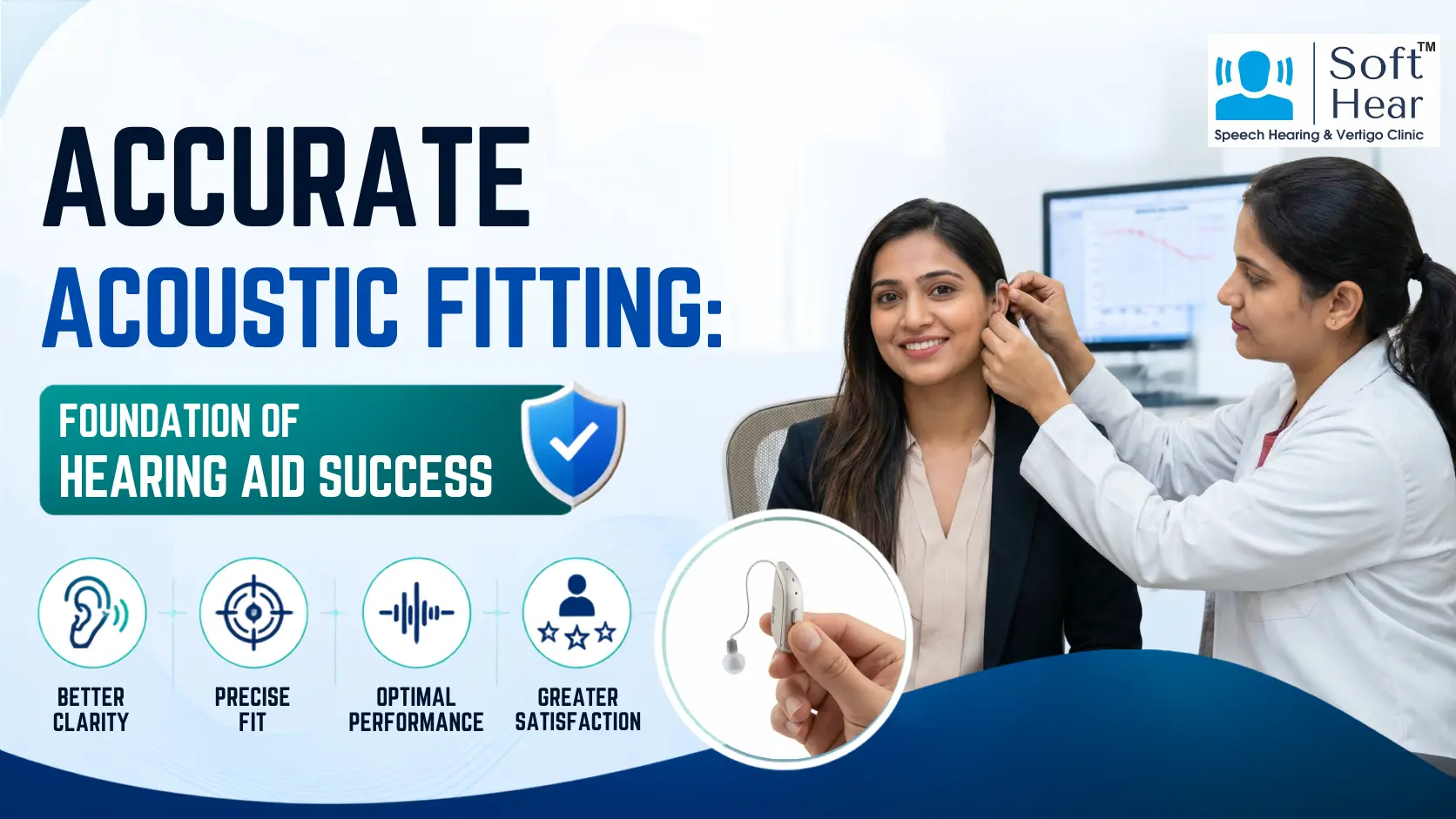
Why is Professional Hearing Aid Fitting Important?
Even with the most sophisticated hearing aid, the best results will not be achieved if it is not fitted correctly.
A professional hearing aid fitting generally consists of:
- Complete hearing assessment
- Lifestyle assessment
- Selecting the appropriate hearing aid style
- Ear impression (if required)
- Programming the device to your hearing loss
- Verification of Real-Ear Measurement (REM)
- Advice on the use & maintenance of hearing aid
- Follow-up visits for fine-tuning
Studies have shown time and again that satisfaction with hearing aids is much higher when they are professionally fitted and regularly adjusted, rather than bought solely on the basis of price or appearance.
The Future of Hearing: Planning Beyond Today
Hearing loss usually progresses over time, especially age-related sensorineural hearing loss. So, when you get a hearing aid you should not only think about your hearing level now but how you will be in the future.
Most modern BTE and RIC hearing aids have flexible programming options to allow audiologists to adjust amplification as your hearing changes. This flexibility can help extend the useful life of your hearing aids and reduce the need for premature replacement.
A discussion with your audiologist about your long-term hearing goals can give you confidence that the hearing aid you select today will still meet your communication needs years from now.
How to Choose Between BTE and RIC Hearing Aids?
Choosing a hearing aid can be a big decision, and it can improve your ability to communicate, your relationships, your confidence, and your quality of life. Once you’ve learned about the differences in design, technology, maintenance and lifestyle compatibility for behind-the-ear (BTE) and receiver-in-canal (RIC) hearing aids, the last step is to determine which style is the best fit for your specific hearing needs.
Remember that there is no one "best" hearing aid for all people. The best hearing aid is one that fits your hearing loss, your ear anatomy, your daily activities, your listening environments and your future hearing needs. A device that works well for one person may not work as well for another person.
The choice of a hearing aid should never be based on its appearance or on its popularity, but on a complete hearing evaluation performed by a qualified audiologist.
Quick Decision Guide: BTE vs RIC
The following comparison may help you decide.
| Why choose BTE Hearing Aids? | Why choose RIC Hearing Aids? |
|---|---|
| You have moderate to severe hearing loss. | You have mild to severe hearing loss. |
| You need more amplification and greater output. | You like clear speech and natural listening. |
| You work in humid, dusty, or physically demanding environments. | You work in an office, attend meetings, or are very social. |
| You have excessive earwax or recurrent ear infections. | You prefer a discreet and lightweight hearing aid. |
| You need custom earmolds for better retention. | You want the open-fit design that decreases the blocked-ear sensation. |
| You want durability and easier maintenance. | You prioritize cosmetic appearance and everyday comfort. |
*This table is for guidance only and Soft Hear’s final recommendation is that the choice of hearing aid should be based on your audiological assessment and professional advice.
Conclusion
Remarkable advances in hearing healthcare are both Behind-the-Ear (BTE) and Receiver-in- Canal (RIC) hearing aids. Digital hearing aids today are smaller, smarter and more efficient than ever before, with features such as artificial intelligence, Bluetooth connectivity, rechargeable batteries, automatic sound adjustment and smartphone integration.
BTE hearing aids remain a great option for those who need more amplification, increased durability and dependable performance in challenging conditions. Their robust construction, ease of maintenance and ability to accommodate a wide range of hearing losses make them particularly suitable for children, the elderly and those with severe to profound hearing loss.
RIC hearing aids, on the other hand, are ideal for those seeking a lightweight, discreet device that offers natural sound quality and outstanding comfort. The open-fit design and receiver placement closer to the eardrum typically offer improved speech perception and a more natural listening experience, especially for individuals with mild to severe sensorineural hearing loss.
Ultimately, the effectiveness of any hearing aid depends not only on its style, but also on accurate diagnosis, professional fitting, regular follow-up and consistent daily use. Most successful hearing aids are tailored to the individual, not just chosen based on appearance or technology.
If you or someone you love is showing signs of hearing loss, schedule a comprehensive hearing evaluation with a qualified audiologist. Early intervention can increase communication skills, social participation and support long term cognitive and emotional health.
FAQs
1. Which is better RIC or BTE style of hearing aid?
There is no better style than any other style. BTE hearing aids are usually recommended for people who need more amplification and durability, while RIC hearing aids are popular with many users because of their natural sound quality, lightweight design and discreet appearance. Your best choice will depend on your hearing loss, your lifestyle and the advice of your audiologist.
2. Are RIC hearing aids good for severe hearing loss?
Yes, Modern RIC hearing aids come with a choice of receiver power levels and can successfully manage many cases of severe hearing loss. But patients with severe hearing loss may benefit more from the power BTE hearing aids, which provide higher amplification.
3. What kind of hearing aid is more comfortable?
Comfort is a matter of opinion. Many users find RIC hearing aids more comfortable because of the open-fit design that reduces the blocked-ear sensation (occlusion effect). However, BTE hearing aids that fit properly are also very comfortable and may be the better choice for users who need custom earmolds.
4. Which hearing aid is the easiest to maintain?
BTE hearing aids generally need less maintenance over time because the receiver is contained within the hearing aid itself, protecting it from earwax and moisture. RIC hearing aids require regular cleaning of the receiver and replacement of wax guards, and occasional servicing of the receiver.
5. Do both BTE and RIC hearing aids support Bluetooth connectivity?
Yes. Most BTE and RIC hearing aids today are equipped with Bluetooth technology that allows users to stream phone calls, music, television audio and other media directly from compatible devices.
6. Both styles of hearing aids can be recharged.
Yes. Both BTE and RIC hearing aids can be had with rechargeable lithium-ion batteries that provide all-day performance without the trouble of changing disposable batteries frequently.