
The Importance of Every Aspect of a Hearing Aid Fitting
The Science of Hearing Aid
Many believe the job is done when the right hearing aid is purchased. Indeed a hearing aid is one component of an integrated system for acoustic rehabilitation. Anything that attaches the hearing aid to the ear will affect the sound that ultimately reaches the eardrum and therefore how the brain interprets that sound.
Hearing aids deliver sound through a complex acoustic pathway, so optimising every physical and electroacoustic parameter is essential to achieving the best possible hearing performance. Successful hearing rehabilitation is dependent on acoustic factors (venting, earmould acoustics, receiver characteristics, insertion depth, ear canal resonance) and patient- specific factors (speech discrimination ability, auditory deprivation, cognitive processing, central auditory function, communication needs, motivation, counselling).
A small change in vent diameter, mould style, receiver strength, dome choice or receiver position can have a significant impact on speech clarity, listening comfort, feedback control, low-frequency gain, sound naturalness and overall hearing performance.
That is why fitting of hearing aids can never be a “one-size-fits-all” process. It should be based on clinical protocols that are evidence-based, verified objectively and performed by a qualified audiologist.
1. Vent Size and Vent Type
Vent selection is one of the most important, yet often overlooked, aspects of hearing aid fitting.
The vent is the port in the earmould or custom shell which allows air and sound to pass between the ear canal and the external environment. It’s a small feature, but it has a great effect on acoustics.
Its size affects directly:
- Occlusion (hearing one's own voice as hollow or booming)
- Voice quality of your own
- Munching sounds
- Low frequency amplification
- Clearness of Speech
- Sound quality
- Comfort Wear
- Genuineness of hearing
- Air circulation in the ear canal
- Ears health
- Feedback (whistling)
- Stability of Hearing Aid
Generally, a larger vent will increase comfort, maintain natural low frequency hearing and reduce the occlusion effect. But it also produces more amplification of low frequency sounds, which may mean less amplification and a greater chance of acoustic feedback.
For example, a smaller vent increases the low frequency amplification and feedback stability, but can increase the sensation of occlusion, and change the perception of one’s own voice.
Choosing the right vent diameter is a balancing act of various acoustic variables based on the patient's hearing thresholds, ear canal anatomy, communication needs, lifestyle, and long- term hearing goals. This balance is one of the basics for a precise fitting of hearing aids.
2. Type, Material and Design of Ear-moulds
An earmould is so much more than a piece of plastic to hold the hearing aid in place.
Its design has direct influences:
- Acoustical Seal
- Retention
- Coziness
- Feedback Management
- Frequency response
- Maximum gain possible
- Long Wear durability
Audiologists select earmoulds based on several factors including:
- Degree of hearing loss
- Ear canal shape and size
- Ear Hygiene
- Visual Appeal
- Manual dexterity
- Required amplification
- Lifestyle needs
Common styles for moulds are:
- Skeleton pattern
- Full shell
- Half shell
- Mould of the canal
- Micro moulds
- Soft silicone moulds
- Hard acrylic moulds
Each design has unique acoustic advantages and clinical indications. The best choice of mould will provide the best amplification, comfort and minimum feedback.
The acoustic performance also depends on the material of the earmould itself. Soft silicone moulds generally provide a better acoustic seal and better feedback control whereas hard acrylic moulds are more durable and easier to insert and may be more appropriate for some ear canal anatomies.
3. Vent Selection Within Custom Moulds
The mould and vent cannot be considered separately because they function as a single acoustic system.
For example, a patient with moderate high-frequency hearing loss may benefit from a larger vent that preserves natural low-frequency hearing while amplifying higher frequencies.
In contrast, an individual with severe hearing loss often requires a smaller vent to provide sufficient low-frequency amplification and minimise acoustic feedback.
Selecting the appropriate vent involves balancing several competing acoustic variables, including:
- Hearing thresholds
- Ear canal acoustics
- Required gain
- Speech intelligibility
- Feedback stability
- Wearing comfort
Every tweak has an effect on the final sound that hits the eardrum. This delicate balance is achieved through scientific acoustic calculations, evidence-based fitting protocols, and clinical expertise rather than just picking a standard vent size.
4. Dome Selection
Open-fit RIC hearing aids rely very heavily on the proper dome selection.
Domes are available in a range of designs:
- Open domes
- Closed domes
- Power domes
- Tulip domes
- Double domes
Each design varies,
- Ventilation
- Feedback sensitivity
- Available to gain
- Low frequency response
- easy to wear
- Speech comprehension
- Acoustic coupling
Even with technically correct hearing aid programming, choosing an unsuitable dome can impair speech clarity.
It depends on:
- Extend of hearing loss
- Frequency configuration
- Size of ear canal
- Comfort of Patient
- Feedback measurement
- Requires amplification
The dome’s physical condition is equally important. A compressed, worn or ill-fitting dome may reduce venting, change the intended low frequency response, increase the sensation of occlusion, affect feedback behaviour and reduce wearing comfort. Even if the electronics of the hearing aid are programmed correctly, these acoustic changes can have a significant impact on hearing performance.
Correct insertion is also important. Improper insertion of the receiver and dome into the ear canal may disturb the desired sound radiation pattern. When they are not properly aligned they do not direct amplified sound efficiently toward the eardrum, but rather they amplify the acoustic reflections, reduce transmission of high frequencies and reduce speech clarity.
For this reason, professional dome selection is not merely about choosing the correct size—it involves selecting the most appropriate acoustic coupling based on the patient's hearing loss, ear canal anatomy, and communication requirements.
5. Length of Receiver Wire
Receiver wire length is often underestimated in hearing aid fitting, however it plays an important role in both acoustic performance and wearing comfort.
A receiver that is too short can:
- Make uncomfortable
- Keep the hearing aid far from the ear
- Increment in movement noise
- Affecting microphone placement
- Improper insertion of the receiver into the ear canal
If the receiver is too long it may be:
- Jaw shift movement
- Domes placed in error
- Reduce efficiency of sound delivery
- Increased chance of damage to receiver
- Influence long-term retention
Receiver length must be accurate to hold the receiver at the desired depth in the ear canal, as well as to stabilize the microphone position behind the ear. That means better sound delivery, comfort, cosmetic appearance and long-term reliability.
Even the best programmed hearing aid will not perform optimally if the receiver is not positioned correctly. The choice of the correct receiver length is an essential part of precision acoustic fitting.
6. Receiver Power Selection
Today’s Receiver-in-Canal (RIC) hearing aids are available with different receiver strengths to fit a range of hearing losses.
These typically consist of:
- Standard (S)
- Medium (M)
- Power (P)
- Ultra Power (UP)
The choice of the appropriate receiver is based on several clinical considerations including:
- Hearing thresholds
- Range dynamics
- Progression of hearing impairment in future
- Margin of feedback
- Required maximum power (RMP)
- Needs of speech recognition
- Acoustics of the ear canal
There are many people who believe that if you get a more powerful receiver it will make the hearing aid louder. In fact, different receiver power levels are designed with different electroacoustic characteristics.
Different receivers are:
- Maximum Output Power (MOP) Frequency response
- Distortion properties
- Available gain before feedback
- Variety of listening environments
If a receiver is too powerful and not matched to the patient’s hearing profile, it can create unnecessary risk of acoustic feedback and listening discomfort.
However, the receiver may not be sufficiently powerful to provide sufficient amplification, especially for high frequency speech sounds that are critical for speech understanding.
So the right receiver is not just about providing enough loudness. It’s about finding the right balance of output, frequency response, distortion, feedback stability, and future hearing needs to make listening as natural, and as comfortable, as possible.
7. With or without telecoil?
Wireless Bluetooth technology is becoming more and more common, but telecoil technology still has many distinct advantages in many listening situations.
A telecoil allows direct reception of electromagnetic signals from compatible sound systems located in:
- Religious sites
- Auditoriums
- Meeting rooms
- Airports
- Public counters
- Cinemas
- Hospitals
Telecoils also can enhance telephone communication for many users by filtering out background noise and clarifying speech.
Telecoils frequently provide better listening performance than conventional microphone listening for people who often attend public events, lectures, religious gatherings or meetings which have hearing loop systems.
The choice to recommend a telecoil is contingent upon the patient's lifestyle, communication requirements, listening environments, and future accessibility needs. Audiologists consider these factors, as well as the latest wireless connectivity features, when recommending the most appropriate solution during hearing aid selection.
8. Ear Acoustics
Every ear canal is unique in shape, length, diameter and volume.
As a result, the same hearing aid programmed with the same software settings can result in very different sound pressure levels for different individuals.
This variation is due to each ear canal having its own acoustic properties affecting the propagation of amplified sound before it reaches the eardrum.
Professional hearing aid fitting therefore involves careful consideration of:
- Resonance of the ear canal
- Acoustic impedance.
- Volume of ear canal
- Acoustics of a single ear canal.
- Real Ear Measurement (REM)
If you ignore these variables, you may end up with over-amplification or under-amplification even if you program the software correctly.
This is one of the reasons why copying the settings of another patient’s hearing aid or simply using the manufacturer software cannot guarantee optimal hearing performance.
Instead, the fitting must be personalised based on the acoustics of each individual patient’s ear canal, so that the prescribed amplification is delivered accurately across all speech frequencies.
9. Tubing Size and Length (For BTE Hearing Aid)
In the case of Behind-the-Ear (BTE) hearing aids, tubing is much more than a simple connection between the hearing aid and the earmould. This is an important acoustic component and has a significant impact on the hearing aid performance.
Tubing diameter and length affects:
- High frequency delivery
- Acoustic attenuation
- Ear canal resonance
- Total frequency response
- Audio lag
- Clear speech
Even small changes in the dimensions of the tubing change how amplified sound gets to the eardrum.
Over time, tubing hardens, shrinks or discolours naturally due to exposure to body heat, moisture, earwax and environmental conditions. Even if the electronic components of the hearing aid are working perfectly, a hardened or shrunk tube can greatly diminish the performance of the hearing aid.
Patients may experience symptoms such as:
- Turn volume down
- Speech intelligibility poor
- Poor quality of sound
- Additional feedback
- Struggles to follow conversations
Routine hearing aid maintenance should include timely checking and replacement of hearing aid tubing.
The condition of the tubing can be checked during follow-up visits by professional audiologists to ensure that the hearing aid is still performing acoustically as intended.
Viewing the tubing as an active acoustic component instead of a mere mechanical conduit allows clinicians to retain fidelity of sound, enhance speech understanding and prolong the efficacy of hearing rehabilitation.
10. Acoustic feedback management: It’s beyond software
One of the most common complaints from hearing aid users is, "Why is my hearing aid whistling?"
Many people think that acoustic feedback just means the hearing aid needs reprogramming or a software tweak. In reality, feedback is a complex acoustic phenomenon, which is influenced by several physical and electroacoustic factors long before any digital processing is involved.
Acoustic feedback happens when amplified sound leaks out of the ear canal and is picked up and re-amplified by the hearing aid’s microphones, creating a continuous loop that results in the familiar whistling sound.
There are several factors that influence feedback stability such as:
- Diameter of the vent
- Length of the vent
- Receiver signal power
- Selection of dome
- Earmould sealant
- Depth of receiver insertion
- Anatomy of ear canal
- Jaw movement while chewing or talking
- Position of the microphone
- Acoustic coupling total
Today’s hearing aids have advanced digital feedback management systems that can detect and eliminate feedback before you can hear it. These technologies are very effective but sometimes excessive electronic feedback suppression may reduce the sound quality, reduce available high frequency amplification or affect speech clarity.
This is why professional hearing aid fitting always puts appropriate acoustic coupling before digital feedback suppression. By carefully choosing the appropriate dome or earmould, vent dimensions, receiver characteristics and insertion depth, audiologists can maximise the natural quality of sound while minimising the need for aggressive electronic feedback cancellation.
This scientific approach keeps speech intelligibility, listening comfort and overall hearing performance.
11. Receiver Insert Depth
Receiver insertion depth is another important but often overlooked aspect of hearing aid fitting.
A difference of only 2–3 mm in the depth of insertion of the receiver in the ear canal can have a significant effect on hearing aid performance.
Insertion depth affects:
- Resonance of ear canal
- Provide high frequency gain
- Comprehension of speech
- Stability of the feedback
- Total frequency response
If the receiver is set too shallow, it may not provide the desired acoustic response and important high frequency speech sounds may become less audible.
Too deep insertion, however, can be uncomfortable for some people if it does not match the anatomy of their ear canal.
Audiologists use the ear canal size, hearing thresholds, receiver length, dome choice and patient comfort to decide the proper insertion depth. Proper insertion will guarantee that the amplified sound will reach the eardrum with the desired frequency response and long-term wearing comfort.
This is one of the many reasons why professional fitting yields much better results than simply purchasing a hearing aid without expert clinical assessment.
12. Bilateral Symmetry: Why Two Hearing Aids May Not Sound The Same
Patients commonly ask, “If I have equal hearing loss in both ears, why don’t the two hearing aids sound the same?”
That is answered by the natural anatomy of the two ears.
Even if the audiogram hearing thresholds are symmetric each ear has its own acoustic properties.
These differences are such as:
- Ear canal volume
- Ear channel resonance
- Acoustic Ventilation
- Ear mold fitting
- Acoustic impedence
- Real Ear Measurement Targets (REM)
Therefore, the sound pressure level generated by the same parameters of hearing aids may be different between the right and left ears.
Professional audiologists therefore program and verify each ear individually, rather than assuming the same software settings will produce the same hearing outcomes.
Each individual is fine-tuned to provide balanced loudness, improved sound localisation, better speech understanding and a more natural listening experience.
For this reason, both hearing aids are rarely programmed exactly the same, even when the hearing loss appears similar in both ears.
13. Objective Verification: Programming Alone Is Not Sufficient
Software used with today's hearing aids is a great start to the fitting process, but programming the software alone does not guarantee that the prescribed amplification is actually being delivered to the patient's eardrum.
Therefore, professional hearing aid fitting includes objective verification processes that ensure the hearing aid is working according to evidence-based clinical targets. Depending on the hearing needs of the patient,
These assessments might include:
- Real Ear Measurement (REM)
- Probe microphone verification
- Speech Mapping
- Calibration of the feedback
- In-situ audiometry (where possible)
- Evaluation of functional gain (when clinically indicated)
These procedures allow the audiologist to compare the actual sound delivered inside the ear canal to internationally accepted prescription targets and make precise adjustments when needed.
If verification is not done, even correctly programmed hearing aids may amplify too little or too much because no two ear canals are acoustically alike.
Programming a hearing aid without objective verification is like prescribing spectacles without measuring the final lens power in front of the patient’s eyes. This may be the right prescription on paper but only verification can confirm that the desired outcome has been achieved.
Hence, objective verification is one of the hallmarks of evidence-based hearing healthcare.
14. Evidence Based Prescription Formulas
Hearing rehabilitation is not just more volume, it begins with the right prescription.
Through decades of clinical research, internationally validated fitting rationales have been developed to guide qualified audiologists in the prescription of amplification.
These are:
- NAL-NL2 (National Acoustic Laboratories – Non-Linear version 2)
- Desired Sensation Level (DSL) v5.0
- Personalized fitting approaches according to patient hearing profile, communication needs, listening situations and clinical objectives.
Each prescription is designed to optimize speech intelligibility, yet maintain listening comfort in a wide variety of listening environments.
But no formula should be followed without thinking.
But instead the given targets are refined one by one by:
- Objective verification measures
- Real Ear Measurement (REM)
- Speech Mapping
- Patient Comment Cards
- Clinical decision making
- Follow up fine tuning
The combination of scientific prescription, acoustic verification and patient-centred optimisation allows hearing aids to be the most accurate, comfortable and effective listening experience possible.
Hear Success: A partnership of sciences
Hearing rehabilitation successfully is not only about selecting a premium hearing aid.
The real success in hearing is the scientific integration of different clinical components working in unison.
‘Evidence-based prescriptions’ + ‘Precision acoustic coupling’ + ‘Objective verification’ + ‘Expert fine-tuning’ + ‘Patient-centred rehabilitation’ = Success in hearing
Every step, from choosing the right hearing aid and acoustic coupling to verifying performance and fine-tuning settings to match the patient’s daily communication needs, contributes to the ultimate listening experience.
The best hearing aid technology is not able to perform at its best without correct fitting, scientific verification and professional aftercare.
Precision Fitting: The Cornerstone of Effective Hearing Rehabilitation
A hearing aid is not merely a device, it is a complex medical rehabilitation system.
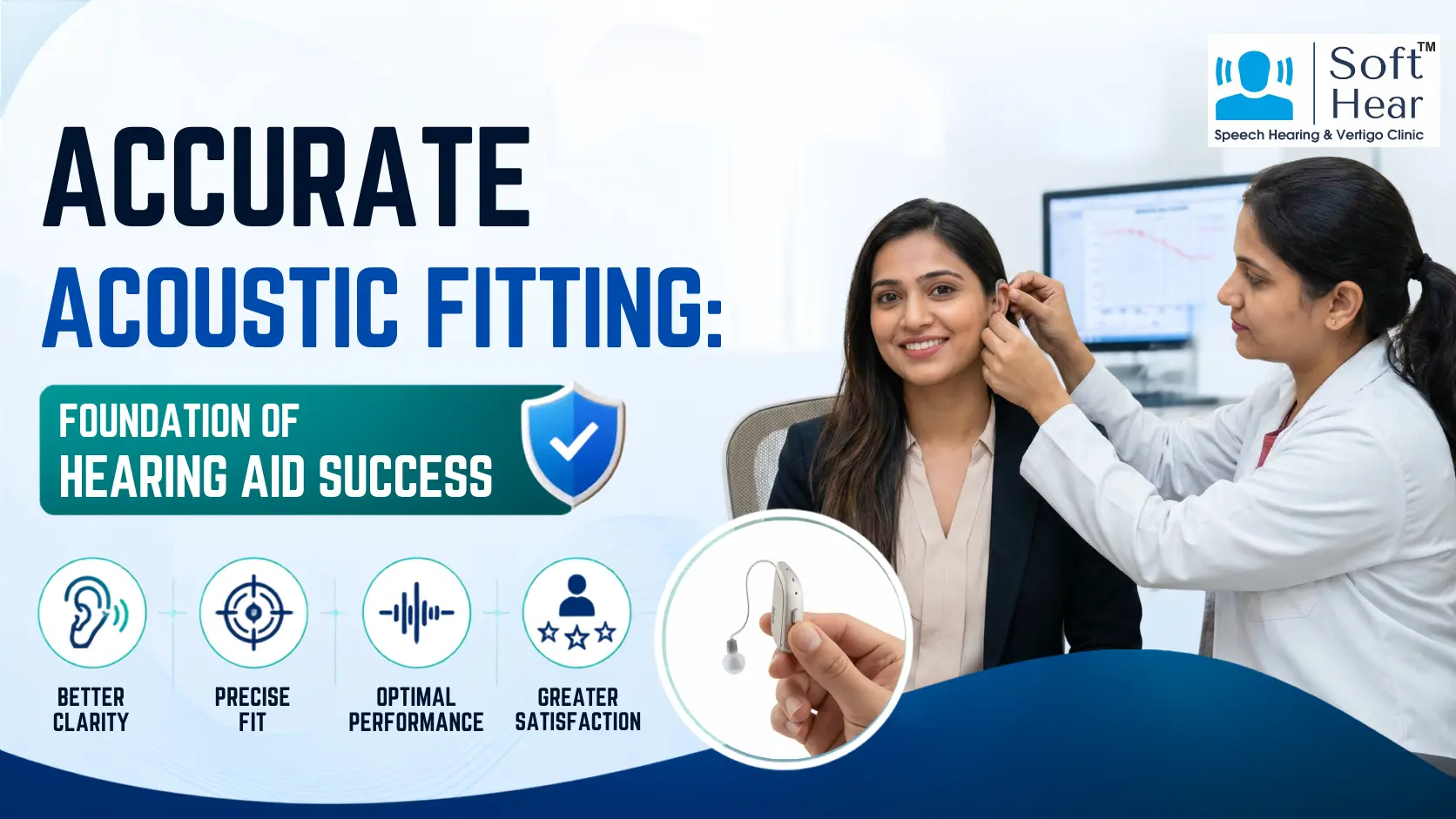
This is due to the fact that it scientifically combines personalized acoustic coupling, evidence based prescription, objective verification and clinical skills of a qualified audiologist.
At Soft Hear – Speech, Hearing & Vertigo Clinic we believe every patient deserves a hearing solution that is tailored to their hearing loss, the unique acoustics of their ears, their communication needs and their lifestyle.
Every clinical decision is made with one objective in mind: to provide the safest, most comfortable and most effective hearing experience possible. This includes the selection of the prescription rationale, the receiver characteristics, the venting dimensions, the earmould design, the dome configuration and insertion depth, the acoustic coupling and the verification methods.
Our philosophy is simple. Technology is only as good as the clinical expertise and evidence based practice that guides it.
Combining internationally recognised prescription methods, precision acoustic fitting, objective verification, personalised counselling and comprehensive follow-up care, we transform advanced hearing technology into meaningful hearing rehabilitation that improves communication, confidence and quality of life.
It is this attention to accuracy that differentiates hearing aid fitting from hearing aid dispensing. That’s also what makes hearing technology truly personalised hearing rehabilitation.
15. The value of follow-up fine-tuning
Getting hearing aids is not the end of rehabilitation, but rather the beginning.
Unlike many medical devices, hearing aids need to be optimised constantly as patients adapt to amplified sound. The first few weeks of hearing aid use is a period for the brain to acoustically adapt, learning to interpret sound that may not have been heard clearly for months or even years.
This means hearing aid settings need to be adjusted after the initial fitting.
At follow-up appointments, audiologists evaluate:
- Speech understanding in quiet and in noise
- Comfort of listening
- Perception of loudness
- Have a voice of quality
- Problems with feedback
- Phone performance
- Listening to the radio
- Music lover
- Comfort of wear
- Daily communication problems
We then tailor according to objective clinical findings and the patient’s real-world listening experiences.
Regular follow-up care helps ensure that hearing aids continue to perform at their best as communication needs and hearing levels change over time.
Successful hearing rehabilitation is thus an ongoing partnership between the patient and the audiologist, not a one-time fitting appointment.
16. Why Two Patients with the Same Hearing Loss May Require Different Hearing Aid Settings?
An audiogram provides valuable information about hearing thresholds, but it does not tell us everything about how a person processes sound.
Two patients with the same hearing test results may need very different settings for their hearing aids, as hearing performance is dependent on many other factors.
These are as follows:
- Speech discrimination ability
- Cognitive
- Length of hearing loss
- loss of hearing
- Hearing aid experience
- Lifestyle and communication needs
- Listening needs in the workplace
- Environments where listening occurs
- Personal sound preference
For example, one person may spend most of the day in a quiet environment whereas another person may regularly attend business meetings, social gatherings or family events with a lot of background noise.
Similarly, one patient may prefer softer amplification with gradual adaptation, while another may require stronger amplification to maximise speech understanding.
Therefore, hearing aid fitting should always be individualised and not just based on the hearing test.
The goal is not just to make hearing thresholds better, but to make communication better in the situations that are important to each person.
17. The Role of Patient Counselling in Hearing Rehabilitation .
Even the most advanced hearing aid technology cannot deliver optimal results without adequate counselling and patient education.
Many first-time hearing aid users expect their hearing to be as good as normal right after fitting. Hearing aids do make sound more accessible, but they can’t bring back normal hearing or undo changes that have happened in the auditory system.
Professional counselling helps patients have realistic expectations and learn how they can get the most out of their hearing aids.
Counselling typically includes advice on:
- Correct insertion and removal
- Daily cleaning & maintenance
- Care of battery or charging
- Communication methods
- Expectations for listening
- Gradually introduce louder sounds
- Participation of family
- Hearing preservation for the long term
Research over and over again shows patients who are thoroughly counselled are more satisfied, have better hearing aid acceptance, use their aids more every day and have a better quality of life overall.
Hearing rehabilitation is more than technology, it is education, communication training and continued professional support.
18. The Role of a Hearing Aid Fitting Professional
Today’s hearing aids boast impressive advances in digital signal processing, artificial intelligence, wireless connectivity, directional microphones and noise management.
But technology alone does not guarantee hearing success.
Ultimately, the success of any hearing instrument is directly related to how well it is prescribed, fitted, verified and fine-tuned for the individual hearing instrument user.
Professional audiologists combine scientific knowledge, clinical experience, objective verification and patient-centred rehabilitation to ensure that every part of the hearing aid system functions as it should.
This comprehensive approach delivers:
- Improved speech understanding
- Improved listening comfort
- Less listening fatigue
- Confidence in conversations
- Better performance in challenging listening situations
- Increased satisfaction with hearing aids over time
- Improved overall quality of life
It is important to select a hearing aid.
It is also very important to choose the correct audiologist.
By combining technology and clinical expertise, the patient benefits fully from today’s hearing rehabilitation.
19. The Ear Canal Anatomy and Its Impact on Hearing Aid Performance
Everyone has different ears.
Even among people with the same degree of hearing loss, the anatomy of the ear canal can have a major impact on how the amplified sound from the hearing aid reaches the eardrum.
The shape, the diameter, the length, the curvature and the volume of the ear canal all influence the acoustic performance of a hearing aid.
These anatomical variants influence:
- Resonance of the ear canal
- Sound pressure level
- High-frequency amplification
- Stability of feedback
- Comfort in use
- Earmold holding
- Dome fit
- Receiver location
For example, a narrow or sharply curved ear canal may need a different length receiver or dome style than a wider canal. Likewise, a bigger ear canal volume may have different acoustic properties than a smaller one with the same hearing aid settings.
This is why professional hearing aid fitting starts with a complete examination of the patient's ear anatomy. Audiologists determine the most appropriate acoustic coupling by assessing the extent of hearing loss and the physical features of the ear.
Even with sophisticated technology, hearing aids that don’t take ear canal anatomy into account may provide less speech clarity, more feedback, discomfort, or insufficient amplification.
Hearing aid fitting is a customized process, with audiologists fine-tuning the hearing aid to fit an individual's ear anatomy to optimize sound quality, comfort and long-term hearing outcomes.
20. Why Hearing Aids Should be Reviewed Regularly
Hearing is not fixed. Hearing thresholds can change over time from aging, medical conditions, exposure to noise, or other causes. The condition of hearing aid components like domes, earmoulds, tubing, wax guards and receivers can also change with regular use.
Periodic reviews of hearing aid fittings are therefore needed to ensure that the prescribed amplification continues to satisfy the patient’s hearing needs.
At regular follow-up appointments, the audiologists:
- Re-evaluate hearing thresholds
- Assess hearing aid performance
- Analysis of sound components
- Change worn domes or tubing
- Verify receiver operation
- Recalibration of the feedback control
- Quantitative measurement of program verification.
- Refine settings for lifestyle adjustments
- Improve communication strategies
Hearing changes are gradual and patients may not be aware their hearing aids are no longer working at their best. By regularly seeing a professional for your hearing, you can catch these changes early and ensure that your hearing remains consistent.
Thus, evidence-based hearing healthcare is a continuous process, not a fitting.
21. Preserving the Acoustic Performance of Your Hearing Aid
Even the best-fitted hearing aid requires regular maintenance for the best service.
Daily exposure to moisture, earwax, dust, skin oils and environmental conditions can impact both the electronic and acoustic components of the hearing aid.
Regular maintenance helps keep:
- Clear speech
- Frequency response
- Accuracy of amplification
- Stability of feedback
- Comfort of wearing
- Device reliability
Patients should adhere to recommendations by their audiologist for routine care including:
- Daily cleaning of the hearing aid
- Clean debris from microphone openings
- Changing wax guards when suggested
- Checking domes and earmoulds for wear
- Checking tubing for hardening/discolouration
- Store hearing aids in a dry and clean place
- Properly charging rechargeable devices or changing batteries as needed
Equally important is routine professional servicing. During maintenance appointments, audiologists check the electronic performance and acoustic integrity of the hearing aid to ensure it continues to function as prescribed.
Proper maintenance will improve sound quality, extend the life of the hearing aid and reduce the risk of unexpected performance problems.
22. What Makes Soft Hear Different – Accurate Hearing Care
At Soft Hear – Speech, Hearing & Vertigo Clinic, we believe hearing rehabilitation should be based on science, precision and personalised care instead of simply choosing a hearing aid.
Each patient undergoes an extensive evaluation that includes hearing thresholds, speech understanding, ear canal acoustics, lifestyle, communication goals, medical history, and long- term hearing needs.
Our hearing aid fitting process incorporates best practice recognised internationally and includes:
- Complete audiological assessment
- Evidence-based prescription with validated fitting rationales
- Custom acoustic coupling.
- Considered choice of receivers, domes, earmoulds and venting
- Appropriate clinical measures to objectively verify.
- Precise fine-tuning· Continued counselling and rehab
- Regular follow-ups and performance reviews
This holistic approach enables us to provide scientifically accurate, personalized hearing solutions that are designed to make a difference in daily communication.
And we don’t just want to improve the results of the hearing tests. We work toward helping each patient re-engage in conversations, engage confidently in family and social interactions, perform well in professional settings and enjoy a better quality of life.
Soft Hear is evidence- based hearing care that is tailored to the individual, accurate and personalized with leading hearing technology and clinical expertise.
Clinical Perspective in Brief
Today’s hearing aids are among the most sophisticated medical devices in existence. But their real success is not just in the quality of the device but in the scientific accuracy with which they are prescribed, fitted, verified and maintained.
Every aspect of vent size, earmould design, receiver characteristics, insertion depth, acoustic coupling, objective verification has a role to play in how sound reaches the auditory system.
Therefore, a successful hearing rehabilitation is a combination of sound clinical decision making, internationally recognised fitting protocols, objective verification and ongoing patient-centred care.
When coupled with the expertise of a properly trained audiologist, these components make hearing aids much more than amplification devices. They become personalised rehabilitation systems that enable people to communicate more effectively, stay socially connected and enjoy a richer quality of life.
This dedication to evidence-based, precision hearing care guides every hearing aid fitting at Soft Hear , so every patient gets a solution tailored not only to their hearing loss, but to the unique acoustics of their ears, their communication needs and their lifestyle.