When people hear "speech therapy," most picture a small child learning to say "r" or "s." That's one part of what we do, and a very important one. But communication matters at every stage of life, and so does help with it.
I've trained in both audiology and speech-language pathology, and I'll tell you something I believe strongly: communication is one of the most basic human needs. When it's difficult, life shrinks. When it improves, so does confidence, learning, work and relationships. Let me show you how speech therapy helps at each age.
What speech therapy actually covers
Speech-language pathologists (also called speech therapists) help with:
- Speech: how clearly sounds and words are produced.
- Language: understanding and using words, sentences and conversation.
- Fluency: smoothness of speech, as in stuttering.
- Voice: quality, pitch and strength of the voice.
- Social communication: using language to interact with others.
- Communication after hearing loss, stroke or other conditions.
- Swallowing difficulties, where the therapist has the training to assess and treat them.
Communication help at each stage of life
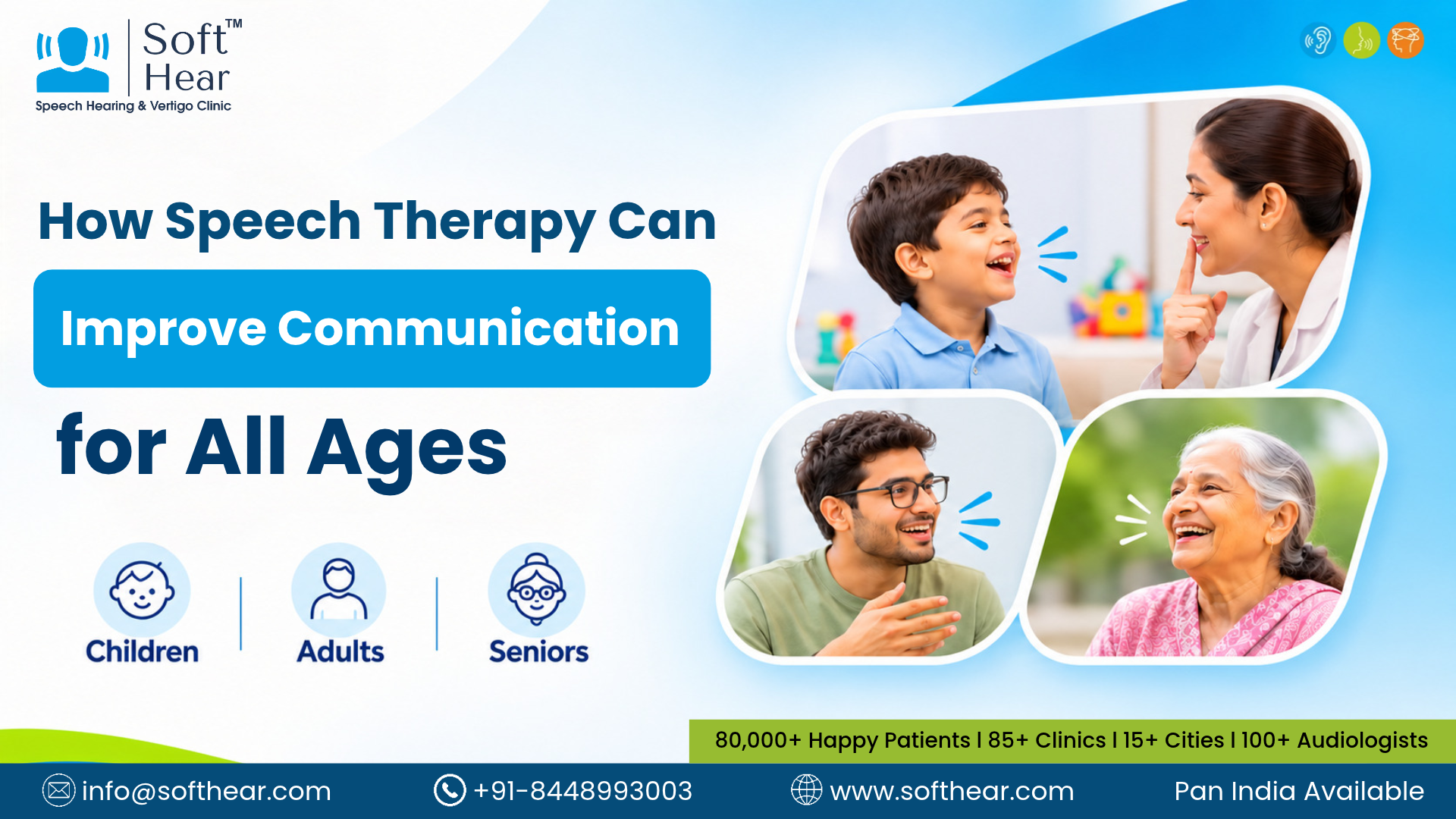
| Age group | Common concerns | How therapy helps |
|---|---|---|
| Infants and toddlers | Few sounds or babbling, late first words, not responding to name, feeding difficulties | Early guidance for parents, play-based activities to build early communication |
| Preschool children | Speech that's hard to understand, limited vocabulary, difficulty following instructions, stuttering | Targeted work on sounds, vocabulary and sentences, with parents learning to practise at home |
| School-age children | Persistent speech errors, reading and learning difficulties linked to language, shy or hesitant speech | Support for speech clarity, language skills and confidence in class |
| Teenagers | Stuttering, voice problems, social communication difficulties, language difficulties affecting studies | Strategies for fluency, voice care and conversation, tailored to the teenager |
| Adults | Voice problems, stuttering, speech or language changes after stroke or brain injury, communication changes in Parkinson's disease, swallowing difficulty | Rehabilitation that rebuilds speech, language and voice, and strategies for daily life and work |
| Older adults | Slurred speech after illness, trouble finding words, difficulty communicating with hearing loss, swallowing problems | Practical strategies, rehabilitation and support for families and carers |
Why starting early helps (but later still works)
For children, the early years are when the brain is most ready to learn language, so early support often makes the biggest difference. But I never want an adult or an older person to think it's too late. Speech and language can improve at any age, whether it's after a stroke, with a voice problem, or simply because you want to speak more confidently at work.
What happens in a speech therapy journey
- Assessment. The therapist talks to you or your family, observes communication, and carries out structured tests. For a child, that includes play. A hearing test is often part of the picture, because hearing problems can affect speech and language.
- Goals. Together, we agree on clear, realistic goals, such as "being understood by teachers" or "making phone calls again."
- Therapy sessions. Activities are tailored to the person: games and stories for children, exercises and real-life practice for adults.
- Home practice. Short daily practice matters more than occasional long sessions. For children, parents are partners, not spectators.
- Review. Progress is tracked, goals updated, and therapy is adjusted or completed when goals are met.
Signs it may be time to seek help
In children
- Few or no words by around 18 months, or not combining words by around two years.
- Speech that's very hard for family to understand as they get older.
- Difficulty understanding or following instructions.
- Repeating sounds or words, or getting stuck when speaking, often with visible tension.
- Not responding consistently to sounds or voices. Please get a hearing test first.
In adults
- Sudden changes in speech or language. If this is sudden, it needs emergency medical care, as it can be a sign of a stroke.
- A hoarse or strained voice lasting more than a few weeks.
- Difficulty finding words, following conversations, or being understood.
- Coughing or choking when eating or drinking.
Myths I'd love to retire
- "He'll grow out of it." Some children catch up, but waiting can mean missing the best window. An assessment will tell you whether to wait or act.
- "Speaking two or three languages confuses children." It doesn't cause speech delay. In many Indian homes, children grow up with more than one language, and that's fine. If a child struggles, the difficulty will usually be present in all their languages and deserves assessment.
- "Speech therapy is only for children." Adults and seniors benefit hugely.
- "Therapy is just practising sounds." Good therapy builds communication in real life.
How long does it take?
It depends on the person, the difficulty, and how consistently skills are practised at home. Some people need a few months, and others benefit from longer support. Your therapist should explain progress honestly and keep goals clear.
Questions people often ask me
Do I need a doctor's referral?
Not always, but if there's a sudden change, a medical condition or a swallowing problem, a doctor's input is important.
Can speech therapy be done online?
Yes. At Soft Hear we offer speech and language therapy both in person at our clinics and online through a digital format, for children and adults. Your therapist will advise which suits you and your goals best.
Why is a hearing test part of speech therapy?
Because hearing affects how we learn and use speech and language. It's one of the first things we check.
Let's help you or your family communicate with confidence
Soft Hear offers speech and language therapy for all ages, in person at our clinics and virtually through our online digital mode, so you can choose what works for your family. Book a speech and language assessment with one of our therapists or call us on +91 84489 93003. Tell us about your concerns, and we'll take it from there.
This article is for general information and is not a substitute for a clinical assessment. Hearing, balance and communication needs are individual, so please consult a qualified audiologist, speech-language pathologist or doctor about your own situation.
Soft Hear | Hear The Future, Live With Confidence.
Phone: +91-8448993003 | Website: www.softhear.com | Email: info@softhear.com
About the author
Hem Prakash Singh is a PhD Audiology Scholar, holds an MSc in Audiology and Speech-Language Pathology, and is a certified vertigo specialist. He is the Founder and CEO of Soft Hear Pvt Ltd, where he also serves as Head Audiologist and Speech Therapist. Soft Hear provides hearing evaluation, hearing-aid fitting, tinnitus care, speech therapy for all ages and vertigo rehabilitation through clinics across India and online.