Why Does Clinical Evaluation Remain the Gold Standard for Hearing Tests & Hearing Aid Fitting?
Due to the convenience of home visit hearing services, many clinics are offering free home hearing tests and hearing aid trials. But now the questions arise:
Are the accuracy, safety, and reliability of a professional audiology clinic and a home-based hearing service the same?
Can home-based hearing care truly meet the standards of a professional audiology clinic?
The truth is, everyone needs to understand that a hearing test is not a casual sound test; it is a medical-grade diagnostic procedure.
An incomplete diagnosis and a wrong hearing test can lead to incorrect treatment, an incorrect hearing aid fitting, delayed medical intervention, and, in some cases, permanent hearing complications.
This is the only reason why clinic-based hearing evaluation is still the gold standard worldwide.
Accurate Hearing Diagnosis is the most crucial step
We can’t ignore the importance of an accurate hearing test just because we're seeking comfort through home hearing services. This test is the foundation for Hearing Aid Selection, Hearing Aid Programming, Surgery Decision, medical referrals, long-term hearing rehabilitation, and cochlear implant candidacy.
Here, it is not possible to bear even a small error. It can impact the entire treatment path.
That is why professional hearing assessment requires Controlled acoustic conditions, Calibrated equipment, Advanced diagnostic tools, Experienced audiologists, and Clinical verification Methods.
These standards are difficult and not possible to meet in a typical home environment.
The limitations of Home Visits are as follows:
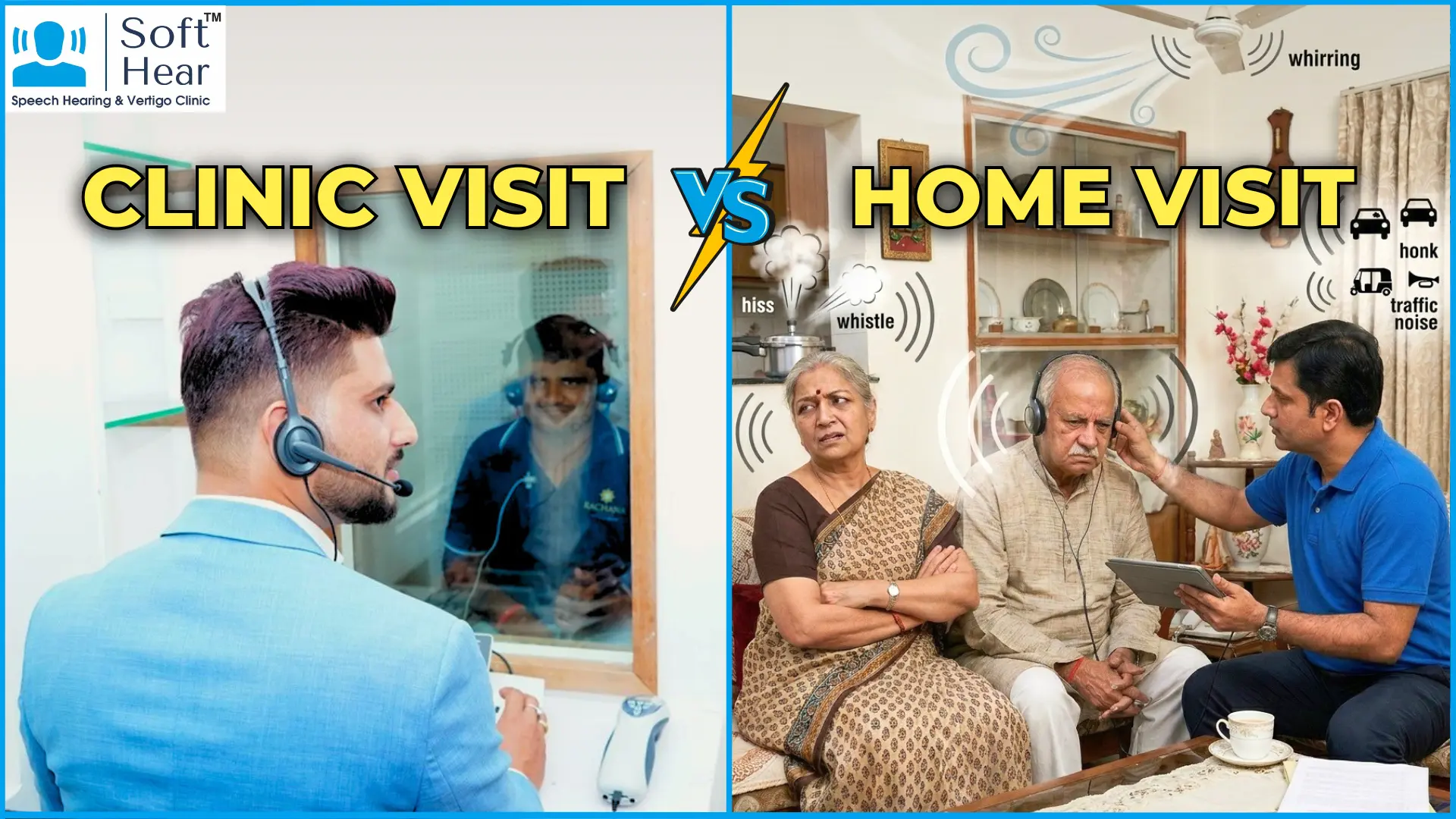
1. Environmental Noise disturbs accuracy
Hearing tests must carried out in a soundproof room with controlled acoustic conditions. Even mild background noise can misleads result.
At home, this is not possible due to ceiling fans, traffic noise, television sounds, kitchen activity, family conversations, Air Conditioners, Outside disturbances, etc.
A patient may appear to have less or more Hearing Loss than actual, and may show a wrong frequency-specific loss.
2. Portable Devices Have Technical Limitations
Home hearing services rely on portable devices designed mainly for convenience, not for comprehensive diagnostics.
In professional audiology clinics, audiologists use Diagnostic-grade audiometers, Advanced Speech Testing systems, calibrated sound booths, Immittance Testing, Tinnitus assessment tools, and REM (Real Ear Measurement) systems. In home visits, many of these are either unavailable or difficult to perform accurately.
3. Serious Medical Conditions might be missed
Hearing loss is not always age-related. Sometimes it indicates sudden sensorineural Hearing loss , Eardrum pathology, Acoustic neuroma, Ménière’s disease, Neurological disorders, and Chronic middle ear infection.
Home-based hearing services may miss these critical warning signs.
In clinics, audiologists and ENT specialists perform detailed examinations and evaluations and immediately recommend medical intervention if required.
4. Precision required in Hearing Aid fitting
Modern Hearing Aids are not simple amplifiers. They are the most sophisticated medical devices. They require frequency-specific programming, loudness Balancing, Speech clarity optimization, Feedback Management, and real-ear measurement verification.
Without accurate diagnostics, hearing aids may become Over-amplified, Under-amplified, Distorted in speech clarity, and Uncomfortable.
Improper fitting can even accelerate hearing dissatisfaction and listening fatigue.
5. REM (Real Ear Measurement) is Rarely Done at Home
REM is considered one of the most crucial verification methods for Hearing Aid Fitting.
Worldwide, Real Ear Measurement (REM) is considered one of the most important verification methods for hearing aid fitting. It ensures better speech understanding, correct amplification inside the ear canal, accurate scientific fitting, and safe loudness levels.
This procedure requires controlled conditions and specialized clinical equipment, which are not available in a home Hearing Service.
What are the Advantages of Clinic-Based Hearing Care?
The first most important point is that in a clinic you have a controlled testing environment. Clinics offer sound-treated rooms, Reliable threshold testing, Acoustic Isolation, and Accurate speech evaluation. This leads to accurate results.
Clinics can perform Pure Tone Audiometry, Speech Audiometry, OAE, Tympanometry, BERA/ABR, Pediatric hearing assessment, and Tinnitus Evaluation.
This leads to comprehensive hearing analysis rather than just basic screening.
Always go for Professional Audiology clinics that involve qualified audiologists, ENT specialists, Hearing Aid Specialists, and Rehabilitation counselors.
This integrated approach leads to diagnostic confidence and treatment outcomes.
Patients treated through proper clinic protocols often experience:
- Better speech understanding
- Improved comfort ability
- Faster adaptation
- Fewer complaints
- Higher hearing aid satisfaction
Because hearing aid performance is based on the accuracy of the hearing test.
Now the question is: When Home Visits May Still Help You?
Home visits may be useful for Bedridden patients, too-old individuals, Follow-up counseling, Minor hearing aid adjustments, and basic support services.
However, Home Hearing Services should ideally complement clinical care. It should not replace or substitute the comprehensive clinic-based diagnosis.
Convenience Should Not Compromise Accuracy
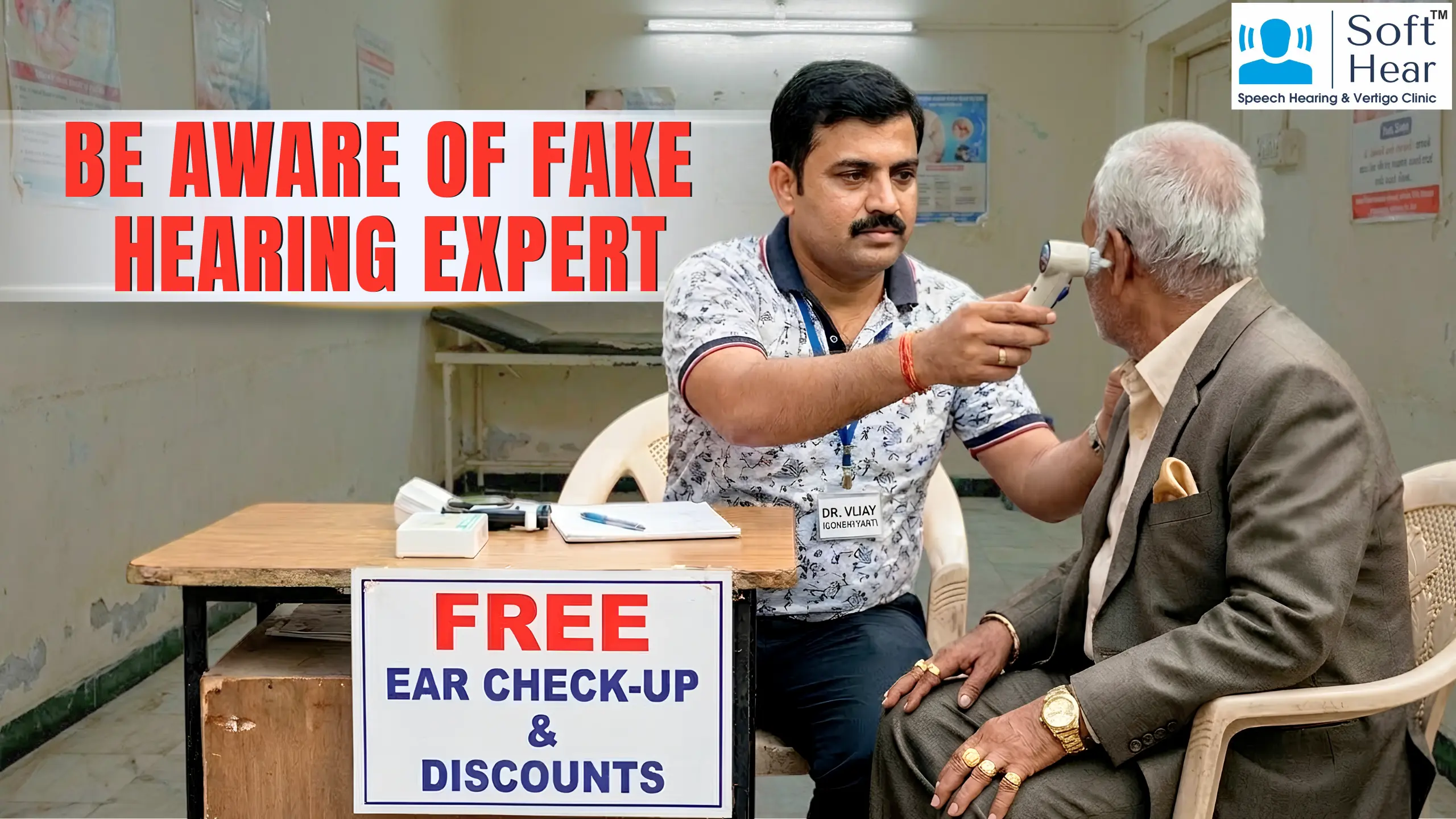
The most worrying situation nowadays is the increasing number of fake audiologists and fake hearing clinics (actually hearing aids sales shops) that prioritize convenience and money over diagnostic precision, which can affect a patient's entire life. These fake hearing clinics and audiologists are just into making money and compromising the health of patients.
The time has come for patients to study and prioritize what is right for them, not what fake audiologists, tele sales personnel, or online tele sales agents are conveying you.
Wake up and smell the coffee
Save yourself from incorrect treatment, wrong hearing aid purchase, delayed medical diagnosis, financial loss, mental stress, and poor hearing outcomes.
Don’t rely on incomplete evaluation methods just because of convenience.
Conclusion:
Patient must not choose comfort over precise diagnosis.
Home hearing services may provide you comfortability but they cannot match the standards of professional clinics. Diagnostic accuracy, controlled environment, scientific testing conditions, advanced equipment, and proper verification systems are not possible in home hearing services.
For hearing tests, diagnosis, hearing aid selection, and hearing aid fitting, clinic visits remain the safest, most accurate, and most reliable option for long-term hearing health and quality of life.
That’s why Clinical Evaluation remains the Gold Standard.
In hearing care, precision is not a luxury. It is the necessity for a quality life.