Introduction
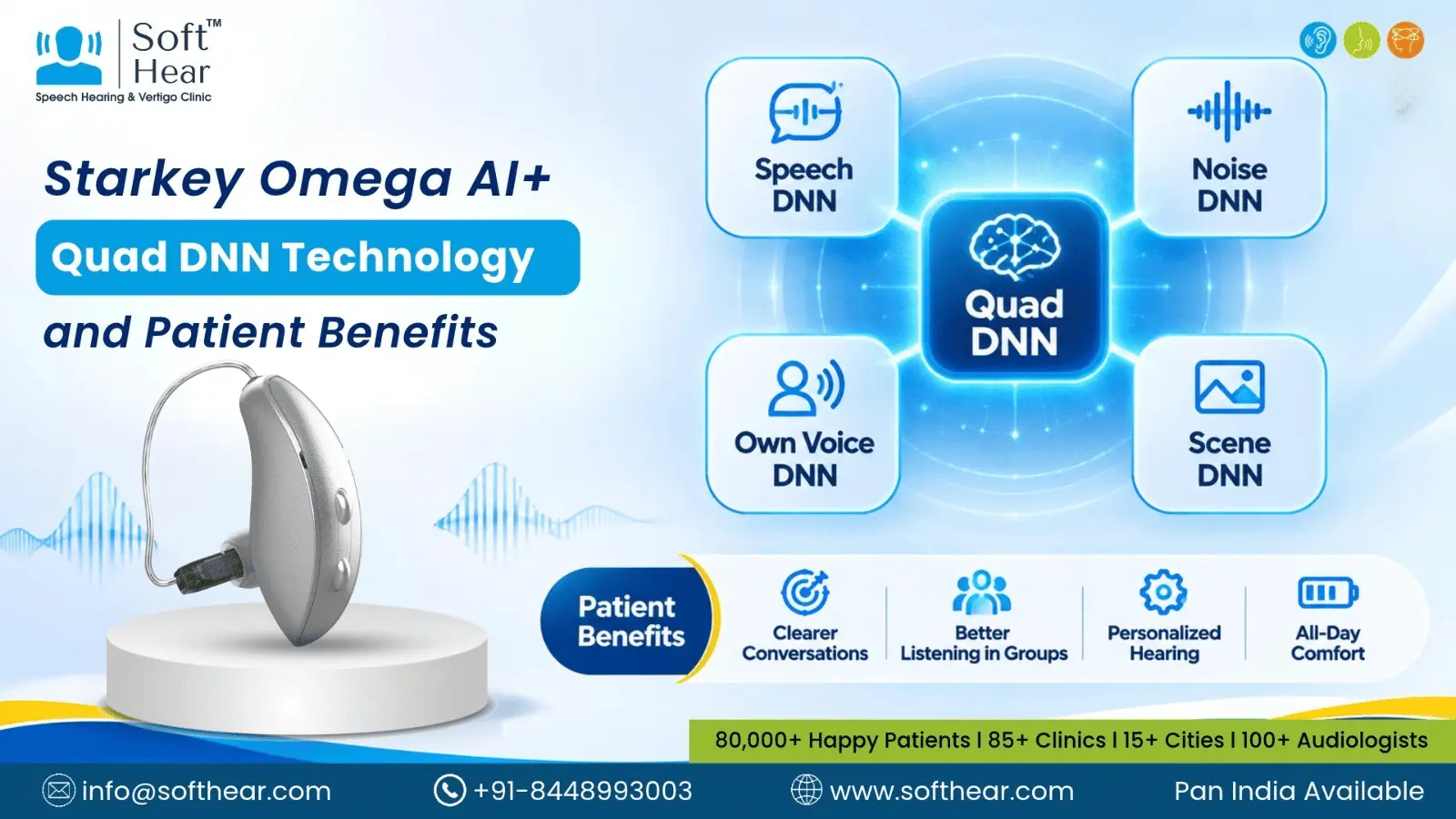
Starkey has always taken a slightly different path from other hearing-aid makers. It was early to put motion sensors and health tracking into hearing aids, and in October 2025 it introduced Omega AI with DNN-based directionality. On 1 October 2026 it followed with Omega AI+, built on a new G4 processor and a “Quad DNN Architecture” (HHTM, 2026).
In this article I explain what the four networks do, why the new DNN Dual Compressor matters more than its technical name suggests, and which patients are most likely to benefit. As always, I separate what Starkey reports from what has been independently measured.
A transparency note: Soft Hear is an authorised Phonak partner. Every performance claim in this article is attributed to its source, and I have marked which findings are independent and which come from manufacturers.
Why hearing-aid technology matters in 2026
Many patients assume the only job of a hearing aid is “making things louder”. In reality, one of the hardest tasks is deciding how quickly to change loudness. Speech consists of quick, soft consonants mixed with louder vowels; noise rises and falls; a door slams. A hearing aid must keep soft speech audible and loud sounds comfortable without making the world sound “pumped” or unnatural. Starkey’s 2026 platform applies AI to this old problem, alongside the speech-in-noise problem every brand is tackling.
What is DNN-based hearing-aid processing?
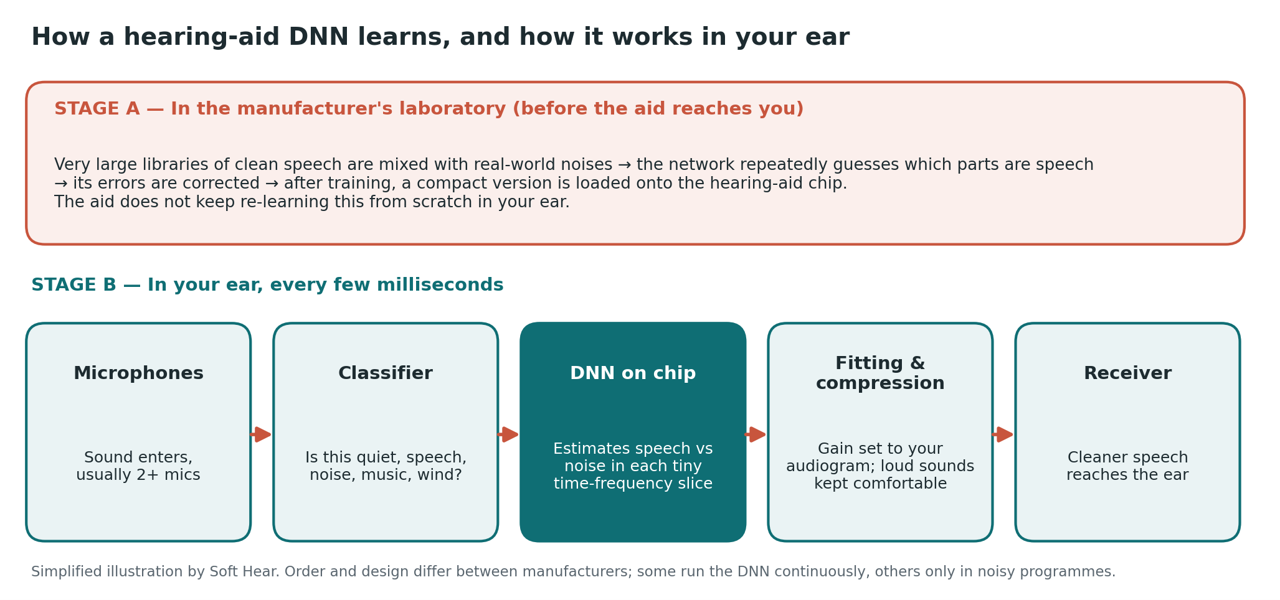
A deep neural network is a pattern-recogniser trained on large amounts of sound data. In hearing aids, DNNs are most often used to separate speech from noise (Andersen et al., 2021). Starkey’s approach is to use several specialised networks rather than one, each optimised for a different part of the listening experience.
What is new in Omega AI+
Quad DNN Architecture. Four networks run at once on the G4 chip, covering speech enhancement, noise reduction, directionality and spatial awareness, and compression (Strom, 2026b). Three build on the DNN 360 system introduced with Starkey Omega AI; the fourth is new.
DNN Dual Compressor. Traditional hearing aids use fast-acting compression to make brief consonants audible, or slow-acting compression for steadier, more natural sound. Starkey says its DNN decides, moment by moment, when fast or slow behaviour is appropriate, aiming to reduce the “pumping” effect, for example when background sound dips after a keyboard click (Strom, 2026b). In company testing, all participating users noticed fewer artefacts than with the previous technology (HHTM, 2026).
Speed. Starkey states that G4 processes sound up to 2.7 times faster than the slowest leading competitor device it evaluated (HHTM, 2026). Lower delay helps sound quality and spatial awareness, and may help people who use a hearing aid in one ear and a cochlear implant in the other (Strom, 2026b).
Edge Mode+. Edge Mode can now stay on continuously and be set as the default, rather than being switched on for difficult moments (HHTM, 2026).
Styles. DNN 360 now extends to custom rechargeable in-the-ear styles, and Automatic Edge Mode reaches custom non-wireless devices (Strom, 2026b). This is significant: several other 2026 platforms launched only as receiver-in-canal aids (Signia, 2026; Sonova, 2026).
Wellness and convenience. Features include Sleep Quality Tracking (in the United States), a “hearing aids left behind” alert, Auracast support, and up to 51 hours of battery life on the rechargeable RIC (HHTM, 2026).
Comparison table
| Technology / platform | Manufacturer | Key DNN function | Reported SNR or noise-reduction outcome | Main patient benefit | Best-suited situations | Evidence source |
|---|---|---|---|---|---|---|
| Omega AI+ | Starkey | Quad DNN incl. DNN Dual Compressor | No dB SNR figure published; 2.7× faster processing (company claim) | Natural sound with fewer artefacts; custom styles | All-day wear; custom-style users | Strom (2026b); HHTM (2026) |
| Omega AI (2025) | Starkey | DNN 360 directionality | Strong feedback control in independent lab testing | Spatial awareness | Everyday listening | HearingTracker (2026) |
| Audéo EON Sphere | Phonak | Speech–noise separation | Up to 10 dB vs omnidirectional; independent lab A grade | Speech from any direction | Loud noise | Phonak (2026); HearAdvisor (2026) |
| Pure C&G MaX | Signia | Four DNNs | No dB value published | Group conversation | Social groups | Signia (2026) |
Bar chart and interpretation
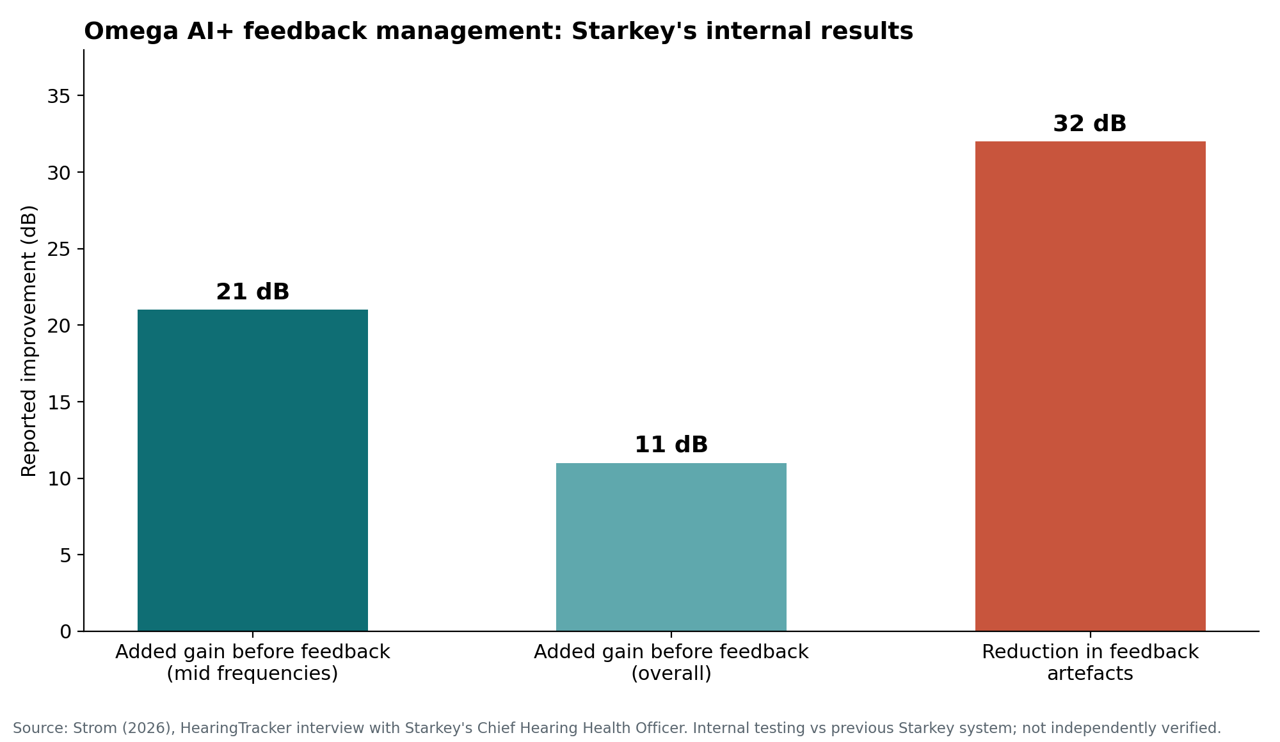
Chart 1 — Less whistling, more usable gain. Starkey’s internal testing showed 21 dB more gain before feedback at mid frequencies, 11 dB overall, and a 32 dB reduction in feedback artefacts with the redesigned feedback system (Strom, 2026b). In plain language: the aid can provide more amplification before it starts to whistle. This matters most for people with greater hearing loss who also prefer an open, comfortable fitting rather than a blocked-up ear. These are company figures and have not been independently verified.
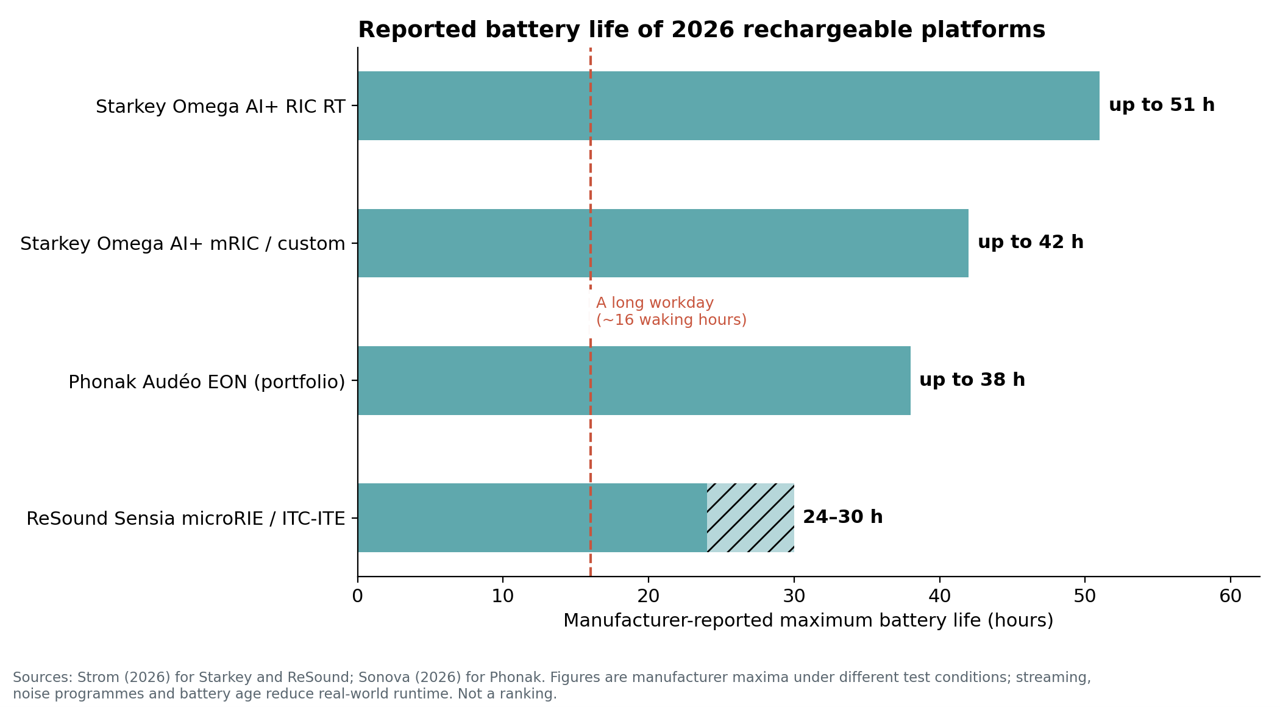
Chart 2 — Battery life. Starkey reports up to 51 hours for the rechargeable RIC and up to 42 hours for the mini-RIC and custom rechargeable models, and says the extra DNN processing did not reduce battery life compared with Omega AI (Strom, 2026b). For comparison, Sonova reports up to 38 hours for EON (Sonova, 2026) and GN rates Sensia at 24 to about 30 hours (Strom, 2026a). Each figure is a manufacturer maximum under different conditions; streaming and noisy programmes shorten real runtime.
Underlying data for Chart 1 (Strom, 2026, Starkey internal testing)
| Measure | Reported improvement |
|---|---|
| Gain before feedback, mid frequencies | +21 dB |
| Gain before feedback, overall | +11 dB |
| Feedback artefacts | −32 dB |
Sound quality comparison
Sound quality is where Omega AI+ makes its most interesting claim. The DNN Dual Compressor is designed to avoid the trade-off between “clear but harsh” and “natural but muffled” (Strom, 2026b). Independent research supports the idea in principle: a 2025 study combining deep-learning noise reduction and compression in one network reduced unwanted interactions between speech and noise in fluctuating backgrounds (Zhang et al., 2025). Whether Starkey’s commercial implementation delivers this for patients will become clearer once independent lab testing, which HearingTracker has said is planned, is published (Strom, 2026b).
For the previous Omega AI, independent testing found strong feedback control, though other aids performed better in the background-noise tests (HearingTracker, 2026).
Noise reduction and SNR comparison
Starkey did not publish a dB SNR figure for Omega AI+ in the launch materials I reviewed. Its claims focus on processing speed, artefact reduction, listening effort and comfort (HHTM, 2026). That is not necessarily a weakness; SNR is only one dimension of performance. But it means I cannot place Omega AI+ on the same SNR scale as platforms that publish figures, and patients should not assume it is better or worse in noise until independent results appear.
What the independent literature does tell us is that combining DNN processing with directional microphones gives the best predicted intelligibility, while room echo reduces the benefit (Ashkanichenarlogh et al., 2025). Starkey’s DNN-driven directionality fits that principle.
DNN advantages and limitations
Advantages
- DNN-based compression targets sound quality, not just noise removal.
- Low processing delay supports spatial awareness and bimodal users (Strom, 2026b).
- AI features extend to custom in-the-ear styles.
- Motion sensors help guide directionality depending on whether you are moving or still (Strom, 2026b).
Limitations
- Performance data are Starkey’s own; independent results for Omega AI+ were pending at the time of writing.
- No published dB SNR figure for comparison.
- Sleep tracking is a wellness feature; Starkey itself states it is not a diagnostic or screening tool for sleep disorders (Strom, 2026b).
- The 2.7× speed claim compares against the slowest competitor Starkey evaluated (HHTM, 2026).
Who Omega AI+ suits, and who it may not
In my clinical reasoning, Omega AI+ deserves a place on the shortlist for three kinds of patients. The first is the person who wants a discreet, custom in-the-ear hearing aid but does not want to give up AI processing. Until recently, choosing a custom style often meant accepting less advanced noise processing; Starkey’s extension of DNN 360 into custom rechargeable styles changes that (Strom, 2026b). The second is the person whose previous hearing aids whistled whenever they hugged a grandchild, wore a cap or held a phone. Better feedback control can allow more useful amplification with a more open, comfortable fit, although Starkey’s figures still await independent confirmation (Strom, 2026b). The third is the person who disliked the “processed” or “pumping” sound of earlier aids, for whom the DNN Dual Compressor is designed (HHTM, 2026).
Omega AI+ may be a less obvious first choice for someone whose single priority is the strongest published speech-in-noise result, because Starkey Hearing Aids has not published a dB SNR figure and independent lab results for Omega AI+ were pending at the time of writing. For such patients, I would compare it directly against a platform that already has independent results (HearAdvisor, 2026), in the patient’s own noisy environment, before deciding.
In the Indian context, two practical points stand out. Long battery life matters for people who travel long distances or face irregular power at home, and custom in-ear styles can be a good choice for people who wear spectacles, a dupatta or a turban, where behind-the-ear devices can feel crowded. As always, these are starting points for discussion, not substitutes for a proper evaluation.
Benefits for different lifestyles
One-to-one conversations. Natural sound and comfortable compression matter most here, which suits Starkey’s focus.
Family gatherings and group conversations. DNN 360 directionality aims to balance focus with awareness, avoiding the “acoustic blinders” effect of strong directionality (Strom, 2026b).
Restaurants, markets and noisy public places. Edge Mode+ can now stay on continuously for changing environments (HHTM, 2026).
Workplace meetings and online calls. Long battery life covers long days with streaming.
Outdoor walking, travel and wind. Motion sensing adjusts directionality while you move; ask your audiologist about wind settings.
Television, phone calls and Bluetooth streaming. Auracast support plus Bluetooth streaming (HHTM, 2026).
Older adults benefit from long battery life and the “left behind” alert. First-time users may appreciate gentler, artefact-free compression. Working professionals benefit from battery life. Experienced users who want AI in a custom in-ear style now have an option.
Clinical relevance in real-life situations
The patients I would think of first for Omega AI+ are those who want a discreet custom in-the-ear device with AI processing, those who struggled with whistling in previous aids, and those who have disliked the “processed” sound of strong noise reduction. As with every platform, outcomes depend on the degree of hearing loss, speech-in-noise ability, cognition, fitting verification and follow-up.
How to choose the right hearing aid
- Decide on style first. If you want a custom in-ear aid with DNN processing, Omega AI+ is one of the few options.
- Mention any past whistling or “pumping” sound to your audiologist.
- Ask for a speech-in-noise test to judge how much noise help you need.
- Compare at least one other platform during your trial.
- Treat wellness features as a bonus, not as medical monitoring.
- Confirm local availability, warranty and service.
Practical advice from an audiologist
If you choose a model with health features, decide in advance which ones you will actually use; a long list of unused features adds nothing. Keep Edge Mode+ on for a week in your usual routine and note where it helps. And if your previous aids whistled when you hugged someone or used the phone, tell your audiologist at the first appointment so that feedback settings can be checked properly.
In India, please ensure your hearing care is provided by a qualified audiologist. Audiologists and speech-language pathologists in India are regulated by the Rehabilitation Council of India (RCI).
Frequently asked questions
1. What is the Quad DNN Architecture?
Four specialised neural networks running at once for speech enhancement, noise reduction, directionality and spatial awareness, and compression (Strom, 2026b).
2. What does the DNN Dual Compressor do?
It decides when amplification should change quickly or slowly, to keep speech clear while avoiding pumping artefacts (Strom, 2026b).
3. Is Omega AI+ available as a custom in-ear hearing aid?
Yes. DNN 360 extends to custom rechargeable styles, and Automatic Edge Mode reaches custom non-wireless devices (Strom, 2026b).
4. Can Omega AI+ diagnose sleep apnoea?
No. Starkey states the sleep feature is not a diagnostic or screening tool (Strom, 2026b).
5. How long does the battery last?
Starkey reports up to 51 hours for the rechargeable RIC and up to 42 hours for mini-RIC and custom rechargeable models; real use varies (Strom, 2026b).
Key takeaways
- Omega AI+ runs four DNNs, including a new AI-controlled compressor for natural sound.
- Starkey extends AI processing to custom in-ear styles.
- Internal tests show better feedback control; independent data are pending.
- No dB SNR figure published, so direct SNR comparisons are not possible.
- Wellness features are useful extras, not medical diagnostics.
Book your hearing evaluation
Considering a discreet AI hearing aid or troubled by whistling? Book a hearing evaluation at any Soft Hear clinic. Call or WhatsApp 8448993003.
Book a hearing test or contact Soft Hear on WhatsApp at 8448993003.
Soft Hear | Hear The Future, Live With Confidence.
Phone: +91-8448993003 | Website: www.softhear.com | Email: info@softhear.com
Have a question? We're here to help.
Share your details and our hearing care team will get in touch with you.
References
- Andersen, A. H., Santurette, S., Pedersen, M. S., Alickovic, E., Fiedler, L., Jensen, J., & Behrens, T. (2021). Creating clarity in noisy environments by using deep learning in hearing aids. Seminars in Hearing, 42(3), 260–281. https://doi.org/10.1055/s-0041-1735134
- Ashkanichenarlogh, V., Folkeard, P., Scollie, S., Kühnel, V., & Parsa, V. (2025). Objective evaluation of a deep learning-based noise reduction algorithm for hearing aids under diverse fitting and listening conditions. Trends in Hearing, 29, 23312165251396644. https://doi.org/10.1177/23312165251396644
- HearAdvisor. (2026). Phonak Audéo EON Sphere expert review. https://www.hearadvisor.com/products/phonak-audeo-eon-sphere
- Hearing Health & Technology Matters. (2026, October 1). Starkey unveils Omega AI+ with G4 Gen AI processor, Auracast and new wellness features. https://hearinghealthmatters.org/hearing-technologies/2026/omega-ai-plus-g4-hearing-aids/
- HearingTracker. (2026). The best hearing aids of 2026: Lab tested and audiologist approved. https://www.hearingtracker.com/best-hearing-aids
- Phonak. (2026). Phonak Audéo EON Sphere outperforms four other hearing aids for clear speech in loud noise [Phonak Insight]. Sonova AG. Phonak Insight PDF
- Signia. (2026, August 24). Signia introduces MaX, powered by Acoustic Intelligence: World’s first AI hearing aid platform with 4 DNNs [Press release]. PR Newswire. PR Newswire
- Sonova. (2026, August 24). Sonova strengthens innovation leadership with Phonak EON portfolio and third-generation proprietary real-time AI [Media release]. https://www.sonova.com/sonova-strengthens-innovation-leadership-with-phonak-eon-portfolio-and-third-generation-proprietary-real-time-ai/
- Strom, K. (2026a, August 10). ReSound Sensia launch: AI that follows the voice you want to hear. HearingTracker. HearingTracker
- Strom, K. (2026b, October 1). Starkey launches Omega AI+ with Quad DNNs and DNN Dual Compression. HearingTracker. HearingTracker
- Zhang, H., Moore, B. C. J., Jiang, F., Diao, M., Ji, F., Li, X., & Zheng, C. (2025). Neural-WDRC: A deep learning wide dynamic range compression method combined with controllable noise reduction for hearing aids. Trends in Hearing, 29.