
Why are Conversations Difficult in Background Noise with Hearing Loss?
People sometimes complain that they can hear but can’t understand what other people are saying in places.
People with hearing loss often complain about this problem. In fact many individuals notice this problem long before they realize they have hearing loss.
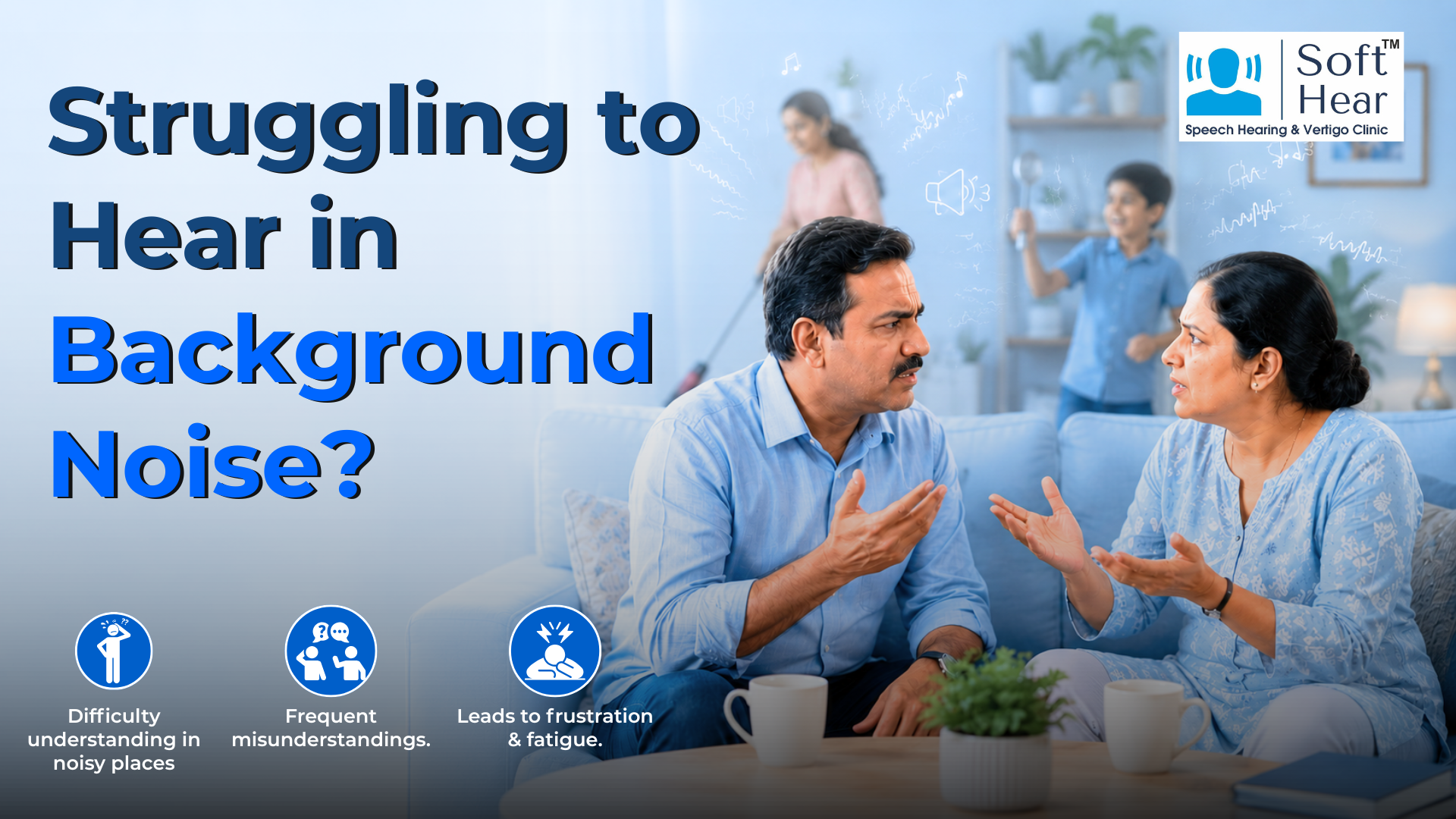
Imagine sitting with your family during dinner enjoying a conversation but struggling to follow what everyone is saying because the television is on, children are playing, and Utensils are clattering. Or Imagine trying to speak with a friend at a restaurant where music is playing and other people are chatting around you. You can hear voices, but the words seem mixed, unclear or incomplete.
This feels frustrating. Many people begin avoiding social gatherings because they are tired of repeatedly asking others to repeat themselves.
Hearing loss is not about the ears it is also about how the brain is processing the sounds. Hearing includes two systems that work together the Ear and the Brain. The ears collect sound while the brain interprets it and assigns meaning. If either system cannot perform efficiently understanding speech becomes difficult.
That’s why people with hearing loss can hear voices but have difficulty understanding words during conversations in crowded environments.
Now it is important to understand following points:
1. Face Difficulty in High-Frequency Sound
Age-related or noise-induced hearing loss affects high-frequency sounds, such as "S" "F" "T" "TH" and "SH." These sounds are soft. They carry essential information that helps us distinguish one word from another. For example words like "sip" and "tip" are different by one sound. If these speech sounds are not heard clearly the brain receives information and starts guessing what was said. In this case people with hearing loss feel people are speaking or mumbling fast.
2. Difficulty in separating sounds
The cochlea hair cells detect different sound frequencies. When these hair cells get damaged by illness, prolonged noise exposure, aging or other causes then they cannot separate sounds accurately as before.
Everything starts to overlap instead of being background noise, with speech heard as separate signals.
3. Delaying in processing speech
Speech happens quickly.
Every second our brain processes changes in pitch, timing and pronunciation to understand language.
People with hearing loss often experience reduced temporal processing, meaning the brain cannot analyze these rapid speech changes efficiently. Word may blend if someone is speaking fast.
For example: Did you get the message?" may sound something like: "Di...ju... ge...the... mes..." The listener hears fragments in place of complete words.
This challenge becomes even greater in places with background noise because the brain is already working harder to fill in the missing information. As a result hearing becomes mentally exhausting.
4. Background Noise Becomes Just as Loud as Speech
Yes background noise becomes just as loud as speech because of a decreasing ability to manage the Signal-to-Noise Ratio. In Normal hearing it's easy to focus on one voice while paying less attention to background sounds, which makes it easier to enjoy conversations at family gatherings or restaurants.
In hearing loss this ability to filter out background noise weakens.
Is Routine Hearing Test Enough?
No a routine hearing test is not enough. It usually Pure Tone Audiometry measures the softest sounds a person can hear inside a room.
However in real-world, communication takes place in markets, offices, restaurants, meetings, classrooms, etc. where background noise always present. That's why professional audiologists perform additional tests, such as Speech-in-Noise Testing, Speech Perception Test, and Signal-to-Noise Ratio. These advanced assessments indicate how well a person can understand in real-world environments. These tests help determine the accurate hearing solution based on the patient's lifestyle and communication needs.
Can hearing aids be a solution for speech understanding?
The answer is yes only if hearing aids are recommended, fitted and programmed by a Qualified audiologist after a hearing assessment.
Nowadays Modern Digital Hearing Aids are more advanced as compare to simple sound amplifiers. These hearing aids improve communication by enhancing speech and reducing background noise.
These modern hearing aids include directional microphones that mainly focus on the speaker, Noise Reduction system that minimizes continuous background sounds, Advanced digital signal processing that improve speech clarity and Personalised programming based on the individual's hearing loss, speech perception ability, listening environments and lifestyle.
These hearing aids make conversations comfortable, but don't restore normal hearing. These hearing aids help the brain to receive communication signals clearly.
In hearing loss early diagnosis and medical intervention can drastically improve hearing ability.
Unfortunately many people ignore the symptoms of hearing loss, early diagnosis and early medical intervention can make a difference. Often, difficulty in hearing speech in noisy places is the earliest sign of hearing loss.
Early diagnosis and treatment not improve your hearing ability but also increase your confidence, improve relationships, reduce hearing fatigue, and ultimately improve quality of life.
Final Words:
If you always experience "I can hear people talking but I can't understand," then don't ignore it.
Understanding Speech and Hearing are not similar.
The assessment carried out by qualified audiologists can identify the exact cause of your hearing loss and help you get the right treatment at the right time. Hearing loss not only affects your ears but it's also about relationships, confidence, independence, and quality of life.
Soft Hear not only treats hearing loss but also helps people understand it. We are committed to sharing information that's easy to understand for everyone and will empowerEverything starts to overlap instead of being background noise, will empower everyone to take care of their hearing.