Introduction
Every hearing-aid brochure in 2026 seems to carry a number followed by “dB SNR”. Ten decibels here, six decibels there, “up to thirty” somewhere else. Patients bring these numbers to me and ask, quite reasonably, which one is biggest.
I understand the temptation. But a decibel figure on its own tells you very little. To read these claims sensibly, you need to know three things: what SNR actually is, how much of it you need, and what situations you really spend your day in. Once those three pieces fit together, the brochures become much easier to understand — and much harder to be misled by.
This article is the third in our series on 2026 hearing technology. It is a little more technical than the first two, but I have tried to keep every idea practical.
A transparency note: Soft Hear is an authorised Phonak partner. All performance claims below are attributed to their sources, and I have marked which findings are independent and which come from manufacturers.
Why hearing-aid technology matters in 2026
Most people with hearing loss can follow a quiet conversation once their hearing aids are fitted well. The trouble begins at the dinner table, the wedding reception, the crowded clinic waiting room. That difficulty is measured in SNR, and it is the problem every major manufacturer is now targeting with artificial intelligence.
A speech test in quiet does not capture this problem. Researchers at Stanford, reviewing data from 5,808 patients, found that speech-in-noise scores showed difficulties at milder degrees of hearing loss than word recognition in quiet did (Fitzgerald et al., 2023). In other words, a person can score “excellent” in a quiet booth and still struggle badly at a family function.
What is SNR, and what does a decibel of it mean?
Signal-to-noise ratio (SNR) is the difference, in decibels, between the level of the speech you want and the level of the noise around it.
- +10 dB SNR: the voice is clearly louder than the background. Most people with mild loss cope.
- 0 dB SNR: the voice and the noise are equally loud. Hard for almost anyone with hearing loss.
- Negative SNR: noise is louder than the voice.
Decibels are logarithmic, so small numbers carry a lot of weight. A 3 dB improvement roughly halves the competing noise power; 10 dB reduces it to one-tenth.
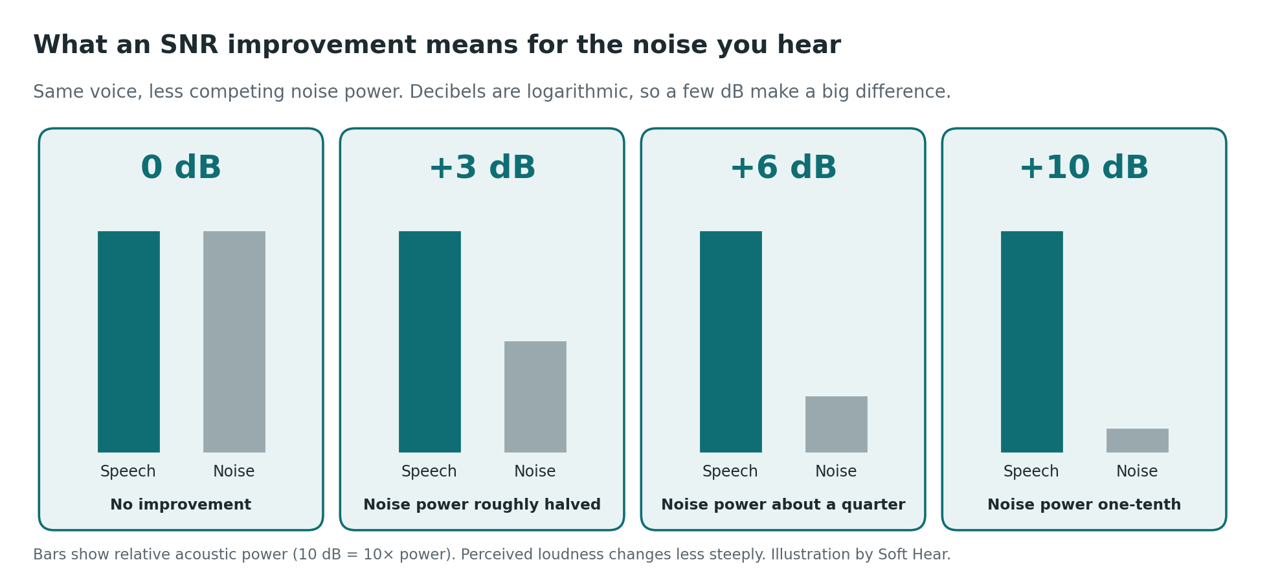
Infographic showing that 3, 6 and 10 decibel SNR improvements reduce competing noise power to about one-half, one-quarter and one-tenth
SNR loss: how much extra you need
Audiologists measure your personal need with a speech-in-noise test such as the QuickSIN, which presents sentences in four-talker babble at progressively harder SNRs (Killion et al., 2004). The result is your SNR loss — how many extra decibels of SNR you need, compared with a typical normal-hearing listener, to understand half the key words. The test’s interpretation guide groups results into normal (0–3 dB), mild (3–7 dB), moderate (7–15 dB) and severe (more than 15 dB) SNR loss.
improvement infographic showing 3, 6 and 10 decibel improvements">What is DNN-based hearing-aid processing?
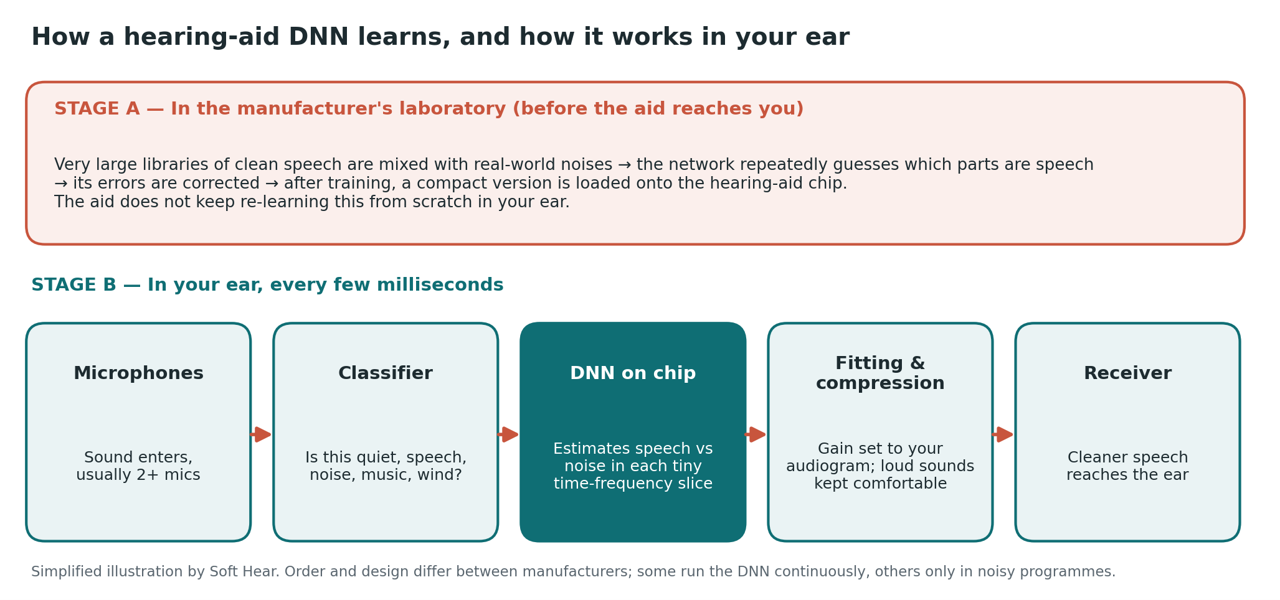
A deep neural network (DNN) is a trained pattern-recogniser that estimates, moment by moment, which parts of the incoming sound are speech and which are noise. The hearing aid then keeps the speech and turns down the rest. In SNR terms, a DNN is simply a new tool for raising the SNR that reaches your ear — especially in babble, where older rule-based noise reduction struggles (Andersen et al., 2021). My previous article explains DNNs in detail.
Infographic showing how a hearing-aid neural network is trained in a laboratory and then separates speech from noise on the hearing-aid chip
Major technology launches compared — through an SNR lens
The 2026 launches differ sharply in what SNR information they make public.
Phonak Audéo EON Sphere. Phonak reports that Spheric Speech Clarity 3.0 maintains an SNR improvement of up to 10 dB relative to omnidirectional microphones (Phonak, 2026). Its predecessor, Phonak Sphere Infinio, was reported at 9.0 dB at default and 10.2 dB at maximum strength (Raufer et al., 2024). EON’s WindBlock 2.0 is reported to improve SNR by up to 30 dB in wind compared with the feature switched off (Sonova, 2026).
Phonak Roger On Sphere. An additional 3 dB SNR over the previous Roger On model, which Phonak equates to roughly halving the noise power (HearingTracker, 2026a).
Widex Allure AI RIC with Clarity Boost. Up to 6 dB better output SNR than leading competitors using AI-based denoising (HHTM, 2026a).
Signia MaX. Signia reports that MaX ranks first in SNR performance in group conversation in noise, but did not publish the dB value in its launch release (Signia, 2026).
Starkey Omega AI+, Oticon Reveal and ReSound Sensia. None published a comparable dB SNR figure in the launch materials I reviewed. Their headline claims concern processing speed, brain response and talker selection respectively (Strom, 2026a; Oticon, 2026; Strom, 2026b).
Comparison table
| Technology / platform | Manufacturer | Key DNN function | Reported SNR outcome (and baseline) | Main patient benefit | Best-suited situations | Evidence source |
|---|---|---|---|---|---|---|
| Audéo EON Sphere | Phonak (Sonova) | Speech–noise separation from any direction | Up to 10 dB vs omnidirectional; independent lab A grade | Speech from all directions in loud noise | Restaurants, gatherings | Phonak (2026); HearAdvisor (2026) |
| EON WindBlock 2.0 | Phonak (Sonova) | Wind-noise management (not described as DNN) | Up to 30 dB vs feature off (wind only) | Conversation outdoors in wind | Walks, scooters, travel | Sonova (2026) |
| Roger On Sphere | Phonak (Sonova) | DNN in remote microphone | +3 dB vs previous Roger On | Speech over distance and in noise | Meetings, lectures, car | HearingTracker (2026a) |
| Allure AI RIC | Widex (WSA) | On-demand DNN co-processor | Up to 6 dB output SNR vs competitors’ AI denoising | Natural sound plus boost when chosen | Intermittent noisy settings | HHTM (2026a) |
| MaX | Signia (WSA) | Four DNNs | “No. 1 in SNR” in group noise; no dB value published | Group conversation | Social groups | Signia (2026) |
| Omega AI+ | Starkey | Quad DNN incl. compression | No dB value published | Clarity with comfort | Everyday wear | Strom (2026a) |
| Reveal | Oticon (Demant) | Speech AI + Context AI | No dB value published | Speech with surrounding awareness | Mixed environments | Oticon (2026) |
| Sensia 9 | ReSound (GN) | DNN denoising + beamformer | No dB value; front talker most audible for 80% of 20 users (internal) | Focus on the person you face | Restaurants | Strom (2026b) |
Bar chart and interpretation
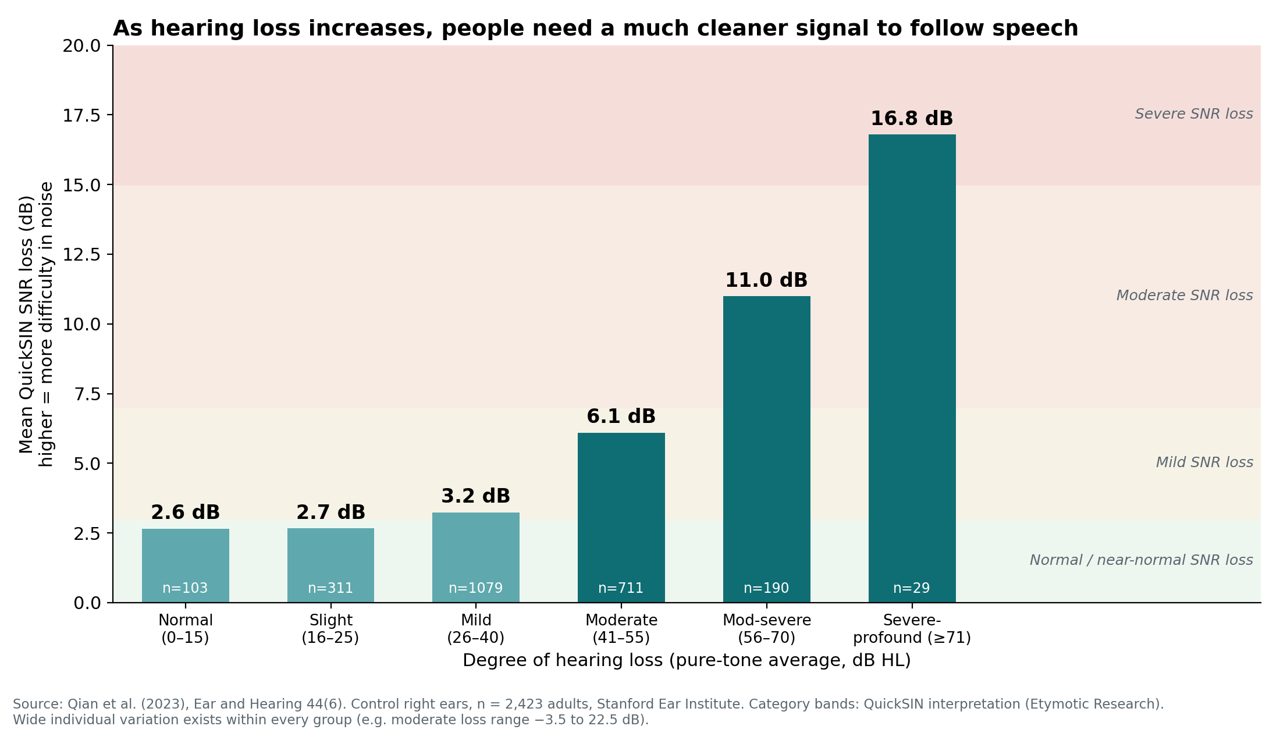
Bar chart showing average QuickSIN SNR loss rising from about 2.6 dB in normal hearing to about 16.8 dB in severe-to-profound hearing loss
Chart 1 — How much extra SNR people need. This chart uses clinical data from 2,423 adults tested at the Stanford Ear Institute (Qian et al., 2023). Average SNR loss stays near normal through slight and mild hearing loss, then climbs steeply: about 6 dB for moderate loss, 11 dB for moderately severe, and almost 17 dB for severe-to-profound loss.
Two lessons follow. First, a person with moderately severe loss may need a signal roughly 11 dB cleaner than their normal-hearing family members to follow the same conversation. Second, the variation within each group is enormous — in the moderate group, individual results ranged from −3.5 to 22.5 dB (Qian et al., 2023). Two people with identical audiograms can have very different experiences in noise. This is why I insist on a speech-in-noise test before recommending a technology level.
Underlying data for Chart 1 (Qian et al., 2023)
| Degree of hearing loss (PTA) | Ears (n) | Mean QuickSIN SNR loss | SNR-loss category |
|---|---|---|---|
| Normal (0–15 dB HL) | 103 | 2.65 dB | Normal |
| Slight (16–25 dB HL) | 311 | 2.66 dB | Normal |
| Mild (26–40 dB HL) | 1,079 | 3.23 dB | Mild |
| Moderate (41–55 dB HL) | 711 | 6.09 dB | Mild |
| Moderately severe (56–70 dB HL) | 190 | 10.99 dB | Moderate |
| Severe-profound (≥71 dB HL) | 29 | 16.79 dB | Severe |
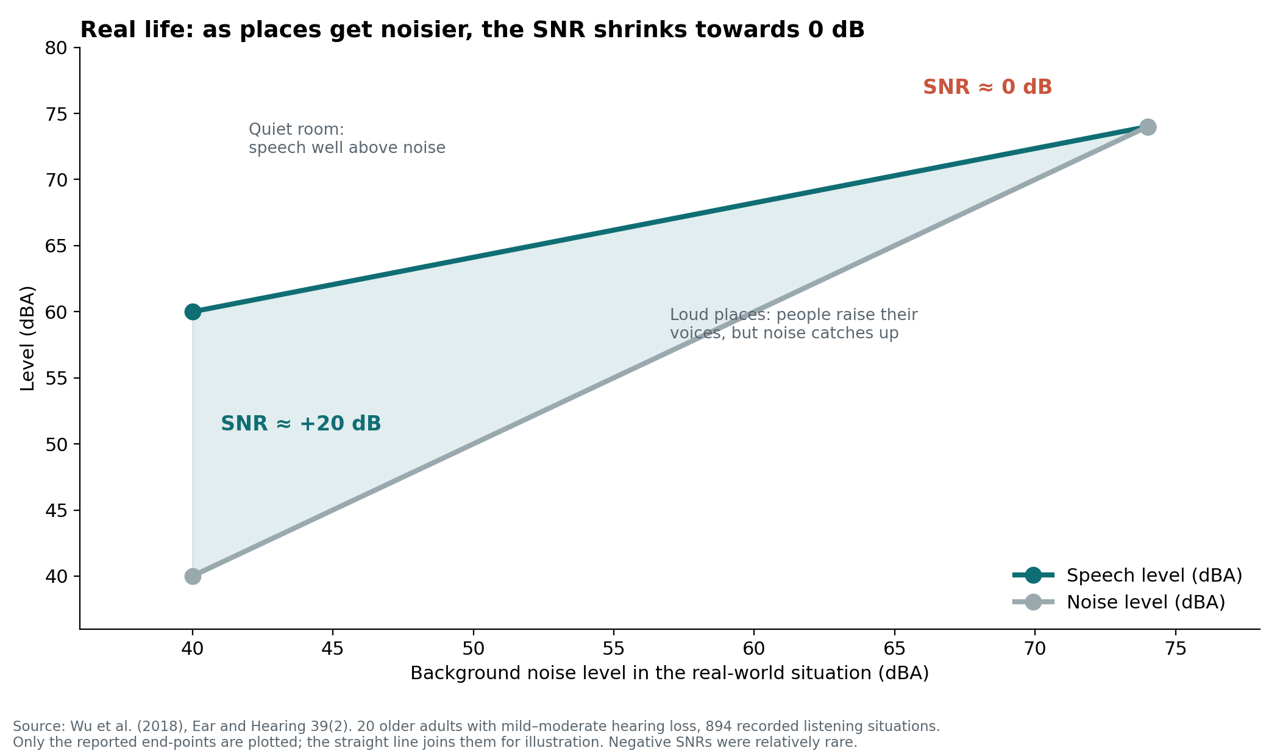
Line chart showing that as real-world background noise rose from 40 to 74 dBA, speech levels rose from 60 to 74 dBA and the signal-to-noise ratio fell from about 20 to 0 dB
Chart 2 — What real life actually looks like. Researchers at the University of Iowa had 20 older adults with mild-to-moderate hearing loss carry recorders for five to six weeks, then analysed 894 real listening situations (Wu et al., 2018). As background noise rose from 40 to 74 dBA, people naturally raised their voices from 60 to 74 dBA — but not enough to keep up, so the SNR fell from about +20 dB to around 0 dB. Situations where noise was louder than speech were relatively rare. A Swedish study using different recordings reached similar conclusions about realistic SNRs (Smeds et al., 2015).
Now put both charts together. In a loud restaurant, the real SNR may be close to 0 dB. A person with moderately severe hearing loss needs, on average, about 11 dB more than normal. That gap is precisely where hearing-aid SNR improvement matters most.
Underlying data for Chart 2 (Wu et al., 2018)
| Background noise | Speech level | Approximate SNR |
|---|---|---|
| 40 dBA (quiet) | 60 dBA | +20 dB |
| 74 dBA (loud) | 74 dBA | 0 dB |
Sound quality comparison
More SNR is not automatically better if it costs naturalness. Aggressive noise suppression can make voices sound thin or make the world feel unnaturally quiet. Manufacturers manage this trade-off differently. Widex keeps everyday processing conventional and offers Clarity Boost on demand (HHTM, 2026a). Oticon’s Context AI aims to preserve surrounding sounds rather than remove them (Oticon, 2026). ReSound deliberately preserves low-frequency all-around information outside its forward beam to protect spatial cues (Strom, 2026b). Independent laboratory testing has so far been published only for Phonak EON among these 2026 platforms, where it achieved an A grade (HearAdvisor, 2026).
Noise reduction and SNR comparison
Here is how I advise patients to read any SNR claim:
- What is the baseline? “Versus omnidirectional microphones”, “versus a competitor” and “versus the feature switched off” are three entirely different comparisons. None can be ranked against the others.
- Is it output SNR or understanding? A cleaner signal at the hearing-aid output is not the same as more words understood. Clinical studies measure the latter.
- What were the test conditions? Many laboratory tests use loudspeakers at fixed angles in rooms with little echo. Reverberation reduces DNN benefit (Ashkanichenarlogh et al., 2025).
- Was it tested at realistic SNRs? Adaptive laboratory tests often find thresholds at much lower SNRs than people actually experience day to day, which can misrepresent how hearing aids behave in real life (Naylor, 2016).
- Who was tested? The same DNN can help one group substantially and another hardly at all (Schulz et al., 2025).
The best independent clinical evidence I can point to is still modest in size: one peer-reviewed study of ten patients measured a 4–5 dB bench SNR improvement for a DNN programme, and sentence-recognition gains of 20–32 percentage points in babble (Saoji et al., 2024).
DNN advantages and limitations — the SNR view
Advantages:
- DNNs can raise SNR for speech from the side and behind, not just the front (Saoji et al., 2024).
- Combined with beamforming, DNNs gave the highest predicted intelligibility across noise types in a large manikin study (Ashkanichenarlogh et al., 2025).
- Higher SNR usually means lower listening effort — less fatigue by evening (Latzel et al., 2025).
Limitations:
- No hearing aid can raise SNR as much as reducing the distance to the talker. That is why remote microphones remain valuable.
- In echoey halls, all processing loses some benefit (Ashkanichenarlogh et al., 2025).
- If the DNN lifts the wrong talker, the SNR for the person you want can actually worsen (Strom, 2026b).
Benefits for different lifestyles
One-to-one conversations. Real-world SNRs are usually comfortable (Wu et al., 2018). Good fitting matters more than SNR technology.
Family gatherings and group conversations. SNR drops as everyone raises their voice. Multi-direction speech enhancement helps most here.
Restaurants, markets and noisy public places. SNR approaches 0 dB. This is where a premium DNN platform or a remote microphone justifies its cost.
Workplace meetings and online calls. Distance and room echo reduce SNR more than people realise. A table microphone often adds more than a hearing-aid upgrade (HearingTracker, 2026a).
Outdoor walking, travel and wind. Wind is a special case; dedicated wind features can show very large SNR improvements in wind specifically (Sonova, 2026).
Television, phone calls and Bluetooth streaming. Streaming sends sound directly to the aids, bypassing the room — effectively the highest SNR you can get.
Older adults often have greater SNR loss and benefit most from automatic systems. First-time users should begin with comfortable noise settings and build up. Working professionals should test the aid during real meetings. Experienced users with a measured moderate-to-severe SNR loss are the strongest candidates for top-tier DNN processing.
Clinical relevance in real-life situations
SNR is the bridge between a laboratory number and a real conversation. When I review a patient’s QuickSIN result alongside their daily environments, I can estimate how big their “SNR gap” is and how much technology is needed to close it. A person with a 3 dB SNR loss who mostly socialises at home may do beautifully with a mid-level aid. A person with a 12 dB SNR loss who attends meetings and weddings every week may need a premium DNN hearing aid and a remote microphone. Cognition, fitting quality, counselling and follow-up then decide how much of that technical benefit becomes real-life benefit.
How to choose the right hearing aid
- Ask for a speech-in-noise test, not just a pure-tone audiogram. Your SNR loss is one of the most useful numbers in your file.
- Describe your noisiest regular situation honestly — a weekly kitty party, a factory floor, a busy shop.
- Read SNR claims for their baseline before comparing brands.
- Ask whether a remote microphone suits you, especially for meetings and lectures.
- Insist on verification and follow-up. The best SNR technology fails if the basic amplification is wrong.
- Confirm local availability and service for the exact model.
Practical advice from an audiologist
You can improve your own SNR today, without any new device. Sit with your back to the noise and your face towards the speaker. Choose a corner table rather than one near the kitchen or speakers. Ask the family to lower the television before a conversation. Move closer — halving the distance to a talker helps more than most people expect. And bring your QuickSIN result to every hearing-aid discussion; it keeps the conversation focused on your needs rather than on brochures.
In India, please ensure your hearing care is provided by a qualified audiologist. Audiologists and speech-language pathologists in India are regulated by the Rehabilitation Council of India (RCI).
Frequently asked questions
1. What is SNR in a hearing aid?
It is how much louder the speech you want is than the background noise, measured in decibels. Hearing-aid technologies try to increase it.
2. What is a good SNR improvement?
Even 3 dB is meaningful, because it roughly halves the competing noise power. But always check what the improvement is compared against.
3. Can I compare SNR figures between brands?
Usually not directly. Brands use different baselines, test rooms and noise types.
4. What is an SNR loss?
It is the extra SNR you need, compared with a typical normal-hearing listener, to understand speech in noise. The QuickSIN test measures it in about a minute per list (Killion et al., 2004).
5. Why do I struggle in noise when my hearing test says “mild”?
Speech-in-noise ability is not fully predicted by the audiogram. People with similar hearing thresholds can have very different SNR loss (Qian et al., 2023).
6. Is a remote microphone better than a premium hearing aid?
They do different jobs. For distant talkers and meetings, a remote microphone often provides the largest SNR improvement; the hearing aid handles everything else.
Key takeaways
- SNR is the gap between the voice you want and the noise around it; every few decibels matter.
- Your personal SNR loss, measured by a speech-in-noise test, tells us how much help you need.
- Real-world SNRs fall towards 0 dB in loud places, exactly where hearing loss hurts most.
- Manufacturer SNR claims use different baselines and cannot be ranked side by side.
- Distance, room acoustics and fitting quality matter as much as the chip.
Book your hearing evaluation
Want to know your own SNR loss? Book a comprehensive hearing evaluation with speech-in-noise testing at any Soft Hear clinic. Call or WhatsApp 8448993003.
Soft Hear | Hear The Future, Live With Confidence.
Phone: +91-8448993003 | Website: www.softhear.com | Email: info@softhear.com
References
Andersen, A. H., Santurette, S., Pedersen, M. S., Alickovic, E., Fiedler, L., Jensen, J., & Behrens, T. (2021). Creating clarity in noisy environments by using deep learning in hearing aids. Seminars in Hearing, 42(3), 260–281. https://doi.org/10.1055/s-0041-1735134
Ashkanichenarlogh, V., Folkeard, P., Scollie, S., Kühnel, V., & Parsa, V. (2025). Objective evaluation of a deep learning-based noise reduction algorithm for hearing aids under diverse fitting and listening conditions. Trends in Hearing, 29, 23312165251396644. https://doi.org/10.1177/23312165251396644
Fitzgerald, M. B., Gianakas, S. P., Qian, Z. J., Losorelli, S., & Swanson, A. C. (2023). Preliminary guidelines for replacing word-recognition in quiet with speech in noise assessment in the routine audiologic test battery. Ear and Hearing, 44(6), 1548–1561. https://pmc.ncbi.nlm.nih.gov/articles/PMC10583951/
HearAdvisor. (2026). Phonak Audéo EON Sphere expert review. https://www.hearadvisor.com/products/phonak-audeo-eon-sphere
HearingTracker. (2026a). Roger On Sphere: Phonak brings AI speech separation to remote microphones. https://www.hearingtracker.com/news/roger-on-sphere-phonak-brings-ai-speech-separation-to-remote-microphones
Hearing Health & Technology Matters. (2026a). Widex introduces Allure AI RIC hearing aids with dual-chip AI processing and advanced connectivity. https://hearinghealthmatters.org/hearing-news-watch/2026/dual-processor-widex-allure-ai/
Killion, M. C., Niquette, P. A., Gudmundsen, G. I., Revit, L. J., & Banerjee, S. (2004). Development of a quick speech-in-noise test for measuring signal-to-noise ratio loss in normal-hearing and hearing-impaired listeners. The Journal of the Acoustical Society of America, 116(4), 2395–2405.
Latzel, M., et al. (2025). Spheric Speech Clarity improves speech understanding and reduces both listening effort and fatigue [Phonak Field Study News]. Sonova AG. https://www.phonak.com/evidence
Naylor, G. (2016). Theoretical issues of validity in the measurement of aided speech reception threshold in noise for comparing nonlinear hearing aid systems. Journal of the American Academy of Audiology, 27(7), 504–514.
Oticon. (2026, August 12). Introducing Oticon Reveal: The world’s first hearing aid powered by a Dual AI system [Press release]. https://www.oticon.com/inside-oticon/press/2026/2026-12
Phonak. (2026). Phonak Audéo EON Sphere outperforms four other hearing aids for clear speech in loud noise [Phonak Insight]. Sonova AG. https://www.phonak.com/content/dam/phonak/en/evidence-library/white-paper/technical-paper/PH_Insight_SphericSpeechClarity-EON-210x297_EN_028-2930-02_V1.00.pdf
Qian, Z. J., Vaisbuch, Y., Gianakas, S. P., Tran, E. D., Ali, N.-E.-S., Blevins, N. H., & Fitzgerald, M. B. (2023). Evaluation of asymmetries in speech-in-noise abilities in audiologic screening for vestibular schwannoma. Ear and Hearing, 44(6), 1540–1547. https://doi.org/10.1097/AUD.0000000000001397
Raufer, S., et al. (2024). Spheric Speech Clarity proven to outperform three key competitors for clear speech in noise [Phonak Field Study News]. Sonova AG. https://www.phonak.com/evidence
Saoji, A. A., et al. (2024). How does deep neural network-based noise reduction in hearing aids impact cochlear implant candidacy? Audiology Research, 14(6). https://doi.org/10.3390/audiolres14060092
Schulz, Wittmann, Hackenberg, Jürgens, & Tchorz. (2025). Effects of low-latency deep-learning-based noise reduction on speech intelligibility for normal hearing, hearing-impaired listeners and cochlear implant users. Frontiers in Audiology and Otology. https://doi.org/10.3389/fauot.2025.1746635
Signia. (2026, August 24). Signia introduces MaX, powered by Acoustic Intelligence: World’s first AI hearing aid platform with 4 DNNs [Press release]. PR Newswire. https://www.prnewswire.com/news-releases/signia-introduces-max-powered-by-acoustic-intelligence-worlds-first-ai-hearing-aid-platform-with-4-dnns-302857407.html
Smeds, K., Wolters, F., & Rung, M. (2015). Estimation of signal-to-noise ratios in realistic sound scenarios. Journal of the American Academy of Audiology, 26(2), 183–196.
Sonova. (2026, August 24). Sonova strengthens innovation leadership with Phonak EON portfolio and third-generation proprietary real-time AI [Media release]. https://www.sonova.com/sonova-strengthens-innovation-leadership-with-phonak-eon-portfolio-and-third-generation-proprietary-real-time-ai/
Strom, K. (2026a, October 1). Starkey launches Omega AI+ with Quad DNNs and DNN Dual Compression. HearingTracker. https://www.hearingtracker.com/news/starkey-launches-omega-ai-with-quad-dnn-and-dual-compression
Strom, K. (2026b, August 10). ReSound Sensia launch: AI that follows the voice you want to hear. HearingTracker. https://www.hearingtracker.com/news/resound-sensia-launch-ai-follows-the-voice-you-want-to-hear
Wu, Y.-H., Stangl, E., Chipara, O., Hasan, S. S., Welhaven, A., & Oleson, J. (2018). Characteristics of real-world signal to noise ratios and speech listening situations of older adults with mild to moderate hearing loss. Ear and Hearing, 39(2), 293–304. https://doi.org/10.1097/AUD.0000000000000486
- Andersen, A. H., Santurette, S., Pedersen, M. S., Alickovic, E., Fiedler, L., Jensen, J., & Behrens, T. (2021). Creating clarity in noisy environments by using deep learning in hearing aids. Seminars in Hearing, 42(3), 260–281. https://doi.org/10.1055/s-0041-1735134
- Ashkanichenarlogh, V., Folkeard, P., Scollie, S., Kühnel, V., & Parsa, V. (2025). Objective evaluation of a deep learning-based noise reduction algorithm for hearing aids under diverse fitting and listening conditions. Trends in Hearing, 29, 23312165251396644. https://doi.org/10.1177/23312165251396644
- Fitzgerald, M. B., Gianakas, S. P., Qian, Z. J., Losorelli, S., & Swanson, A. C. (2023). Preliminary guidelines for replacing word-recognition in quiet with speech in noise assessment in the routine audiologic test battery. Ear and Hearing, 44(6), 1548–1561. https://pmc.ncbi.nlm.nih.gov/articles/PMC10583951/
- HearAdvisor. (2026). Phonak Audéo EON Sphere expert review. https://www.hearadvisor.com/products/phonak-audeo-eon-sphere
- HearingTracker. (2026a). Roger On Sphere: Phonak brings AI speech separation to remote microphones. https://www.hearingtracker.com/news/roger-on-sphere-phonak-brings-ai-speech-separation-to-remote-microphones
- Hearing Health & Technology Matters. (2026a). Widex introduces Allure AI RIC hearing aids with dual-chip AI processing and advanced connectivity. https://hearinghealthmatters.org/hearing-news-watch/2026/dual-processor-widex-allure-ai/
- Killion, M. C., Niquette, P. A., Gudmundsen, G. I., Revit, L. J., & Banerjee, S. (2004). Development of a quick speech-in-noise test for measuring signal-to-noise ratio loss in normal-hearing and hearing-impaired listeners. The Journal of the Acoustical Society of America, 116(4), 2395–2405.
- Latzel, M., et al. (2025). Spheric Speech Clarity improves speech understanding and reduces both listening effort and fatigue [Phonak Field Study News]. Sonova AG. https://www.phonak.com/evidence
- Naylor, G. (2016). Theoretical issues of validity in the measurement of aided speech reception threshold in noise for comparing nonlinear hearing aid systems. Journal of the American Academy of Audiology, 27(7), 504–514.
- Oticon. (2026, August 12). Introducing Oticon Reveal: The world’s first hearing aid powered by a Dual AI system [Press release]. https://www.oticon.com/inside-oticon/press/2026/2026-12
- Phonak. (2026). Phonak Audéo EON Sphere outperforms four other hearing aids for clear speech in loud noise [Phonak Insight]. Sonova AG. https://www.phonak.com/content/dam/phonak/en/evidence-library/white-paper/technical-paper/PH_Insight_SphericSpeechClarity-EON-210x297_EN_028-2930-02_V1.00.pdf
- Qian, Z. J., Vaisbuch, Y., Gianakas, S. P., Tran, E. D., Ali, N.-E.-S., Blevins, N. H., & Fitzgerald, M. B. (2023). Evaluation of asymmetries in speech-in-noise abilities in audiologic screening for vestibular schwannoma. Ear and Hearing, 44(6), 1540–1547. https://doi.org/10.1097/AUD.0000000000001397
- Raufer, S., et al. (2024). Spheric Speech Clarity proven to outperform three key competitors for clear speech in noise [Phonak Field Study News]. Sonova AG. https://www.phonak.com/evidence
- Saoji, A. A., et al. (2024). How does deep neural network-based noise reduction in hearing aids impact cochlear implant candidacy? Audiology Research, 14(6). https://doi.org/10.3390/audiolres14060092
- Schulz, Wittmann, Hackenberg, Jürgens, & Tchorz. (2025). Effects of low-latency deep-learning-based noise reduction on speech intelligibility for normal hearing, hearing-impaired listeners and cochlear implant users. Frontiers in Audiology and Otology. https://doi.org/10.3389/fauot.2025.1746635
- Signia. (2026, August 24). Signia introduces MaX, powered by Acoustic Intelligence: World’s first AI hearing aid platform with 4 DNNs [Press release]. PR Newswire. https://www.prnewswire.com/news-releases/signia-introduces-max-powered-by-acoustic-intelligence-worlds-first-ai-hearing-aid-platform-with-4-dnns-302857407.html
- Smeds, K., Wolters, F., & Rung, M. (2015). Estimation of signal-to-noise ratios in realistic sound scenarios. Journal of the American Academy of Audiology, 26(2), 183–196.
- Sonova. (2026, August 24). Sonova strengthens innovation leadership with Phonak EON portfolio and third-generation proprietary real-time AI [Media release]. https://www.sonova.com/sonova-strengthens-innovation-leadership-with-phonak-eon-portfolio-and-third-generation-proprietary-real-time-ai/
- Strom, K. (2026a, October 1). Starkey launches Omega AI+ with Quad DNNs and DNN Dual Compression. HearingTracker. https://www.hearingtracker.com/news/starkey-launches-omega-ai-with-quad-dnn-and-dual-compression
- Strom, K. (2026b, August 10). ReSound Sensia launch: AI that follows the voice you want to hear. HearingTracker. https://www.hearingtracker.com/news/resound-sensia-launch-ai-follows-the-voice-you-want-to-hear
- Wu, Y.-H., Stangl, E., Chipara, O., Hasan, S. S., Welhaven, A., & Oleson, J. (2018). Characteristics of real-world signal to noise ratios and speech listening situations of older adults with mild to moderate hearing loss. Ear and Hearing, 39(2), 293–304. https://doi.org/10.1097/AUD.0000000000000486