Introduction
Almost every week in our clinics, someone puts a phone in front of me with a headline about a new “AI hearing aid” and asks one question: Is this the best one?
It is a fair question. Between May and October 2026, six of the world’s largest manufacturers released new flagship platforms, each with confident claims about artificial intelligence, deep neural networks (DNNs) and clearer speech in noise.
My honest answer is that there is no single best hearing aid for everyone. There is, however, a best-fitted hearing aid for you, and understanding what these technologies actually do makes that conversation far easier. In this article I compare the major 2026 launches, separate manufacturer claims from independent evidence, and explain what the numbers mean in a crowded Indian wedding hall, an office meeting or a windy morning walk.
A transparency note: Soft Hear is an authorised Phonak partner. To keep this comparison fair, every performance claim below is attributed to its source, and I have flagged clearly which findings are independent and which come from the manufacturers themselves.
Why hearing-aid technology matters in 2026
Untreated hearing loss is not only about missing words. It affects relationships, work and confidence, and it is increasingly discussed as a modifiable factor in healthy ageing. The World Health Organization’s 2026 guidelines on reducing the risk of cognitive decline and dementia address hearing loss directly (World Health Organization, 2026).
The most common complaint I hear, even from experienced users, is: “I can hear, but I cannot understand when there is noise.” That one problem — speech in noise — is exactly where the 2026 launches have focused their engineering.
What is DNN-based hearing-aid processing?
A deep neural network is a type of machine-learning system that learns patterns from very large amounts of example data. In a hearing aid, a DNN is typically trained on many thousands of hours of recorded speech mixed with different noises, so that it learns to estimate which parts of incoming sound are speech and which are not.
Conventional noise reduction works like a fixed rule: “turn down steady sounds like a fan.” A DNN is more like an experienced listener who has heard countless restaurants and markets and guesses, moment by moment, what you want to hear.
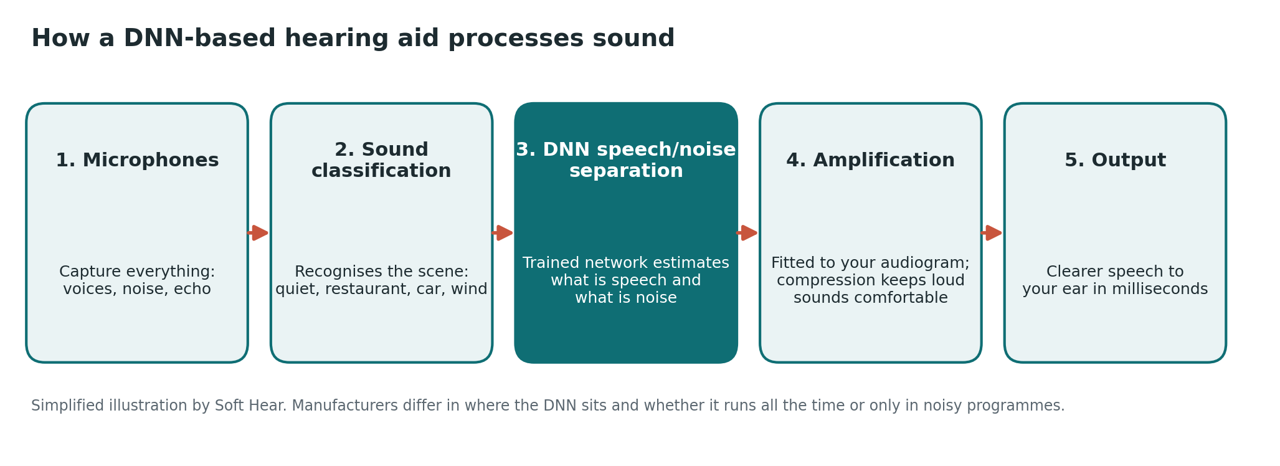
Infographic showing how a DNN hearing aid processes sound from microphones through classification, speech-noise separation, amplification and output.
The 2026 platforms use DNNs for different jobs: separating speech from noise, steering directional microphones, recognising your own voice, classifying the environment, and even deciding how amplification should change from moment to moment. The important point for patients is this: a DNN is a tool, not a guarantee. How it is used, when it switches on, and how well the aid is fitted to your ears matter just as much.
Major technology launches compared
Phonak Audéo EON (launched 24 August 2026). EON is built on a new HYPERSONIC chip running the third generation of Phonak’s Spheric Speech Clarity. Sonova reports that the chip uses 37% less power than the previous Sphere generation, allowing a device that is 25% smaller and 20% lighter (Sonova, 2026). Phonak’s studies report that wearers are twice as likely to understand every word from any direction compared with the same aids without the feature, and up to 37% less listening effort (Sonova, 2026; Latzel et al., 2025; Wright et al., 2024). The new WindBlock 2.0 is reported to reduce wind noise by up to 50 dB (Lindeman & Brunner, 2026).
Phonak Roger On Sphere (available from mid-November 2026). This is not a hearing aid but a remote microphone. Phonak describes it as the first remote microphone to separate speech from noise with a DNN in real time, reporting an extra 3 dB SNR benefit over the previous Roger On (HearingTracker, 2026a).
Signia MaX — Multi-adaptive Xperience (launched 24 August 2026). Signia’s Acoustic Intelligence runs four task-specific DNNs simultaneously: speech detection, own-voice detection, scene analysis and noise processing. Signia reports that 97% of wearers performed better with MaX in noisy group conversations compared with key competitors, citing its own 2026 white papers (Signia, 2026). The first model is the Pure Charge&Go MaX receiver-in-canal aid; Signia states that full Auracast functionality arrives via a firmware update by March 2027 (Signia, 2026).
Starkey Omega AI+ (launched 1 October 2026). Starkey’s G4 processor runs a “Quad DNN Architecture” covering speech enhancement, noise reduction, directionality and spatial awareness, and a new DNN Dual Compressor that decides when fast or slow compression is appropriate (Strom, 2026a). Starkey’s internal testing reports improved feedback control, and the platform extends DNN 360 processing into custom rechargeable in-the-ear styles (Strom, 2026a).
Oticon Reveal (orderable from 24 August 2026). Oticon describes Reveal as the first hearing aid powered by a “Dual AI” system: one AI for speech clarity, and one for preserving the surrounding sounds that give speech its context (Oticon, 2026). Oticon reports a 60% stronger brain response than its previous Intent platform, based on internal research (Medical Trade Journal, 2026).
ReSound Sensia (US availability from 20 August 2026). Sensia combines environment classification (AcoustIQ), a binaural four-microphone beamformer and DNN denoising, with the aim of lifting the voice you are facing rather than the loudest voice in the room (Strom, 2026b). In GN’s internal study of 20 hearing-aid users, Sensia made the front talker most audible for 80% of participants (Strom, 2026b).
Widex Allure AI RIC with Clarity Boost (introduced May 2026; wider rollout from October 2026). Widex takes a deliberately different route: natural everyday sound on its W1 chip, with a dedicated AI co-processor that the wearer switches on for difficult noise. Widex reports up to 6 dB better output SNR than leading competitors using AI denoising (Hearing Health & Technology Matters [HHTM], 2026a).
Comparison table
| Technology / platform | Manufacturer | Key DNN function | Reported SNR or noise outcome | Main patient benefit | Best-suited situations | Evidence source |
|---|---|---|---|---|---|---|
| Audéo EON Sphere | Phonak (Sonova) | Always-available speech-from-noise separation (SSC 3.0) | SNR benefit up to 10 dB vs omnidirectional (manufacturer); A grade, #1 of 39 aids in independent lab testing | Speech from any direction in loud noise; smaller device | Restaurants, family gatherings, walking outdoors | Sonova (2026); Phonak (2026); HearAdvisor (2026) |
| Roger On Sphere | Phonak (Sonova) | DNN speech separation inside a remote microphone | +3 dB SNR vs previous Roger On (manufacturer) | Clearer speech over distance and in noise | Meetings, lectures, car, online calls | HearingTracker (2026a) |
| Pure C&G MaX | Signia (WSA) | Four DNNs: speech, own voice, scene, noise | “No. 1 in SNR” in group noise (manufacturer; no dB figure published) | Group conversation with natural own voice | Group conversations, social events | Signia (2026) |
| Omega AI+ | Starkey | Quad DNN including DNN Dual Compressor | No dB SNR figure published at launch | Clarity plus comfort; custom styles; wellness tracking | Daily wear, custom-style users | Strom (2026a) |
| Reveal | Oticon (Demant) | Dual AI: Speech AI + Context AI | No dB SNR figure published; 60% stronger brain response vs Intent (internal) | Speech while keeping surrounding sound | Varied everyday environments | Oticon (2026); Medical Trade Journal (2026) |
| Sensia | ReSound (GN) | DNN denoising + beamformer, steered by classification | Front talker most audible for 80% of 20 users (internal) | Focus on the person you face, automatically | Restaurants, multi-talker settings | Strom (2026b) |
| Allure AI RIC (Clarity Boost) | Widex (WSA) | On-demand DNN co-processor | Up to 6 dB output SNR vs competitors’ AI denoising (manufacturer) | Natural sound by default, extra help on demand | Music lovers, intermittent noise | HHTM (2026a, 2026b) |
Bar chart and interpretation
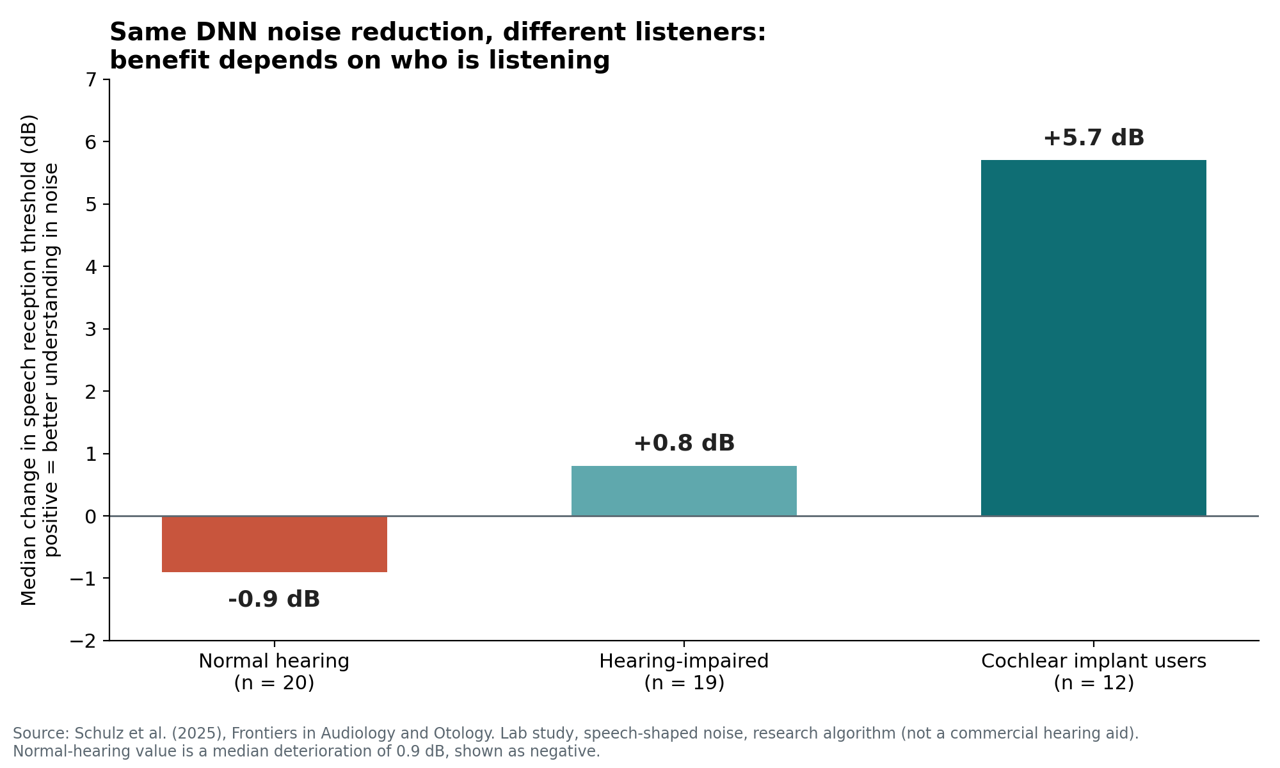
Bar chart showing a DNN noise-reduction algorithm worsened speech-in-noise scores for normal-hearing listeners and improved them for hearing-impaired and cochlear implant users.
Chart 1 — Independent, peer-reviewed evidence. This chart comes from a 2025 laboratory study that tested one low-latency DNN noise-reduction algorithm on three groups of listeners (Schulz et al., 2025). The result is humbling and useful: the same algorithm worsened speech understanding slightly for normal-hearing listeners (a 0.9 dB median deterioration), helped hearing-impaired listeners modestly (0.8 dB), and helped cochlear-implant users substantially (5.7 dB). The lesson for patients is that DNN benefit depends on who is listening. This was a research algorithm, not one of the commercial aids above.
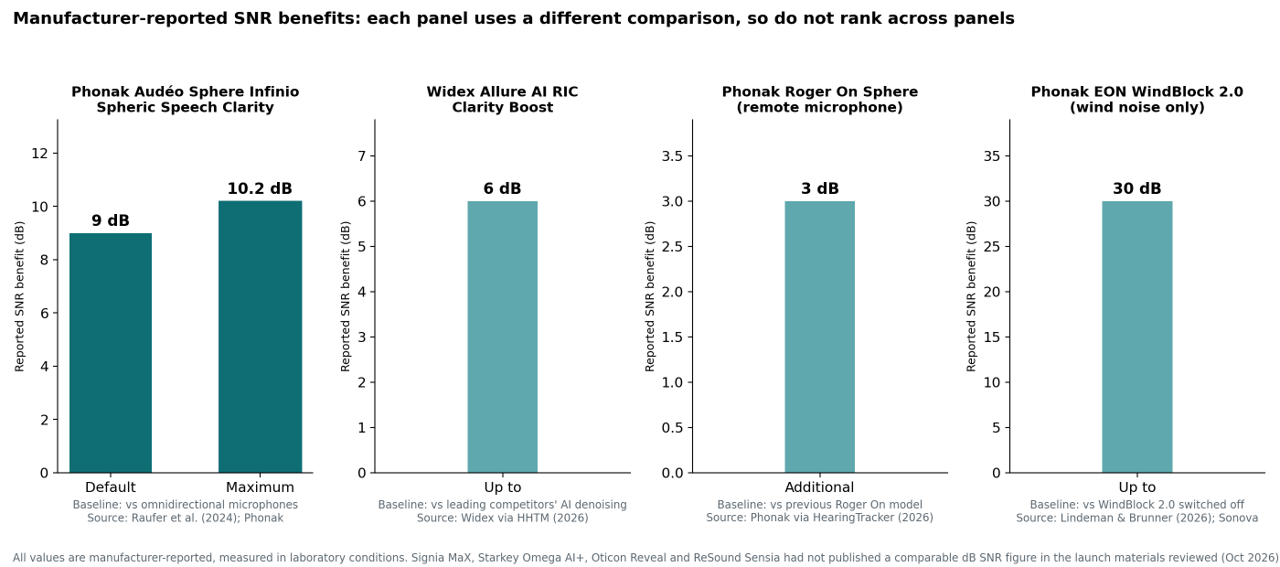
Four-panel chart of manufacturer-reported SNR benefits for Phonak, Widex and Roger On Sphere, each against a different baseline.
Chart 2 — Manufacturer-reported SNR benefits. I have deliberately drawn each claim in its own panel, because each uses a different comparison. Phonak’s 9.0–10.2 dB figure is measured against omnidirectional microphones (Raufer et al., 2024); Widex’s 6 dB is measured against competitors’ AI denoising (HHTM, 2026a); Roger On Sphere’s 3 dB is against the previous Roger model (HearingTracker, 2026a); and WindBlock’s 30 dB applies only to wind noise (Lindeman & Brunner, 2026). Placing these side by side as a ranking would be misleading.
Underlying data for Chart 1 (Schulz et al., 2025)
| Listener group | n | Median SRT change with DNN |
|---|---|---|
| Normal hearing | 20 | 0.9 dB worse |
| Hearing-impaired | 19 | 0.8 dB better |
| Cochlear implant users | 12 | 5.7 dB better |
Underlying data for Chart 2 (manufacturer-reported)
| Feature | Reported SNR benefit | Comparison baseline | Source |
|---|---|---|---|
| Phonak Sphere Infinio, Spheric Speech Clarity | 9.0 dB (default); 10.2 dB (maximum) | Omnidirectional microphones | Raufer et al. (2024) |
| Widex Allure AI RIC, Clarity Boost | Up to 6 dB | Leading competitors with AI denoising | HHTM (2026a) |
| Phonak Roger On Sphere | +3 dB | Previous Roger On | HearingTracker (2026a) |
| Phonak EON WindBlock 2.0 | Up to 30 dB (wind only) | WindBlock 2.0 off | Lindeman & Brunner (2026) |
Sound quality comparison
Sound quality is where personal preference matters most, and where the published evidence is thinnest. Widex has built its reputation on natural sound and reports that five times as many participants preferred Allure AI with Clarity Boost over two competing AI hearing aids in evaluated real-world situations (HHTM, 2026b). Starkey’s DNN Dual Compressor is designed to reduce the “pumping” effect that occurs when amplification changes too quickly — for example, background sound dipping after a keyboard click (Strom, 2026a). Signia’s own-voice DNN aims to make your own voice sound natural without in-clinic calibration (Signia, 2026) — important for first-time users.
Independent laboratory testing by HearAdvisor gave the Phonak Audéo EON Sphere 90 a 5.0/5 SoundScore and an A grade, ranking it first among 39 prescription aids tested (HearAdvisor, 2026). HearingTracker noted that once both devices were expertly tuned, EON’s speech results were nearly identical to its predecessor, Sphere Infinio Ultra (HearingTracker, 2026b). As of October 2026, independent laboratory results for Signia MaX, Oticon Reveal, ReSound Sensia and Starkey Omega AI+ had not yet been published.
Noise reduction and SNR comparison
SNR in simple words: signal-to-noise ratio is how much louder the voice you want is than the noise around it. Every 1 dB matters. In typical speech-in-noise tests, an improvement of a few decibels can mean the difference between catching most of a sentence and losing it.
Three cautions apply to every SNR number in this article:
- Laboratory is not life. Most figures are measured with loudspeakers at fixed positions in controlled rooms. Real rooms have echo, moving talkers and unpredictable noise.
- Baselines differ. “10 dB versus omnidirectional” and “6 dB versus a competitor” are different statements.
- Output SNR is not understanding. A cleaner signal still has to be processed by your ear and brain.
The best-documented independent clinical data still relate to Phonak’s earlier Sphere Infinio. A peer-reviewed study of ten patients found that its DNN programme improved sentence recognition by 23 and 32 percentage points at 10 and 5 dB SNR compared with a standard programme (Saoji et al., 2024). Encouraging, but a small sample.
DNN advantages and limitations
Advantages supported by evidence:
- DNNs can reduce non-steady noise such as babble, which conventional noise reduction handles poorly (Diehl et al., 2023).
- Combined with directional microphones, DNN denoising can improve predicted intelligibility across many noise types and fittings (Ashkanichenarlogh et al., 2025).
- Several manufacturers report reduced listening effort, which patients describe as feeling less tired at the end of the day (Latzel et al., 2025; HHTM, 2026b).
Limitations to understand:
- A DNN may lift the wrong voice — the loudest, not the one you want (Strom, 2026b).
- In noise without speech, such as a mixer-grinder or vacuum cleaner, a speech-trained DNN can introduce artefacts; ReSound switches to conventional noise reduction in such scenes for this reason (Strom, 2026b).
- DNN processing costs battery power, which is why some brands run it only in noisy programmes.
- Most performance data are manufacturer-funded. Independent, peer-reviewed trials of the newest 2026 devices are not yet available.
Benefits for different lifestyles
One-to-one conversations. In quiet, all premium 2026 platforms perform well. Fitting accuracy and own-voice comfort matter more here than AI.
Family gatherings and group conversations. This is where multi-talker technology earns its price. Signia’s design is explicitly built for groups (Signia, 2026); Phonak’s spherical approach targets speech from any direction (Sonova, 2026).
Restaurants, markets and noisy public places. Look for strong DNN speech-in-noise processing. If you prefer to decide when the AI works, Widex’s on-demand Clarity Boost suits you; if you want it to happen automatically, Sensia 9 and EON Sphere are designed for that (Strom, 2026b; Sonova, 2026).
Workplace meetings and online calls. A remote microphone often helps more than any hearing-aid upgrade, because it shortens the distance between talker and microphone. Roger On Sphere adds DNN processing to that advantage (HearingTracker, 2026a).
Outdoor walking, travel and wind. Wind is a major complaint during morning walks and scooter rides. Phonak’s WindBlock 2.0 is the most clearly quantified wind feature among these launches (Lindeman & Brunner, 2026).
Television, phone calls and Bluetooth. Auracast broadcast audio is functional at launch on Oticon Reveal and ReSound Sensia (Oticon, 2026; Strom, 2026b), supported on Phonak EON (Sonova, 2026), and coming to Signia MaX via firmware (Signia, 2026). In India, Auracast venues are still rare, so phone compatibility matters more today.
Older adults often benefit most from automatic systems that need no button-pressing, plus long battery life. First-time users need gradual acclimatisation more than maximum technology. Working professionals should prioritise call quality and remote-microphone compatibility. Experienced users upgrading from an older aid are most likely to notice the DNN difference in noise.
Clinical relevance in real-life situations
Patients do not want a better SNR graph; they want to follow the dinner-table conversation without feeling exhausted. That depends on the degree and type of hearing loss, how well the brain processes speech, cognition, the accuracy of the fitting (ideally verified with real-ear measurement), counselling, assistive devices and follow-up care. A premium DNN aid fitted poorly will usually underperform a mid-level aid fitted carefully.
How to choose the right hearing aid
- Start with a complete diagnostic hearing evaluation, including speech-in-noise testing, not just a pure-tone audiogram.
- List your three hardest listening situations. Choose technology for those, not for the brochure.
- Ask what is automatic and what is manual. Some DNN features work only at the top technology level or only in a separate programme (Strom, 2026b).
- Check style options. Several 2026 platforms launched in only one receiver-in-canal style.
- Confirm Indian availability, warranty and service. Many of these launches began in the US and Europe; ask your audiologist what is actually available locally.
- Insist on a trial period with follow-up adjustments.
Practical advice from an audiologist
In my experience, the patients who do best are not always those with the newest device. They wear their aids every day, return for fine-tuning, and tell us honestly where they still struggle. Give your brain six to eight weeks to adapt, bring a family member to appointments, and if noise is your biggest challenge, ask about a remote microphone before paying for a higher technology level.
In India, please make sure your hearing care is delivered by a qualified audiologist. Audiologists and speech-language pathologists in India are regulated by the Rehabilitation Council of India (RCI).
Frequently asked questions
1. Which is the best hearing aid in 2026?
There is no universal best. Phonak EON Sphere has the strongest independent laboratory result so far (HearAdvisor, 2026), but other 2026 platforms have not yet been independently tested, and the right choice depends on your hearing and lifestyle.
2. Do AI hearing aids really work better in noise?
Evidence suggests DNN processing can improve speech understanding in noise, but benefit varies by person and situation (Schulz et al., 2025; Saoji et al., 2024).
3. Is a higher dB SNR claim always better?
Not necessarily. SNR claims use different baselines and test conditions, so they cannot be compared directly across brands.
4. Will an AI hearing aid help my elderly parent?
Often, yes — especially automatic systems that need no app or button use. A proper hearing test and realistic counselling come first.
5. Are these new hearing aids available in India?
Availability varies by brand and model. Several launched first in the US and Europe. Ask your audiologist for current local availability and pricing.
Key takeaways
- 2026 brought six major AI platforms; all focus on speech in noise, but in different ways.
- Manufacturer SNR claims use different baselines — do not rank them side by side.
- Independent peer-reviewed evidence confirms DNN benefit is real but varies by listener.
- Only Phonak EON Sphere had published independent lab results by October 2026.
- Fitting quality, counselling and follow-up matter as much as the chip.
Book your hearing evaluation
If you or a family member struggle to follow conversations in noise, book a comprehensive hearing evaluation at any Soft Hear clinic.
Soft Hear | Hear The Future, Live With Confidence.
Phone: +91-8448993003 | Website: www.softhear.com | Email: info@softhear.com
About the author
Hem Prakash Singh is a PhD Audiology Scholar, holds an MSc in Audiology and Speech-Language Pathology, and is a certified vertigo specialist. He is the Founder and CEO of Soft Hear Pvt Ltd, where he also serves as Head Audiologist and Speech Therapist. Soft Hear provides hearing evaluation, hearing-aid fitting, tinnitus care, speech therapy for all ages and vertigo rehabilitation through clinics across India and online.