Introduction
“Doctor sahab, is this hearing aid really thinking?”
A retired schoolteacher asked me this last month after reading that his new hearing aid had “artificial intelligence”. It is a lovely question, and the honest answer is: not in the way we think. A hearing aid does not understand your conversation. But the best ones now contain a small, highly trained pattern-recogniser — a deep neural network, or DNN — that has learned, from an enormous number of examples, what speech looks like when it is buried in noise.
In this article, we explain what a DNN actually does inside a hearing aid, how the 2026 platforms use it, what the research shows, and where the technology still falls short.
Transparency note: Soft Hear is an authorised Phonak partner. Performance claims should be interpreted according to their cited sources, including the distinction between independent research and manufacturer-reported findings.
Why Hearing-Aid Technology Matters in 2026
The hardest listening situation for someone with hearing loss is not silence. It is a wedding hall, a family dinner or a busy OPD waiting area. Conventional hearing aids make sound louder, but in noisy environments they can also make unwanted noise louder.
For decades, the main tools for managing noise have included directional microphones and rule-based noise reduction. Both can help, but both have limitations, especially when the background noise consists of other people talking.
Deep neural network technology introduces another approach: using a trained model to recognise patterns associated with speech and help separate speech from competing sounds.
What Is DNN-Based Hearing-Aid Processing?
The Traditional Approach
A modern hearing aid's noise-reduction system has traditionally used two important components: a beamformer and a postfilter.
A beamformer uses two or more microphones to favour sound from a particular direction. A postfilter then attempts to reduce the noise that remains.
Traditional postfilters often rely on predefined rules. For example, sounds that remain steady over time may be classified as noise. This approach can work well for sounds such as a fan or an air conditioner, but it can struggle when the background contains multiple voices.
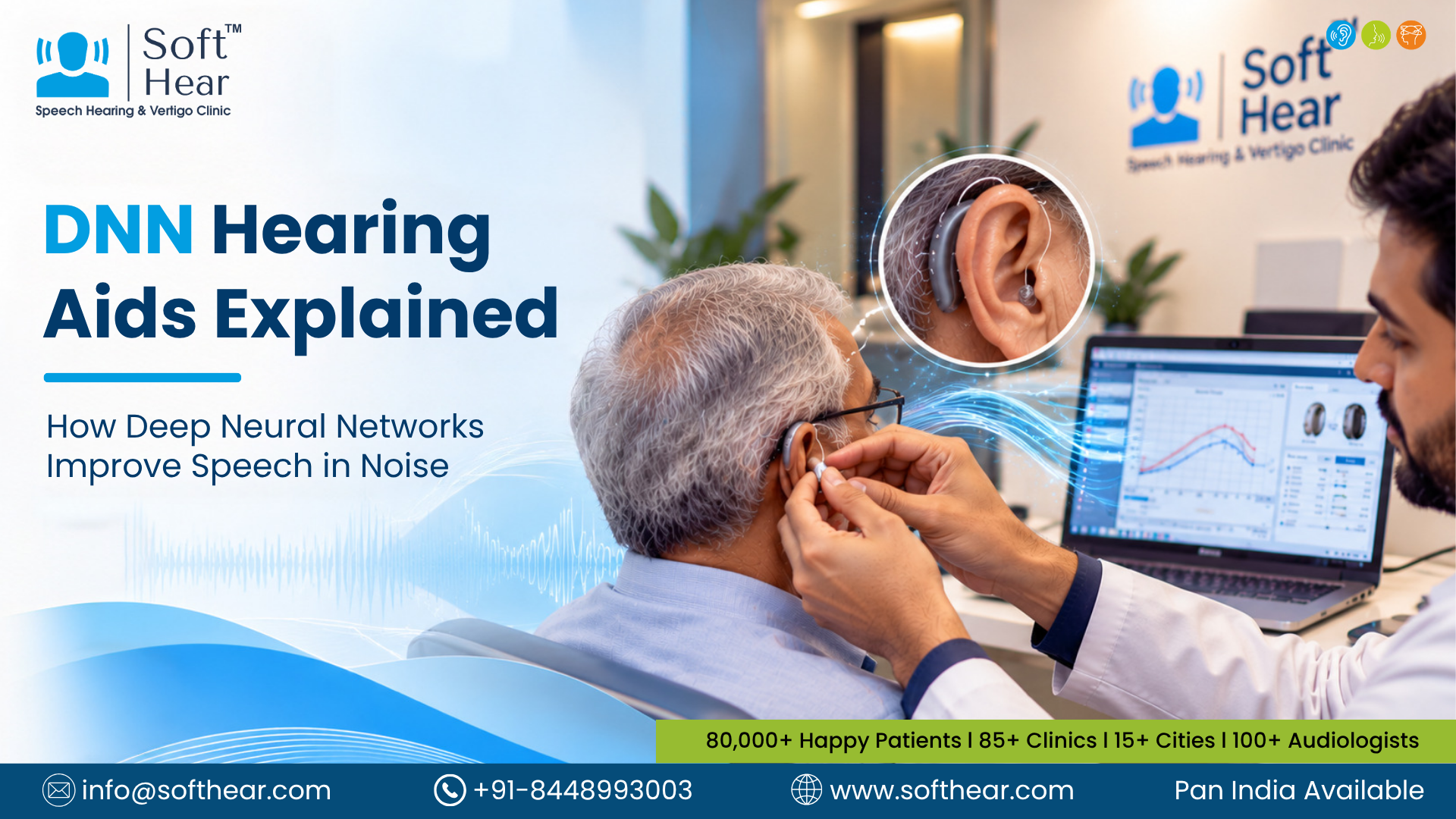
A deep neural network is a layered mathematical model that learns patterns from data instead of relying only on hand-written rules. Researchers have investigated how neural networks can perform the postfiltering task and help separate speech from noise.
The learning process can be understood in two stages.
Stage A — Training in the Manufacturer's Laboratory
Engineers use large collections of clean speech recordings and combine them with different types of real-world noise. The network repeatedly estimates which parts of the sound contain speech, and its errors are corrected during training.
Some research systems have also used a separate neural network to predict human judgements of sound quality during optimisation.
Stage B — Processing Sound Inside Your Hearing Aid
After training, a compact version of the network is loaded onto the hearing-aid chip. It analyses incoming sound in short time intervals and across different frequencies, estimating which components are likely to contain speech.
The hearing aid uses those estimates to reduce unwanted sound before applying the amplification prescribed by the audiologist.
Put simply, conventional noise reduction is like a gatekeeper following a fixed list of rules. A DNN is more like a gatekeeper trained on countless examples who can recognise patterns associated with a voice in a crowd.
Why DNN Hearing Aids Became Possible More Recently
In 2023, researchers demonstrated that a deep-learning system could restore speech intelligibility for hearing-aid users in laboratory conditions. However, that system ran on a laptop, and deployment on a hearing-aid chip was still a challenge.
In 2024, Phonak described the Audéo Sphere Infinio as the first hearing aid with a dedicated AI chip. By 2026, major manufacturers have introduced different approaches to neural-network-based processing.
Each platform uses its technology differently. The design influences when noise reduction activates, how speech is prioritised and how the hearing aid manages surrounding sounds.
Major Hearing-Aid Technology Platforms Compared
The following overview summarises the platforms and functions described in the article's 2026 technology comparison. Features and performance can vary by model and technology level.
| Technology / Platform | Manufacturer | Main DNN Function | Potential Listening Benefit | Example Situation |
|---|---|---|---|---|
| Audéo EON Sphere | Phonak | Speech and noise separation from different directions | Helps make speech more accessible in loud environments | Group dinners and crowded rooms |
| Roger On Sphere | Phonak | Speech separation in a remote microphone | Helps improve access to speech over distance | Meetings and classrooms |
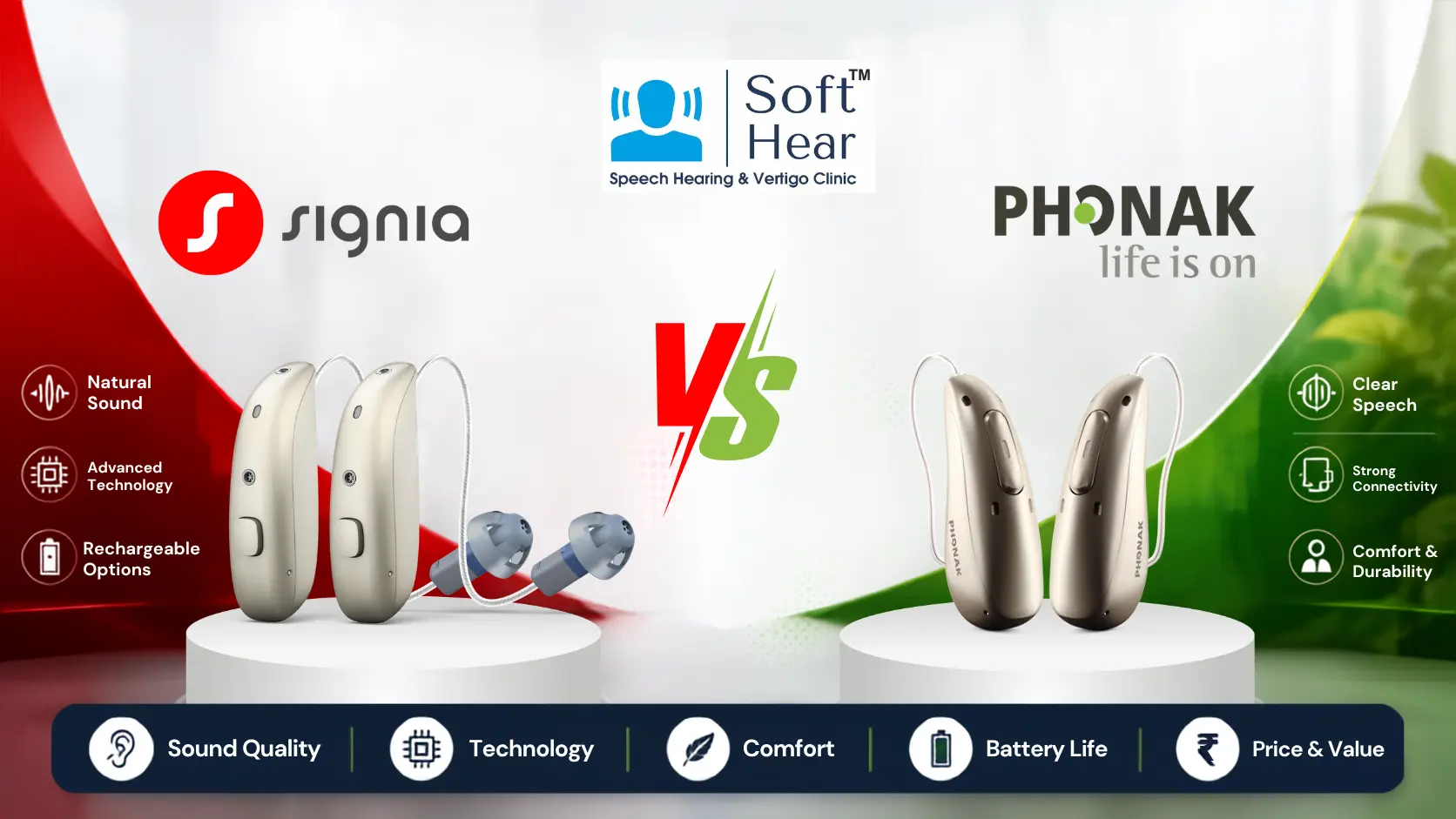
| MaX | Signia | Four task-specific DNNs for speech, own voice, scene analysis and noise processing | Supports speech clarity and listening in complex sound environments | Multi-talker conversations |
| Omega AI+ | Starkey | Quad DNN architecture for speech enhancement, noise reduction, directionality and spatial awareness | Designed to improve clarity while managing changes in amplification | Everyday listening and noisy environments |
| Reveal | Oticon | Speech AI and Context AI | Designed to support speech while retaining awareness of surrounding sounds | Mixed everyday environments |
| Sensia 9 | ReSound | DNN denoising combined with an environment classifier and beamforming | Designed to prioritise the person the wearer wants to hear | Restaurants and cafés |
| Allure AI RIC | Widex | On-demand DNN co-processor using Clarity Boost | Allows the wearer to activate additional processing when needed | Occasionally noisy environments |
These technologies are not identical. Some focus on speech separation, others use multiple networks for different tasks, and some allow the wearer to activate additional processing when the listening situation becomes difficult.
Manufacturer-reported results should not automatically be treated as independent proof that one brand is better than another. The evidence available for each device may differ.
What Does Research Say About DNN Hearing Aids?
Speech Recognition in Background Noise
A peer-reviewed clinical study by Saoji and colleagues in 2024 examined ten adults listening to sentences in multi-talker babble. Participants tried three programmes on the same Phonak hearing aid: a calm-situation programme, a conventional speech-in-noise programme and a DNN-based programme.
Compared with the calm-situation programme, the DNN programme improved sentence recognition by an average of 23 percentage points at +10 dB signal-to-noise ratio (SNR) and 32 percentage points at +5 dB SNR. Compared with the conventional speech-in-noise programme, the gains were 20 and 23 percentage points, respectively.
The study also measured a 4–5 dB SNR improvement for the DNN programme in bench testing.
Important limitation: The study included only ten participants and evaluated an earlier-generation device. It supports the potential benefit of DNN processing but does not establish that one current hearing-aid brand is superior to another.
Sound Quality
Some hearing-aid users worry that strong noise reduction may make speech sound thin, artificial or as though it is coming from underwater.
Research involving cochlear-implant users has reported that two DNN algorithms improved speech understanding in noise without compromising overall perceived speech quality. However, results depend on the algorithm, listener and listening conditions.
Combining DNN Processing With Beamforming
Independent research suggests that combining DNN processing with beamforming can improve predicted speech intelligibility across different noise types. One large manikin study analysed 1,152 recordings and reported particularly strong gains at 0 and +5 dB SNR.
The same research found that the benefit was smaller in more reverberant rooms. This matters in real-world locations such as banquet halls, where hard walls and floors can cause sound reflections.
Results Differ Between Listeners
The benefit of DNN processing is not the same for everyone. A 2025 study reported different outcomes for cochlear-implant users, hearing-impaired listeners and normal-hearing listeners using the same algorithm.
These findings reinforce the importance of an individual assessment rather than assuming that a technology will provide the same benefit to every person.
Advantages of DNN Hearing Aids
- Managing competing voices: DNN processing can help handle babble and changing background noise more effectively than some traditional rule-based approaches.
- Speech from different directions: Certain systems are designed to help with speech coming from the side or behind the wearer, where conventional directional processing may have limitations.
- Potentially lower listening effort: Some studies and manufacturer reports suggest that improved speech access may reduce listening effort and fatigue.
- More flexible processing: Different platforms can combine speech separation with scene analysis, directionality or other processing features.
Limitations You Should Know About
- The wrong-talker problem: A system may prioritise a prominent voice even when it belongs to someone the wearer does not want to hear.
- Unwanted processing artefacts: A speech-trained network can sometimes introduce artefacts in non-speech sounds, such as those from a mixer-grinder or vacuum cleaner. Some systems switch to conventional processing in these situations.
- Battery consumption: DNN processing uses power. Some hearing aids therefore use it only in particular programmes or listening conditions.
- Processing delay: Sound processing must be fast enough to avoid distracting delays. Manufacturer claims about processing speed should be distinguished from independently verified results.
- Clinical assessment: DNN programmes can affect aided speech scores in noise, so audiologists need to consider the programme being used during cochlear-implant candidacy testing.
- Evidence gaps: Independent clinical trials may not be available for every new device at launch. New technology claims should be interpreted in light of the evidence available for the specific model.
Benefits in Different Everyday Situations
One-to-One Conversations
In a quiet room, DNN processing may add relatively little. Accurate hearing-aid fitting and appropriate amplification remain essential.
Family Gatherings and Group Conversations
This is one of the situations in which DNN technology may be especially useful. Systems designed to handle speech from multiple directions may help when several family members are talking together.
Restaurants, Markets and Public Places
Consider how the hearing aid handles noise in busy environments. Some systems activate DNN processing automatically, while others offer user-controlled options. The most suitable approach depends on the person's listening needs and comfort.
Workplace Meetings and Online Calls
A remote microphone can be useful when the main challenge is distance from the speaker. A microphone placed close to the talker may provide a clearer signal than relying entirely on sound captured at the ear.
Outdoor Walking, Travel and Wind
Wind is a different problem from competing speech. It is generally managed through separate wind-noise features, so a DNN's speech separation capability should not be assumed to solve every outdoor listening challenge.
Television, Phone Calls and Bluetooth Streaming
When audio is streamed directly to a hearing aid, room noise may be less important than connectivity and streaming performance. The right features depend on how the wearer uses their devices.
Clinical Relevance: Why Proper Fitting Still Matters
In clinical practice, DNN technology may influence how much speech patients understand in noise, how tired they feel by evening and whether they feel comfortable participating in social activities.
However, a DNN cannot compensate for an incorrectly fitted hearing aid, a dome that leaks sound or a brain that has not yet adapted to amplification. The degree and type of hearing loss, cognitive health, counselling and follow-up remain important parts of hearing care.
How to Choose the Right DNN Hearing Aid
- Get a comprehensive hearing evaluation. Ask whether a speech-in-noise test is appropriate for your listening difficulties.
- Ask when the DNN operates. Find out whether it is always on, activated automatically or controlled through a dedicated programme.
- Check the technology level. On some platforms, particular processing features are limited to specific technology levels.
- Confirm fitting accuracy. Ask your audiologist about real-ear measurement and verification of the prescribed amplification.
- Trial the hearing aid in your most difficult situation. If restaurants or family gatherings are challenging, discuss how you can evaluate the device in those environments.
- Check model availability and service in India. Confirm that the exact model and its required support are available to you.
Practical Advice From an Audiologist
If your DNN hearing aid has a dedicated noisy-environment programme, practise using it before attending a wedding or another busy event. Do not wait until the event itself to learn how it works.
Face the person you want to hear, as some systems use head direction as one of their processing clues. When possible, sit with your back to the noisiest part of the room.
Tell your audiologist exactly where you still struggle. A restaurant with music and an office with air-conditioning noise are different listening situations and may require different adjustments.
In India, hearing care should be provided by a qualified audiologist. Audiologists and speech-language pathologists in India are regulated by the Rehabilitation Council of India (RCI).
Frequently Asked Questions
1. What does DNN mean in a hearing aid?
DNN stands for deep neural network. It is a trained pattern-recognition model that estimates which parts of incoming sound are speech and which are noise, allowing the hearing aid to reduce unwanted noise.
2. Does an AI hearing aid learn my voice and preferences?
Most of the learning happens in the manufacturer's laboratory before the hearing aid reaches the user. Some features adapt to the listening environment or user settings, but the core DNN is pre-trained.
3. Is a DNN hearing aid better than a directional microphone?
They perform different jobs and can work together. Research suggests that combining DNN processing with beamforming can improve predicted speech intelligibility in certain conditions.
4. Will a DNN hearing aid remove all background noise?
No. It can reduce noise and improve the balance between speech and noise, but some background sound may remain. Retaining awareness of the surrounding environment is also important.
5. Does DNN processing drain the battery faster?
DNN processing uses power, which is why some hearing aids activate it only when needed. Battery life depends on the model, streaming use and listening environment.
6. Are DNN hearing aids useful for cochlear-implant users?
Research involving cochlear-implant users is encouraging, but the suitability of a particular programme should be discussed with the person's cochlear-implant team.
Key Takeaways
- A DNN is a pre-trained pattern recogniser that can help separate speech from noise.
- Hearing-aid brands use neural networks differently, including single-task processing, multiple networks and on-demand processing.
- Research indicates potential benefits in challenging listening conditions, particularly when DNN processing is combined with beamforming.
- Results can be affected by reverberation, the listening situation and the individual listener.
- DNN technology can have limitations, so accurate fitting, professional guidance and follow-up remain essential.
Book Your Hearing Evaluation at Soft Hear
If conversations in noisy environments leave you exhausted or you struggle to follow discussions in restaurants and family gatherings, a comprehensive hearing evaluation can help identify your needs.
At Soft Hear, our hearing-care team can guide you through hearing assessment, hearing-aid options and fitting considerations based on your individual listening difficulties.
Call or WhatsApp: 8448993003
References
- Andersen, A. H., et al. (2021). Creating clarity in noisy environments by using deep learning in hearing aids. Seminars in Hearing, 42(3), 260–281. Read research
- Ashkanichenarlogh, V., et al. (2025). Objective evaluation of a deep learning-based noise reduction algorithm for hearing aids under diverse fitting and listening conditions. Trends in Hearing, 29. Read research
- Borjigin, A., et al. (2024). Deep learning restores speech intelligibility in multi-talker interference for cochlear implant users. Scientific Reports, 14. Read research
- Diehl, P. U., et al. (2023). Restoring speech intelligibility for hearing aid users with deep learning. Scientific Reports, 13, 2719. Read research
- Saoji, A. A., et al. (2024). How does deep neural network-based noise reduction in hearing aids impact cochlear implant candidacy? Audiology Research, 14(6). Read research
- Schulz, Wittmann, Hackenberg, Jürgens and Tchorz (2025). Effects of low-latency deep-learning-based noise reduction on speech intelligibility for normal hearing, hearing-impaired listeners and cochlear implant users. Frontiers in Audiology and Otology. Read research
- Zhang, H., et al. (2025). Neural-WDRC: A deep learning wide dynamic range compression method combined with controllable noise reduction for hearing aids. Trends in Hearing, 29.
About the Author
Hem Prakash Singh is a PhD Audiology Scholar, holds an MSc in Audiology and Speech-Language Pathology, and is a certified vertigo specialist. He is the Founder and Managing Director of Soft Hear Pvt Ltd, where he also serves as Head Audiologist and Speech Therapist. Soft Hear provides hearing evaluation, hearing-aid fitting, tinnitus care, speech therapy for all ages and vertigo rehabilitation through clinics across India and online.