If you or someone you love has profound hearing loss, you've probably heard two very different messages. One says, "Hearing aids won't help at all." The other says, "Just buy the most powerful one." Neither is quite right.
The truth sits in between, and it's worth understanding properly, because the right decision can change how much of life you hear.
What "profound" hearing loss means
Profound hearing loss means that, without amplification, you miss almost all speech and most everyday sounds. On a hearing test, thresholds are around 80 to 90 decibels or worse, depending on the classification system your audiologist uses. Even very loud sounds may be barely audible.
It's important to know that two people with the same audiogram can understand speech very differently. That's why the assessment doesn't stop at the hearing test. I also look at how much speech you understand with hearing aids, because that tells us what to do next.
Can hearing aids help with profound hearing loss?
Yes, they often can, but the benefit varies. Many people with profound loss gain awareness of sounds, help with lip-reading, better safety and, for some, useful speech understanding. Others find that speech remains unclear even with the best-fitted device. And that's not a failure. It's information, and it tells us it's time to talk about other options.
What to look for in a hearing aid for profound loss
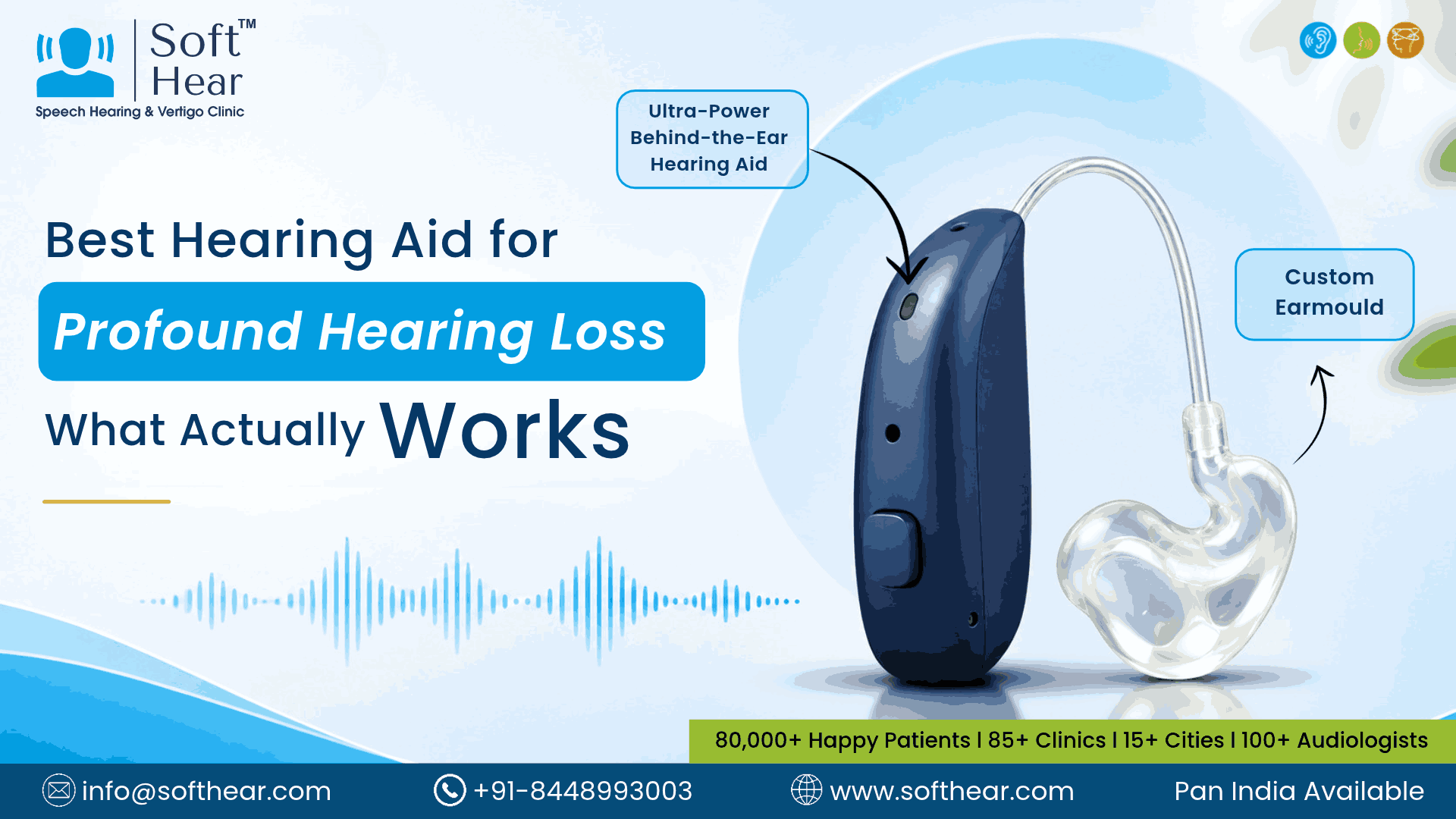
- An ultra-power behind-the-ear (BTE) model. These are built to deliver strong output with less risk of whistling. Several major brands make them, and model names change, so ask your audiologist what's currently available.
- A well-made custom earmould. For profound loss this is not an accessory, it's half of the hearing aids. A tight, comfortable seal controls feedback and lets the device deliver its power.
- Feedback management. Power and whistling go together, so good feedback control matters.
- Frequency-lowering features. These move high-pitched sounds you can't hear into a range you can. Brands name them differently, and they help some people more than others.
- A telecoil and remote microphone options. These help with phones, loop systems and noisy rooms, and are valuable when hearing from a distance.
- Sturdy build and simple controls. You'll use these daily. Easy buttons, a secure battery door and water and dust resistance help.
- Battery type. Powerful devices use more energy. Ask about battery size or rechargeable options, and how long they last in real use.
The options at a glance
| Option | Who it may suit | Worth knowing |
|---|---|---|
| Ultra-power BTE with custom earmould | Many adults and children with profound loss who still gain speech awareness from amplification | The usual first step, fitted carefully and reviewed regularly |
| Hearing aid plus remote microphone | People who struggle in noise or at a distance | A small microphone sends the speaker's voice straight to your hearing aid |
| Cochlear implant | People who get limited speech understanding even with well-fitted hearing aids | A surgical option that stimulates the hearing nerve directly. Needs a full evaluation. |
| Hearing aid in one ear, implant in the other (bimodal) | Some implant users who keep useful hearing in the other ear | Can combine natural-sounding low pitches with the implant |
When to think about a cochlear implant
A hearing aid makes sounds louder. A cochlear implant bypasses the damaged part of the inner ear and sends signals directly to the hearing nerve. For some people with profound loss, that can give far better speech understanding than any hearing aid.
The question we ask is simple: how much speech do you understand with properly fitted hearing aids? If the answer is "not enough," a referral for a cochlear implant evaluation is the right next step. That evaluation includes hearing tests, imaging, a medical review by an ENT surgeon, and counselling about expectations and rehabilitation.
For children, time matters. If a child has profound hearing loss, early diagnosis and early decisions make a real difference to speech and language development, so please don't wait.
Hearing aids are only part of the picture
Even the best device works better with support around it:
- Auditory training and speech therapy help your brain make sense of what you hear, especially for children and for adults who are newly deaf.
- Lip-reading and communication strategies help you and your family, such as facing the speaker, good lighting and reducing background noise.
- Everyday technology such as live captioning on your phone, vibrating alarm clocks, and visual or vibrating alerts for doorbells and smoke alarms can improve safety and confidence.
Common mistakes I see
- Choosing a device by size, when power and fit matter more.
- Skipping the custom earmould, or accepting a poorly fitting one.
- Expecting normal hearing. Hearing aids help, but they don't restore healthy hearing.
- Delaying the cochlear implant conversation when hearing aids clearly aren't enough.
When to see a doctor first
Please see an ENT specialist promptly for sudden hearing loss, hearing loss in one ear only, ear pain or discharge, or dizziness along with hearing changes. These need medical evaluation first.
Questions people often ask me
Can someone with profound hearing loss use a hearing aid?
Yes, many do, and some benefit greatly. But the amount of benefit varies, which is why the aided speech tests matter.
Is a cochlear implant better than a hearing aid?
For people who get limited benefit from hearing aids, it can be. For people who do well with hearing aids, it isn't needed. The decision comes from testing, not assumptions.
Will a very powerful hearing aid damage my remaining hearing?
Properly fitted devices are set to safe output limits. This is one reason to have them fitted and checked by an audiologist.
Can children with profound hearing loss use hearing aids?
Yes, and they should be fitted as early as possible while the implant evaluation is considered, if needed.
Let's work out what will help you
Book a hearing assessment with one of our audiologists or call us on +91 84489 93003. We'll test how you hear with and without amplification, explain what we find in plain language, and help you decide on the next step.
This article is for general information and is not a substitute for a clinical assessment. Hearing, balance and communication needs are individual, so please consult a qualified audiologist, speech-language pathologist or doctor about your own situation.
Soft Hear | Hear The Future, Live With Confidence.
Phone: +91-8448993003 | Website: www.softhear.com | Email: info@softhear.com