Introduction
When Phonak introduced Audéo Sphere Infinio in 2024, it was the first hearing aid built around a dedicated artificial-intelligence chip (Phonak, 2024). Two years later, the Sphere family has moved through three generations, and Phonak has now taken the same idea into a remote microphone: Roger On Sphere.
Patients ask me two questions about this technology. “Does it really work in a noisy room?” and “Do I need the microphone if I already have the hearing aid?” This article answers both, using Phonak’s own data where that is all that exists, and independent research wherever I can find it.
A quick note on names. Sphere Infinio (2024) was followed by Infinio Ultra Sphere (2025) and then Audéo EON Sphere, launched in August 2026 (Sonova, 2026). Many people still say “Sphere Infinio” for the whole family, so I cover all three here.
A transparency note: Soft Hear is an authorised Phonak partner, and this article is about Phonak products. For that reason I have been especially careful to label every claim as manufacturer-reported or independent, to include the technology’s limitations, and to explain when another brand’s approach may suit a patient better.
Why hearing-aid technology matters in 2026
The hardest listening situation for most of my patients is a group conversation in noise, with people speaking from different sides. Traditional directional microphones help mainly with speech from the front. That leaves the person beside you at a dinner table, or the grandchild speaking from behind, poorly served. Phonak’s Sphere approach was designed specifically for speech “from any direction” (Wright et al., 2024), which is why it deserves a closer look.
What is DNN-based hearing-aid processing?
A deep neural network (DNN) is a pattern-recogniser trained on very large amounts of speech mixed with noise. Inside a hearing aid, it estimates, many times a second, which parts of the incoming sound are speech and which are noise, and turns down the noise. Phonak calls its version Spheric Speech Clarity. My earlier article in this series, “DNN Hearing Aids Explained”, covers the general principle in detail.
What is distinctive about Phonak’s 2026 system is that a DNN can now act in two places: in the hearing aid itself, for sound all around you, and in the Roger On Sphere microphone, close to the person speaking.
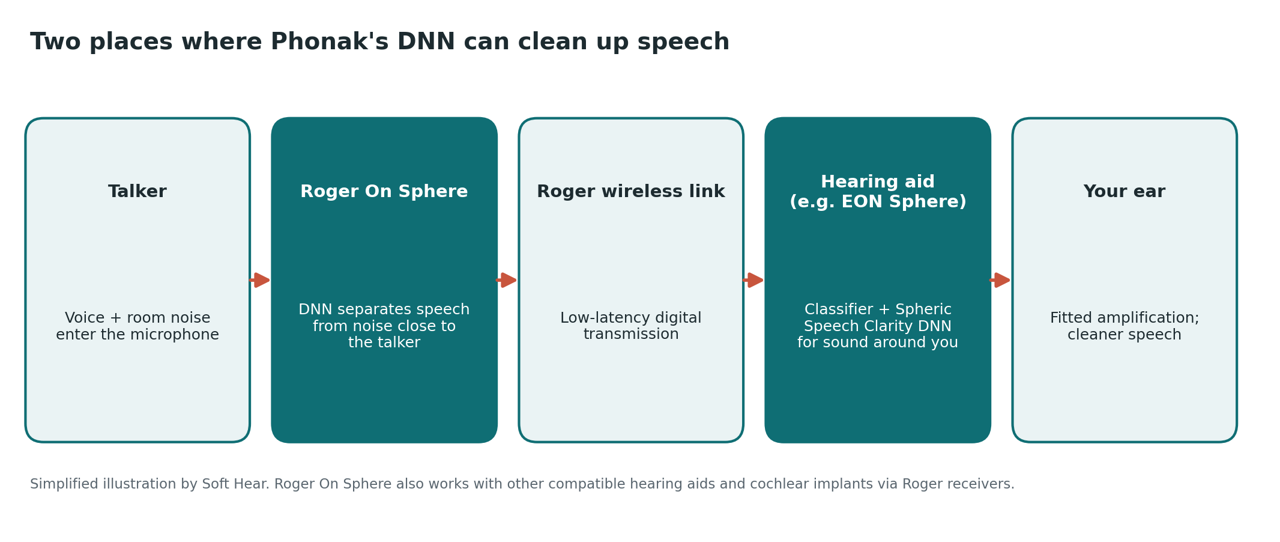
Infographic showing speech passing from a talker through the Roger On Sphere microphone, a wireless link and a Sphere hearing aid, with neural-network processing in both the microphone and the hearing aid
Major technology launches compared
Audéo Sphere Infinio (2024)
Phonak described Sphere Infinio as the first hearing aid with a dedicated AI chip, called DEEPSONIC (Phonak, 2024). Its Spheric Speech Clarity feature, combined with a fixed directional microphone, was reported to improve SNR by 9.0 dB at default strength and 10.2 dB at maximum, compared with omnidirectional microphones (Raufer et al., 2024). In a Phonak field study, wearers were reported to be two to three times more likely to understand speech in noise with the feature switched on (Wright et al., 2024).
Infinio Ultra Sphere (2025)
The second generation introduced Spheric Speech Clarity 2.0 with a retrained DNN, which Phonak reports is 30% more efficient than its predecessor (AudiologyOnline, 2026). Notably, Phonak allowed earlier Infinio users to update to Infinio Ultra through firmware (Strom, 2026a) — a practical advantage for existing wearers.
Audéo EON Sphere (August 2026)
EON Sphere moves to a new HYPERSONIC chip running Spheric Speech Clarity 3.0. Sonova reports 37% lower power use than the previous Sphere generation, a device 25% smaller and 20% lighter, up to 37% less listening effort, and up to 38 hours of battery life (Sonova, 2026). Phonak’s technical paper states that the SNR improvement is maintained at up to 10 dB relative to omnidirectional microphones (Phonak, 2026). EON also adds WindBlock 2.0, reported to reduce wind noise by up to 50 dB (Sonova, 2026), and changes how the aid decides to stay in its speech-in-noise mode, so a brief lull in noise is less likely to make it switch out (HHTM, 2026b).
Roger On Sphere (available from mid-November 2026)
Roger On Sphere is a remote microphone that the talker wears, or that sits on a table. Phonak describes it as the first remote microphone to use a DNN for real-time speech-from-noise separation, and reports an extra 3 dB SNR benefit over the previous Roger On, which it equates to roughly halving the noise power (Strom, 2026b). It switches microphone modes automatically for lectures, meetings, online calls, car journeys and social gatherings, and works with many hearing aids, Phonak’s Naída and Virto ranges, and Advanced Bionics cochlear implants (Strom, 2026b).
How Phonak’s approach differs from other 2026 platforms
Every major brand now uses AI, but the philosophies differ. Signia MaX uses four DNNs with a strong focus on group conversation and own-voice processing (Signia, 2026). ReSound Sensia combines DNN denoising with a beamformer to favour the person you are facing (Strom, 2026a). Widex Allure AI keeps everyday sound conventional and offers DNN help only on demand, which some musicians prefer (HHTM, 2026a). Starkey Omega AI+ extends DNN processing into custom in-the-ear styles (Strom, 2026c). Phonak’s Sphere family, by contrast, is available only as a receiver-in-canal style (Sonova, 2026). If a patient needs a custom in-ear device, or strongly prefers a particular sound character, another platform may be the better choice.
Comparison table
| Technology / platform | Manufacturer | Key DNN function | Reported SNR or noise-reduction outcome | Main patient benefit | Best-suited situations | Evidence source |
|---|---|---|---|---|---|---|
| Audéo Sphere Infinio (2024) | Phonak | Spheric Speech Clarity 1.0 on DEEPSONIC chip | 9.0 dB (default), 10.2 dB (max) vs omnidirectional (manufacturer) | Speech from any direction in loud noise | Group dinners, crowded rooms | Raufer et al. (2024); Phonak (2024) |
| Infinio Ultra Sphere (2025) | Phonak | Retrained DNN (SSC 2.0) | 10.2 dB vs omnidirectional; 30% more efficient (manufacturer) | Same benefit, better efficiency; firmware upgrade path | As above | AudiologyOnline (2026) |
| Audéo EON Sphere (2026) | Phonak | SSC 3.0 on HYPERSONIC chip | Up to 10 dB vs omnidirectional (manufacturer); A grade, #1 of 39 aids (independent lab) | Smaller, lighter, longer battery; strong noise performance | Restaurants, gatherings, outdoors | Phonak (2026); HearAdvisor (2026) |
| EON WindBlock 2.0 | Phonak | Wind management (not described as DNN) | Up to 50 dB less wind noise; up to 30 dB SNR in wind (manufacturer) | Conversation while walking outdoors | Morning walks, travel | Sonova (2026) |
| Roger On Sphere (2026) | Phonak | DNN speech separation in the microphone | +3 dB SNR vs previous Roger On (manufacturer) | Clear speech over distance and in noise | Meetings, classrooms, car, dining | Strom (2026b) |
Bar chart and interpretation
Bar chart showing three generations of Phonak Sphere hearing aids with similar reported SNR benefit of about 10 decibels, alongside gains in power efficiency and size
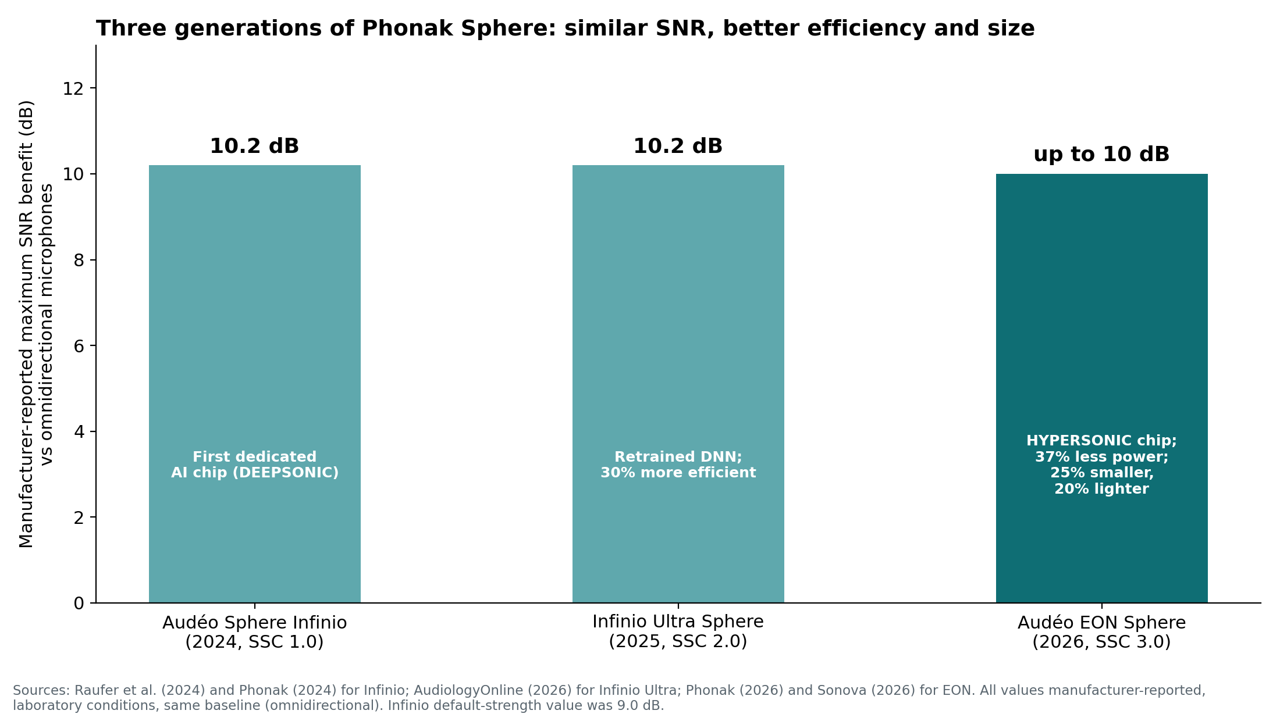
Chart 1 — Three generations, one consistent finding. All three Sphere generations report a similar maximum SNR benefit of about 10 dB against the same baseline (Raufer et al., 2024; AudiologyOnline, 2026; Phonak, 2026). The advances since 2024 have been in efficiency, size and battery life rather than in raw SNR. Independent testing points the same way: HearingTracker found that once both devices were expertly tuned, EON’s speech results were nearly identical to Infinio Ultra Sphere (HearingTracker, 2026). For an existing Infinio Ultra Sphere wearer, this matters — an upgrade buys comfort and battery life more than extra clarity.
Bar chart showing a table remote microphone improved speech recognition in noise by 61 percent over hearing aids or cochlear implants alone in a simulated group dinner
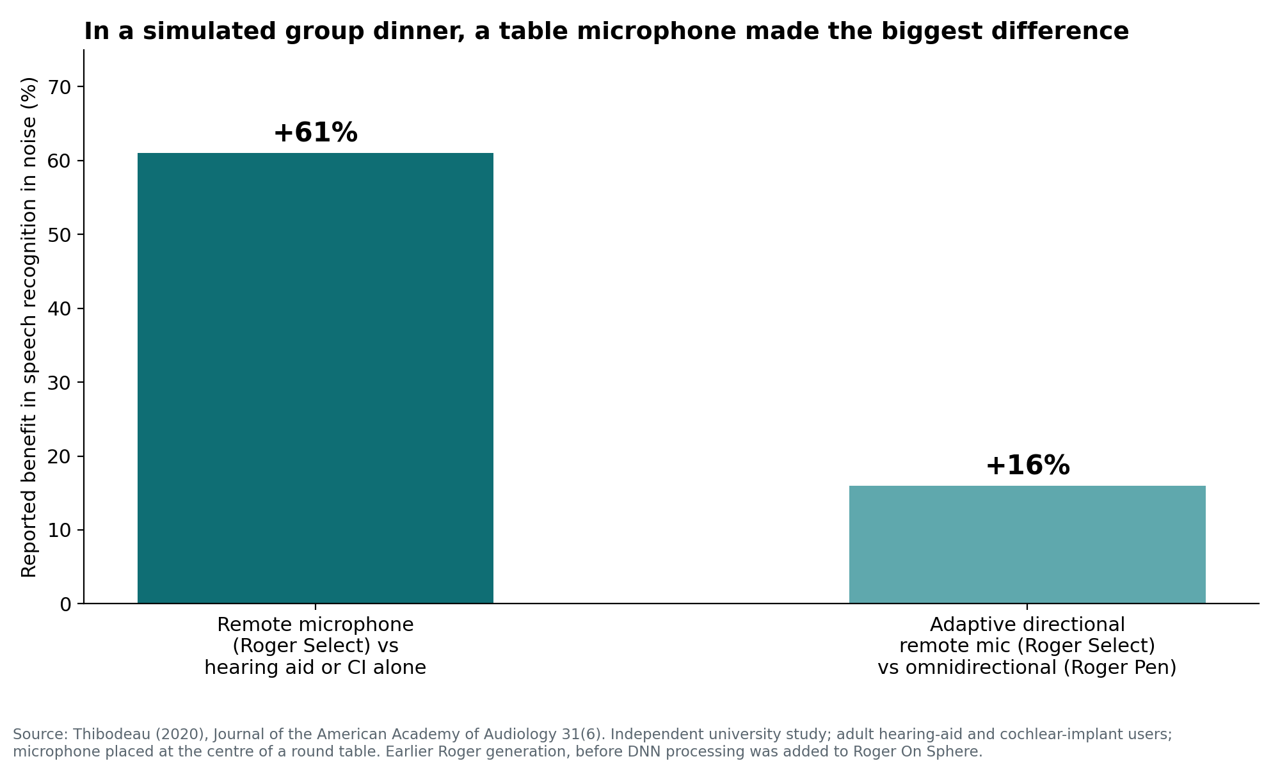
Chart 2 — Why the microphone still matters. This independent university study simulated a group dinner, with a Roger microphone placed at the centre of a round table (Thibodeau, 2020). Adding the microphone improved speech recognition in noise by 61% compared with hearing aids or cochlear implants alone, and an adaptive directional microphone gave a further 16% over an omnidirectional one. These results come from an earlier Roger generation, before DNN processing was added. An earlier study by the same researcher found that, at noise levels of 65 dB and above, hearing-aid users with Roger performed better on a speech test than normal-hearing listeners without it (Thibodeau, 2014).
The lesson is simple: a hearing aid, however intelligent, still has to listen from your ears. A remote microphone listens from the talker’s mouth.
Underlying data for Chart 1 (manufacturer-reported, vs omnidirectional microphones)
| Generation | Year | Maximum reported SNR benefit | Other reported change | Source |
|---|---|---|---|---|
| Audéo Sphere Infinio | 2024 | 10.2 dB (9.0 dB default) | First dedicated AI chip | Raufer et al. (2024); Phonak (2024) |
| Infinio Ultra Sphere | 2025 | 10.2 dB | 30% more efficient DNN | AudiologyOnline (2026) |
| Audéo EON Sphere | 2026 | Up to 10 dB | 37% less power; 25% smaller; 20% lighter | Phonak (2026); Sonova (2026) |
Underlying data for Chart 2 (Thibodeau, 2020)
| Comparison | Reported benefit in speech recognition in noise |
|---|---|
| Roger Select remote microphone vs hearing aid or CI alone | 61% |
| Roger Select (adaptive directional) vs Roger Pen (omnidirectional) | 16% |
Sound quality comparison
Phonak positions Sphere as “always ready” rather than always aggressive: its AutoSense system recognises the environment and engages Spheric Speech Clarity in loud speech-in-noise situations, while APD 4.0 adjusts gain for a natural sound from the first fit (Sonova, 2026). In independent laboratory testing, the EON Sphere 90 achieved a 5.0/5 SoundScore, an A grade and the top rank among 39 prescription hearing aids tested (HearAdvisor, 2026). That said, sound quality is personal. Some of my patients who are musicians prefer platforms that keep AI out of the everyday sound path, such as Widex Allure AI (HHTM, 2026a). A trial in your own environments remains the best test.
Noise reduction and SNR comparison
SNR in simple words: how much louder the voice you want is than the noise. A 3 dB gain roughly halves the competing noise power; 10 dB reduces it to one-tenth.
What we can say with confidence:
- Manufacturer data consistently report about 10 dB SNR benefit for Sphere hearing aids against omnidirectional microphones, measured in laboratory conditions (Raufer et al., 2024; Phonak, 2026).
- Independent clinical data for the earlier Sphere programme are smaller in scale but supportive: in a peer-reviewed study of ten patients, the DNN programme showed a 4–5 dB bench SNR improvement and improved sentence recognition by 20–32 percentage points in babble (Saoji et al., 2024).
- Independent laboratory data rank EON Sphere highly for speech in noise (HearAdvisor, 2026).
- Roger On Sphere’s 3 dB figure is relative to the previous Roger On, not to hearing aids alone, and has not yet been independently tested (Strom, 2026b).
The difference between “10 dB in the lab” and “4–5 dB on the bench with real patients” is not a contradiction. It reflects different baselines, rooms and measurement methods — a theme I explained in the previous article on SNR.
DNN advantages and limitations
Advantages:- Speech from the side and behind is supported, not just speech from the front (Wright et al., 2024; Saoji et al., 2024).
- Reduced listening effort is reported, which patients notice as less fatigue (Latzel et al., 2025).
- Roger On Sphere extends AI processing to users of compatible older hearing aids and implants through Roger receivers (Strom, 2026b).
Limitations:
- Most performance data come from Phonak’s own studies.
- Sphere is available only as a receiver-in-canal style; there is no custom in-ear Sphere model (Sonova, 2026).
- Room echo reduces DNN benefit in any hearing aid (Ashkanichenarlogh et al., 2025).
- A remote microphone needs the talker’s cooperation — someone has to wear it or place it well.
- For people being assessed for a cochlear implant, aided scores with a DNN programme can be higher, so clinicians must choose test programmes carefully (Saoji et al., 2024).
Benefits for different lifestyles
One-to-one conversations. Any well-fitted modern aid performs well. Sphere’s advantage is small here.
Family gatherings and group conversations. Sphere’s all-direction design is most valuable here. Add Roger On Sphere on the table for large gatherings.
Restaurants, markets and noisy public places. Sphere hearing aids for general noise; Roger On Sphere for the one person you most need to hear.
Workplace meetings and online calls. Roger On Sphere’s automatic meeting and call modes are designed for exactly this (Strom, 2026b).
Outdoor walking, travel and wind. EON’s WindBlock 2.0 is a meaningful upgrade for wind (Sonova, 2026).
Television, phone calls and Bluetooth streaming. EON supports Bluetooth Classic, Roger and Auracast in one device (Sonova, 2026).
Older adults benefit from automatic operation and long battery life. First-time users may find strong noise reduction unfamiliar and should adapt gradually. Working professionals often gain most from adding Roger On Sphere. Experienced Infinio users should weigh EON’s comfort and battery gains against the near-identical tuned speech results.
Clinical relevance in real-life situations
In clinic, I think of Sphere and Roger as two tools for two problems. The hearing aid improves the whole sound scene around you; the microphone improves one chosen voice. Many patients need only the first. Teachers, executives, lawyers, students and people with severe hearing loss or a large measured SNR loss often benefit greatly from both. As always, the degree of hearing loss, cognition, fitting verification, counselling and follow-up decide how much technical benefit becomes everyday benefit.
How to choose the right hearing aid
- Get a speech-in-noise test so we know how much help you need.
- Decide whether a receiver-in-canal style suits you. If not, Sphere is not an option.
- If you already wear Infinio Ultra Sphere, ask whether EON’s smaller size and longer battery justify the cost for you.
- Try Roger On Sphere in the clinic if meetings, lectures or distant speech are your main problem.
- Compare at least one other platform if sound quality for music or a custom style matters to you.
- Confirm availability, warranty and service in India for the exact model.
Practical advice from an audiologist
If you buy a Roger microphone, use it. I meet many patients whose microphone sits in a drawer because they feel shy handing it to someone. A simple line helps: “Would you mind wearing this? It helps me hear you clearly.” Most people are happy to. Place a table microphone at the centre of the group, away from the kitchen or music. And for Sphere hearing aids, let the automatic system do its work for a few weeks before asking for a separate noisy programme.
In India, please ensure your hearing care is provided by a qualified audiologist. Audiologists and speech-language pathologists in India are regulated by the Rehabilitation Council of India (RCI).
Frequently asked questions
What is the difference between Sphere Infinio and EON Sphere?
Both use Phonak’s Spheric Speech Clarity DNN. EON Sphere uses a new chip, is smaller and lighter, uses less power and adds WindBlock 2.0 (Sonova, 2026). Tuned speech results are reported to be very similar (HearingTracker, 2026).
Do I need Roger On Sphere if I have a Sphere hearing aid?
Not always. It helps most for distant talkers, meetings, lectures and large groups, where a microphone near the talker outperforms any hearing aid alone (Thibodeau, 2020).
Does Roger On Sphere work with non-Phonak hearing aids?
It works with many hearing aids and cochlear implants through compatible Roger receivers (Strom, 2026b). Your audiologist can check your device.
Is Phonak Sphere the best hearing aid for noise?
It has the strongest independent laboratory result published so far among 2026 platforms (HearAdvisor, 2026), but other platforms had not yet been independently tested, and the best choice depends on you.
Can I upgrade my Infinio to Infinio Ultra?
Phonak offered a firmware path from Infinio to Infinio Ultra (Strom, 2026a). Ask your audiologist whether your device qualifies.
Is Phonak Sphere available in custom in-ear styles?
No. The Sphere family is receiver-in-canal only at present (Sonova, 2026).
Key takeaways
- Phonak Sphere uses a dedicated DNN to separate speech from noise coming from any direction.
- Reported SNR benefit has stayed at about 10 dB across three generations; recent gains are in size, power and battery.
- EON Sphere leads published independent lab testing, but most other data are Phonak’s own.
- Roger On Sphere moves AI to the talker’s side; remote microphones show large independent benefits in group noise.
- Sphere is receiver-in-canal only; other brands may suit custom-style or music-focused users better.
Book your hearing evaluation
Would you like to try Sphere hearing aids or Roger On Sphere in your own listening situations? Book a hearing evaluation and demonstration at any Soft Hear clinic. Call or WhatsApp 8448993003.
Soft Hear | Hear The Future, Live With Confidence.
Phone: +91-8448993003 | Website: www.softhear.com | Email: info@softhear.com
References
- Ashkanichenarlogh, V., Folkeard, P., Scollie, S., Kühnel, V., & Parsa, V. (2025). Objective evaluation of a deep learning-based noise reduction algorithm for hearing aids under diverse fitting and listening conditions. Trends in Hearing, 29, 23312165251396644. https://doi.org/10.1177/23312165251396644
- AudiologyOnline. (2026). How has AI evolved with Phonak Infinio devices? [Ask the Experts 29684]. https://www.audiologyonline.com/ask-the-experts/has-ai-evolved-with-phonak-29684
- HearAdvisor. (2026). Phonak Audéo EON Sphere expert review. https://www.hearadvisor.com/products/phonak-audeo-eon-sphere
- HearingTracker. (2026). Phonak Audéo EON Sphere hands-on review with lab results. https://www.hearingtracker.com/hearing-aids/phonak-audeo-eon
- Hearing Health & Technology Matters. (2026a). Widex introduces Allure AI RIC hearing aids with dual-chip AI processing and advanced connectivity. https://hearinghealthmatters.org/hearing-news-watch/2026/dual-processor-widex-allure-ai/
- Hearing Health & Technology Matters. (2026b, August 24). Phonak introduces EON hearing aid platform with HYPERSONIC chip and updated AI processing. https://hearinghealthmatters.org/hearing-technologies/2026/phonak-eon-hearing-aids-new-chip/
- Latzel, M., et al. (2025). Spheric Speech Clarity improves speech understanding and reduces both listening effort and fatigue [Phonak Field Study News]. Sonova AG. https://www.phonak.com/evidence
- Phonak. (2024). DEEPSONIC enables Spheric Speech Clarity [Evidence infographic]. Sonova AG. https://www.phonak.com/content/dam/phonak/en/evidence-library/white-paper/infographic/PH_Infographic_InfinioEvidence-Spheric-Speech-Clarity-210x297_EN_028-2703-02_V1.00.pdf
- Phonak. (2026). Phonak Audéo EON Sphere outperforms four other hearing aids for clear speech in loud noise [Phonak Insight]. Sonova AG. https://www.phonak.com/content/dam/phonak/en/evidence-library/white-paper/technical-paper/PH_Insight_SphericSpeechClarity-EON-210x297_EN_028-2930-02_V1.00.pdf
- Raufer, S., et al. (2024). Spheric Speech Clarity proven to outperform three key competitors for clear speech in noise [Phonak Field Study News]. Sonova AG. https://www.phonak.com/evidence
- Saoji, A. A., et al. (2024). How does deep neural network-based noise reduction in hearing aids impact cochlear implant candidacy? Audiology Research, 14(6). https://doi.org/10.3390/audiolres14060092
- Signia. (2026, August 24). Signia introduces MaX, powered by Acoustic Intelligence: World’s first AI hearing aid platform with 4 DNNs [Press release]. PR Newswire. https://www.prnewswire.com/news-releases/signia-introduces-max-powered-by-acoustic-intelligence-worlds-first-ai-hearing-aid-platform-with-4-dnns-302857407.html
- Sonova. (2026, August 24). Sonova strengthens innovation leadership with Phonak EON portfolio and third-generation proprietary real-time AI [Media release]. https://www.sonova.com/sonova-strengthens-innovation-leadership-with-phonak-eon-portfolio-and-third-generation-proprietary-real-time-ai/
- Strom, K. (2026a, August 10). ReSound Sensia launch: AI that follows the voice you want to hear. HearingTracker. https://www.hearingtracker.com/news/resound-sensia-launch-ai-follows-the-voice-you-want-to-hear
- Strom, K. (2026b, October 14). Roger On Sphere: Phonak brings AI speech separation to remote microphones. HearingTracker. https://www.hearingtracker.com/news/roger-on-sphere-phonak-brings-ai-speech-separation-to-remote-microphones
- Strom, K. (2026c, October 1). Starkey launches Omega AI+ with Quad DNNs and DNN Dual Compression. HearingTracker. https://www.hearingtracker.com/news/starkey-launches-omega-ai-with-quad-dnn-and-dual-compression
- Thibodeau, L. (2014). Comparison of speech recognition with adaptive digital and FM remote microphone hearing assistance technology by listeners who use hearing aids. American Journal of Audiology, 23(2), 201–210.
- Thibodeau, L. (2020). Benefits in speech recognition in noise with remote wireless microphones in group settings. Journal of the American Academy of Audiology, 31(6), 404–411. https://doi.org/10.3766/jaaa.19060
- Wright, A., Kuehnel, V., Keller, M., Seitz-Paquette, K., & Latzel, M. (2024). Spheric Speech Clarity applies DNN signal processing to significantly improve speech understanding from any direction and reduce the listening effort [Phonak Field Study News]. Sonova AG. https://www.phonak.com/evidence