
Hearing Aid is the initial step for managing Hearing Loss
Hearing Loss affects million of lives. It is not just about sound, but it is also about struggling with relationships, confidence, communication, & quality of life.
To address this hearing problem, Hearing Healthcare offers two advanced, highly effective solutions: cochlear implants and hearing aids. Though many patients and their family members always have in mind the question “Should I go for Hearing Aids or Cochlear Implants?”
It is important to know the difference between Hearing Aids and Cochlear Implants. First, we need to understand that these technologies serve different degrees and types of Hearing Loss. Choosing the right one can transform life and vice versa.
According to the WHO (World Health Organization), for Hearing Loss, early identification and appropriate medical intervention will lead to significant improvements in communication outcomes and social participation.
What is a Hearing Aid?
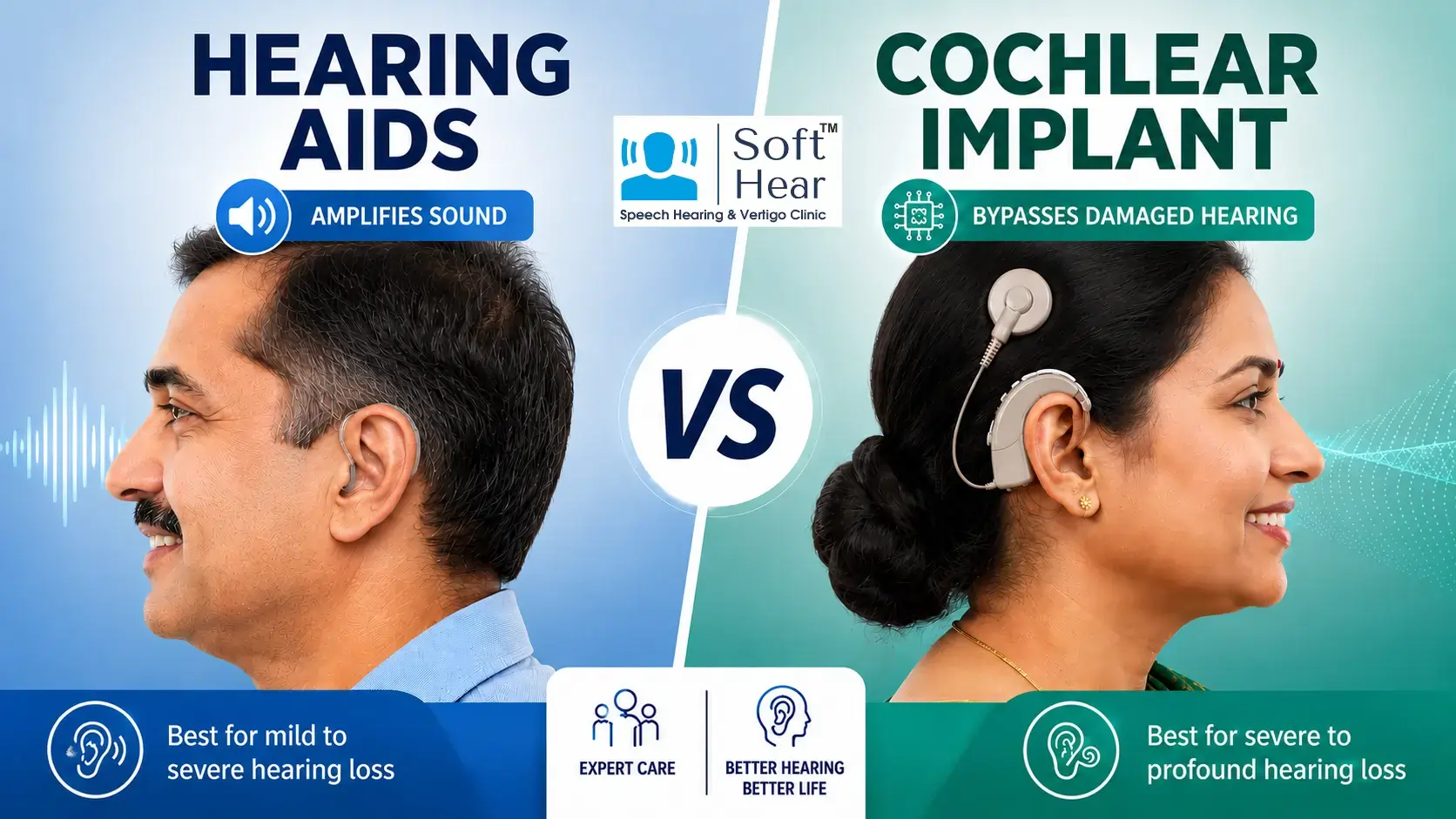
A hearing aids is an electronic device that works to amplify sound and transmit it into the ears. It is basically used for patients with mild to moderate hearing loss. It is also helpful in cases of critical hearing loss, where the Cochlea is still functional.
A hearing aid includes a microphone to capture sound waves, an amplifier to raise the volume, and a speaker to transmit it to the ear.
These electronic devices make sound clearer and louder, which helps patients understand speech better in daily conversations, but these devices do not restore normal hearing.
What do you understand about Cochlear Implant?
It is a medical device designed for patients with severe-to-profound hearing loss who derive little or no benefit from hearing aids. Cochlear implants, unlike hearing aids, don’t simply amplify sound. Rather, it directly stimulates the auditory nerve, bypassing the damaged parts of the inner ear.
A cochlear implant consists of two main components:
- External processor, which is worn behind the ear
- Internal implant, surgically placed inside the cochlea and under the skin
This converts sound into electrical signals, which are sent directly to the brain via the auditory nerve.
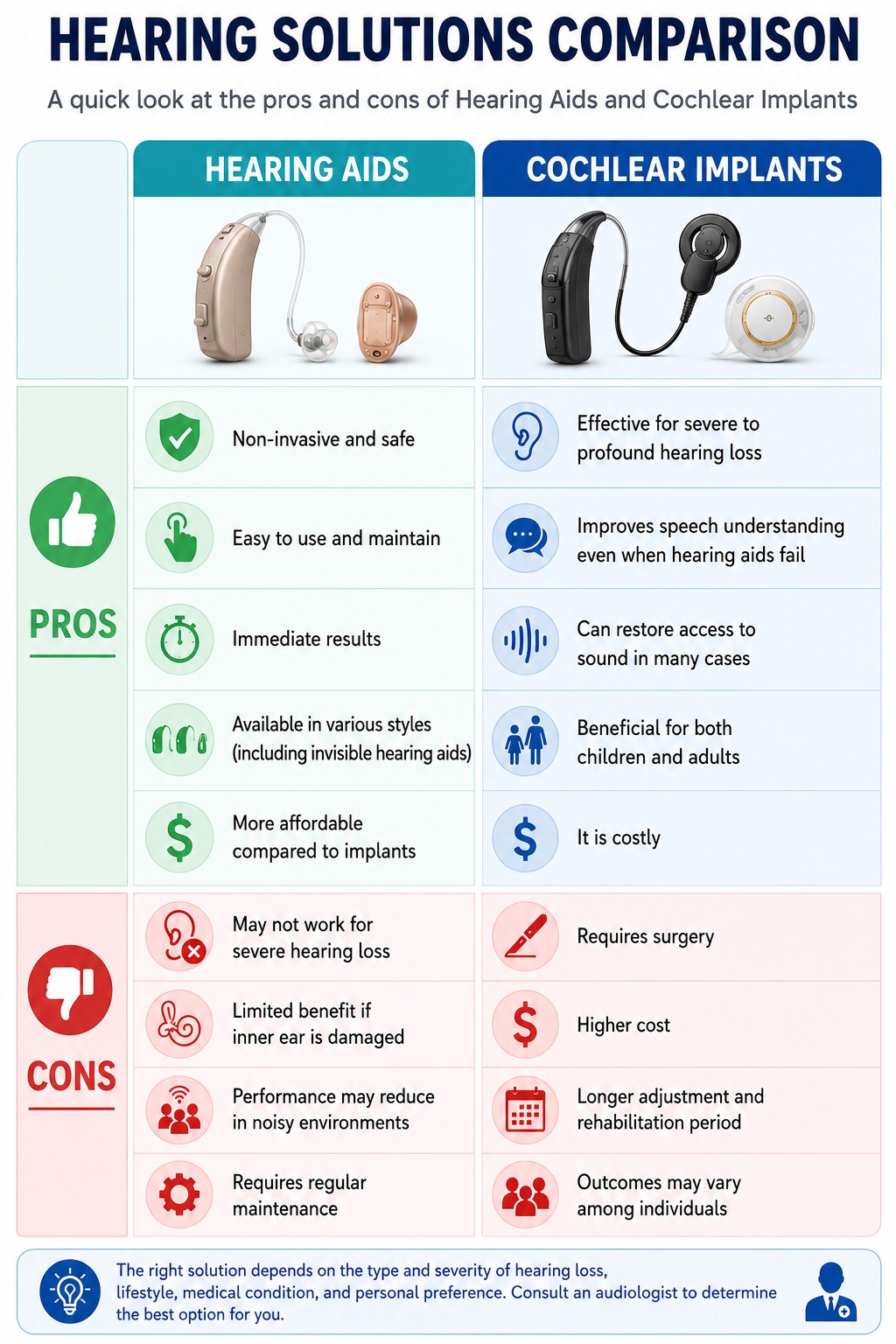
| Feature | Hearing Aids | Cochlear Implants |
|---|---|---|
| Type of Solution | Non-surgical | Surgical |
| Suitable For | Mild to moderate hearing loss | Severe to profound hearing loss |
| Working Mechanism | Amplifies sound | Directly stimulates auditory nerve |
| Cost | Lower | Higher |
| Invasiveness | No surgery required | Requires surgery |
| Sound Experience | Natural but amplified | Artificial but interpretable |
| Adjustment Period | Short | Longer rehabilitation required |
Who Should go for Hearing Aids?
Hearing aids are generally recommended for patients who are suffering from mild to moderate Hearing loss, Patients who can still understand speech with amplification, and whose Inner ear structures are functional.
Research suggests that early medical intervention, detailed, comprehensive examinations by qualified audiologists, and correctly fitted hearing aids can drastically improve communication, reduce mental stress, and improve quality of life.
Who Should Go for Cochlear Implants?
Cochlear implants are right for those patients who are suffering from severe to profound hearing loss, didn’t benefit from hearing aids, have poor understanding of speech, are medically eligible for surgery, and are willing to undergo therapy and rehabilitation.
It is particularly advantageous for adults who have hearing loss later in life and for those children with congenital hearing loss.
In children, early implantation leads to significant improvements in speech and language development.
Cost Comparison in India, 2026
(Costs vary based on brand, technology, hospital, and aftercare services)
| Solution | Approximate Cost |
|---|---|
| Hearing Aids | ₹25,000 – ₹3,50,000+ |
| Cochlear Implant (including surgery) | ₹6,00,000 – ₹15,00,000+ |
Why Professional Assessment is Crucial?
Here, one thing we need to understand is that one device can’t fit all. Every individual has different problems and different needs, but due to a lack of awareness, many patients choose the wrong device or delay treatment. Professional, qualified audiologists examine the root cause and type of hearing loss, the level of severity, and the ability to understand speech, and determine the best treatment. A professional, qualified audiologist will recommend a hearing aid that fits your needs and addresses your hearing problem
Clinical guidelines are that cochlear implants are only suggested to patients for whom hearing aids are no longer working and are not providing desired outcomes
At Soft Hear Clinics, we ensure that we guide all our patients step by step, from examining their hearing loss to recommending the appropriate hearing aid, until they feel comfortable. We do longitudinal monitoring after fitting hearing aids
Conclusion
The question of which one is right, a hearing aid or a cochlear implant? It is crucial to understand that it depends on the condition of the inner ear, the severity of hearing loss, and the patient's response to amplification
A hearing aid is the best solution when hearing loss is mild or moderate, and a cochlear implant is the right option when hearing loss is severe to profound and not benefiting from hearing aids
The most crucial point is that, at the initial stage, have your hearing checked by qualified audiologists; early medical intervention can drastically improve your hearing. Professionally qualified audiologists will make the right diagnosis before recommending any device to you. These are all small steps in hearing loss that can improve your quality of life.
Frequently Asked Questions (FAQs)
1. Which one is right for me a hearing aid or cochlear implant?
A Hearing aid is right for mild to moderate hearing loss, while a cochlear implant is right for severe to profound hearing loss.
2. After using a hearing aid, can I switch to a cochlear implant?
If a hearing aid is not giving you the required comfort and advantage then you can switch to Cochlear implants.
3. Is cochlear implant surgery considered safe?
Yes, it is mostly safe (but any surgical procedure carries risks and medical assessment.)
4. Can I restore normal hearing ability with a cochlear implant?
No, but they transform sound into electrical signals, which the brain gradually learns to understand.
5. How do I know which option is right for me?
A comprehensive hearing test and consultation with a qualified audiologist and ENT specialist are essential for determining the best solution.