Introduction
“In one-to-one conversation I am fine, but at a family function I just smile and nod.” I hear this sentence in our clinics almost every day. It describes the single most common unmet need among hearing-aid users: following a lively group conversation in noise.
Signia’s new platform, Multi-adaptive Xperience (MaX), launched on 24 August 2026, is built specifically around that problem (Signia, 2026). In this article I explain what Signia’s “four DNNs” actually do, what the company claims, what has and has not been independently tested, and who is likely to benefit.
A transparency note: Soft Hear is an authorised Phonak partner. Every performance claim in this article is attributed to its source, and I have marked which findings are independent and which come from manufacturers.
Why hearing-aid technology matters in 2026
Group conversation is hard for a simple reason: there is no single “front”. Voices come from several directions, overlap, and change quickly. Real-world recordings show that as places get louder, people raise their voices but the signal-to-noise ratio still falls towards 0 dB (Wu et al., 2018). For someone with hearing loss, that is exactly where conversation breaks down. Every 2026 flagship platform targets this situation; Signia has made it the centre of its design.
What is DNN-based hearing-aid processing?
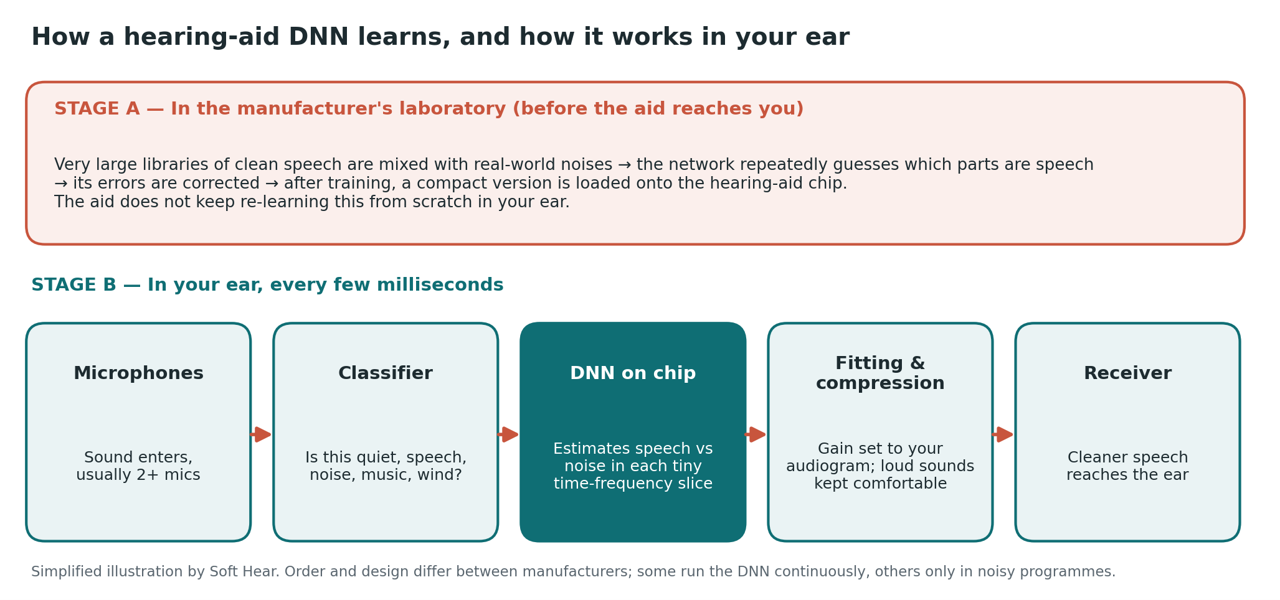
A deep neural network (DNN) is a pattern-recogniser trained on very large amounts of speech mixed with noise. Inside a hearing aid it estimates, moment by moment, which parts of the sound are speech and which are noise, so that noise can be reduced (Andersen et al., 2021). Most platforms use one main network for this job. Signia’s argument is that one network is not enough to understand a whole social scene.
Major technology launches compared
What Signia MaX is
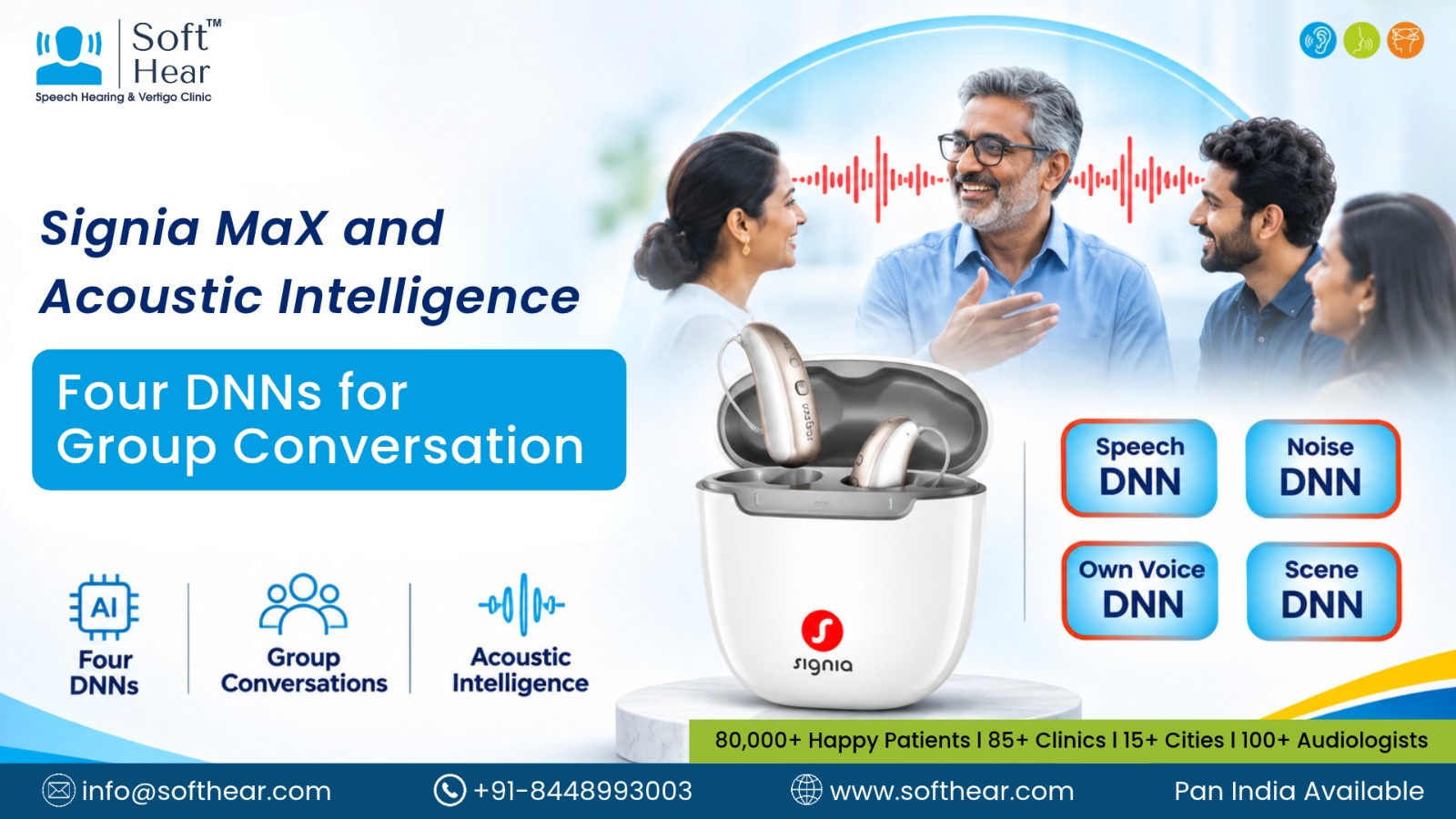
Signia describes Acoustic Intelligence as four task-specific DNNs that run at the same time and share information (Signia, 2026):
- Speech detection — is someone talking, and where?
- Own-voice detection — is the wearer speaking?
- Scene analysis — what kind of environment is this?
- Noise processing — what noise is present, and how much should be removed?
These networks drive four features. RealTime Conversation Enhancement AI locates and enhances several conversation partners and, according to Signia, processes 75% more data points per second than the previous Signia IX. Own Voice Processing AI recognises your own voice without in-clinic calibration. Ambient Scene Adaptation AI continuously adapts to the environment rather than switching between fixed programmes. Dynamic Noise Control AI adjusts noise reduction depending on what noise is present and whether you are in a conversation (Signia, 2026).
The first model is the Signia Pure Charge&Go MaX, a receiver-in-canal aid in eight colours, with Bluetooth Classic, LE Audio and a telecoil. Signia states that full Auracast functionality will arrive through a firmware update by March 2027 (Signia, 2026).
How MaX compares with other 2026 approaches
Phonak’s EON Sphere uses one focused DNN to separate speech from noise from any direction (Sonova, 2026). ReSound Sensia combines DNN denoising with a beamformer so that the person you face is favoured (Strom, 2026a). Starkey Omega AI+ also uses four DNNs, but one of them controls compression rather than scene analysis (Strom, 2026b). Signia’s distinguishing idea is the combination of own-voice and scene understanding with speech and noise processing.
Comparison table
| Technology / platform | Manufacturer | Key DNN function | Reported SNR or noise-reduction outcome | Main patient benefit | Best-suited situations | Evidence source |
|---|---|---|---|---|---|---|
| Pure C&G MaX | Signia (WSA) | Four DNNs: speech, own voice, scene, noise | “No. 1 in SNR” in group noise; 97% performed better vs key competitors (internal; no dB value published) | Multi-talker conversation; natural own voice | Family functions, social groups | Signia (2026) |
| Audéo EON Sphere | Phonak | One DNN for speech–noise separation | Up to 10 dB vs omnidirectional (manufacturer); independent lab A grade | Speech from any direction | Loud restaurants, gatherings | Phonak (2026); HearAdvisor (2026) |
| Omega AI+ | Starkey | Quad DNN incl. compression | No dB value published | Clarity with comfort; custom styles | Everyday wear | Strom (2026b) |
| Sensia 9 | ReSound | DNN + beamformer, classifier-steered | Front talker most audible for 80% of 20 users (internal) | Focus on the person you face | Restaurants, cafés | Strom (2026a) |
Bar chart and interpretation
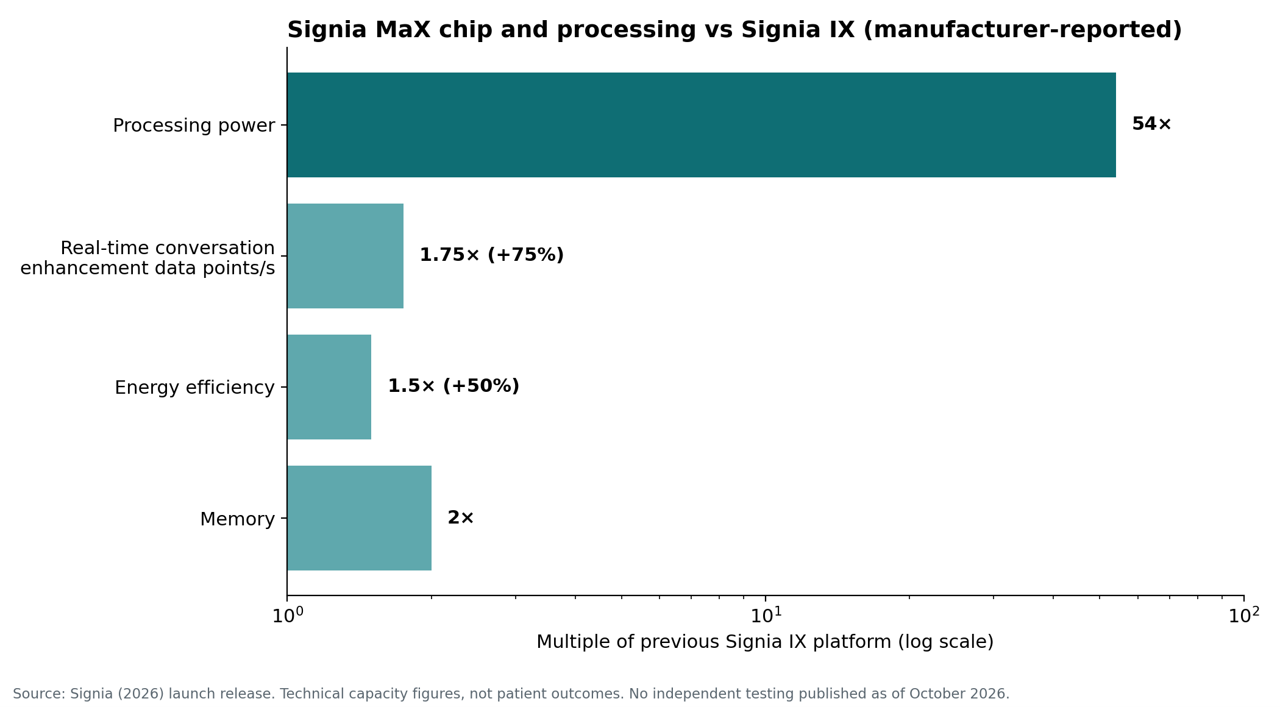
Chart 1 — What changed inside the chip. Signia reports that the MaX chip delivers 54 times the processing power of Signia IX, 50% greater energy efficiency and twice the memory, and that its conversation-enhancement feature processes 75% more data points per second (Signia, 2026). These are engineering figures. They explain how four DNNs can run at once all day, but they are not measures of how many more words a patient will understand.
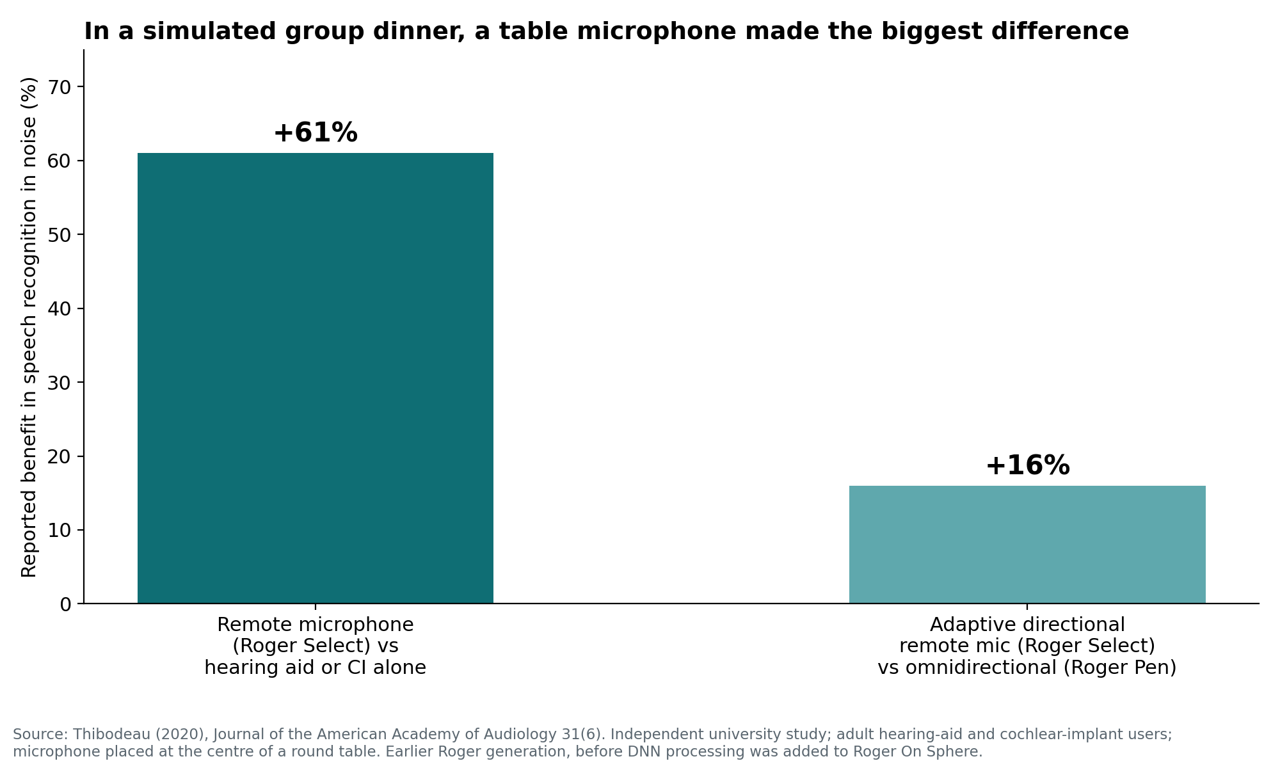
Chart 2 — An independent benchmark for group settings. For perspective, this independent study simulated a group dinner and found that a remote microphone at the centre of the table improved speech recognition in noise by 61% over hearing aids or implants alone (Thibodeau, 2020). I include it because it reminds us that, in very difficult group settings, a well-placed microphone remains one of the most powerful tools, whichever hearing-aid brand you wear.
Underlying data for Chart 1 (Signia, 2026)
| Measure | MaX relative to Signia IX |
|---|---|
| Processing power | 54× |
| Memory | 2× |
| Energy efficiency | 1.5× (+50%) |
| Conversation-enhancement data points per second | 1.75× (+75%) |
Sound quality comparison
Own-voice quality is one of the most underrated parts of hearing-aid satisfaction. First-time users often say their own voice sounds “hollow” or “like a drum”. Signia’s Own Voice Processing AI aims to recognise the wearer’s voice immediately and process it separately, without calibration in the clinic (Signia, 2026). If it works as described, this could help people who talk a lot in groups — teachers, sales professionals, grandparents at family functions. Independent sound-quality data for MaX had not been published at the time of writing.
Noise reduction and SNR comparison
Signia states that MaX ranked first for SNR performance in group conversation in noise, and that 97% of wearers performed better with MaX than with key competitors in noisy group conversations. Both claims cite Signia’s own 2026 white papers (Signia, 2026). The release did not publish the dB value, the competitor devices, the number of participants or the test protocol.
That does not make the claims untrue. It does mean they cannot yet be weighed against Phonak’s reported 10 dB figure or Widex’s 6 dB figure, which use different baselines in any case (Phonak, 2026; HHTM, 2026). Industry coverage at launch noted that no peer-reviewed or independent efficacy data accompanied the announcement (The Hearing Wire, 2026). My advice is to treat MaX’s group-conversation performance as promising but unverified until independent laboratory results appear.
DNN advantages and limitations
Potential advantages of Signia’s approach:
- Understanding own voice and scene alongside speech and noise may reduce the “wrong decision” problem, where a hearing aid treats your own voice or a sudden scene change as something to suppress.
- Continuous scene adaptation avoids abrupt programme switching.
- Binaural synchronisation between the two aids aims to keep decisions consistent across both ears (Signia, 2026).
Limitations to keep in mind:
- All performance claims currently come from Signia.
- At launch, MaX is available in one receiver-in-canal style only.
- Full Auracast functionality depends on a future firmware update (Signia, 2026).
- More processing does not automatically mean more benefit; fitting and acclimatisation still matter.
Benefits for different lifestyles
One-to-one conversations. Little difference from other premium aids in quiet.
Family gatherings and group conversations. This is MaX’s design target. Multi-talker enhancement plus own-voice processing suits people who both listen and talk a lot in groups.
Restaurants, markets and noisy public places. Promising, but independent comparisons are needed.
Workplace meetings and online calls. Own-voice processing helps when you speak often; a remote microphone helps more for distant talkers.
Outdoor walking, travel and wind. Signia’s launch material focuses on conversation rather than wind; ask about wind settings during your trial.
Television, phone calls and Bluetooth streaming. Bluetooth Classic and LE Audio are supported, with full Auracast to follow (Signia, 2026).
Older adults may appreciate continuous adaptation without programme changes. First-time users may benefit from own-voice processing during acclimatisation. Working professionals who lead meetings should test own-voice comfort. Experienced users upgrading from Signia IX are the group most likely to notice the change in groups.
Clinical relevance in real-life situations
Consider a typical example from our clinics: a retired bank manager who enjoys his weekly gathering of old colleagues at a busy café. In quiet he manages well; in the group he gives up after twenty minutes because he is exhausted. For a patient like him, the relevant question is not “which chip is fastest?” but “which system helps him follow overlapping voices from several directions with the least effort?” Signia’s design is aimed directly at that question, which is why it belongs on his shortlist alongside other premium platforms, to be compared during a real-life trial.
Group conversation is where hearing loss most affects social participation. If MaX’s claims are confirmed, it could make family functions and social gatherings less tiring. But the outcome for any one patient will depend on their degree of hearing loss, speech-in-noise ability, cognition, fitting accuracy, counselling and follow-up. A measured speech-in-noise result helps us decide whether a group-focused premium platform is likely to be worth it (Killion et al., 2004).
How to choose the right hearing aid
- Measure your speech-in-noise ability, not just your audiogram.
- Describe your typical group situation — size, noise, how often you speak.
- Ask how the platform handles your own voice, especially if it bothered you before.
- Check style availability; MaX launched in one receiver-in-canal model.
- Compare at least two platforms during a trial if group conversation is your priority.
- Confirm local availability, warranty and service for the exact model.
Practical advice from an audiologist
In group settings, sit where you can see most faces; lip-reading still adds a great deal. Choose a seat with your back to the loudest noise source. Let your family know that slowing down and taking turns helps more than shouting. And give any new hearing aid several weeks in real groups before judging it.
In India, please ensure your hearing care is provided by a qualified audiologist. Audiologists and speech-language pathologists in India are regulated by the Rehabilitation Council of India (RCI).
Frequently asked questions
1. What does “four DNNs” mean in Signia MaX?
Four separate neural networks analyse speech, your own voice, the scene and the noise at the same time, and share information to guide processing (Signia, 2026).
2. Is Signia MaX better than Phonak or Starkey in groups?
Signia’s own research says it outperforms key competitors in group noise, but independent comparisons were not available at the time of writing.
3. Does MaX need my own voice to be calibrated?
Signia states its Own Voice Processing AI works without in-clinic calibration (Signia, 2026).
4. Does Signia MaX support Auracast?It has Auracast-ready hardware; Signia says full functionality will arrive by firmware update by March 2027 (Signia, 2026).
5. Who is Signia MaX best suited for?
People whose main difficulty is lively group conversation, especially those who also talk a lot and were bothered by their own voice in previous aids.
Key takeaways
- Signia MaX runs four DNNs for speech, own voice, scene and noise, designed for group conversation.
- The MaX chip offers major processing gains over Signia IX, according to Signia.
- Group-performance claims are Signia’s own; independent data are still awaited.
- One receiver-in-canal style at launch; full Auracast by firmware update.
- A remote microphone remains valuable in the hardest group settings.
Book your hearing evaluation
If group conversations leave you smiling and nodding, book a hearing and speech-in-noise evaluation at any Soft Hear clinic. Call or WhatsApp 8448993003.
Book a hearing test or contact Soft Hear on WhatsApp at 8448993003.
Soft Hear | Hear The Future, Live With Confidence.
Phone: +91-8448993003 | Website: www.softhear.com | Email: info@softhear.com
References
- Andersen, A. H., Santurette, S., Pedersen, M. S., Alickovic, E., Fiedler, L., Jensen, J., & Behrens, T. (2021). Creating clarity in noisy environments by using deep learning in hearing aids. Seminars in Hearing, 42(3), 260–281. https://doi.org/10.1055/s-0041-1735134
- HearAdvisor. (2026). Phonak Audéo EON Sphere expert review. https://www.hearadvisor.com/products/phonak-audeo-eon-sphere
- Hearing Health & Technology Matters. (2026, May). Widex introduces Allure AI RIC hearing aids with dual-chip AI processing and advanced connectivity. https://hearinghealthmatters.org/hearing-news-watch/2026/dual-processor-widex-allure-ai/
- Killion, M. C., Niquette, P. A., Gudmundsen, G. I., Revit, L. J., & Banerjee, S. (2004). Development of a quick speech-in-noise test for measuring signal-to-noise ratio loss in normal-hearing and hearing-impaired listeners. The Journal of the Acoustical Society of America, 116(4), 2395–2405.
- Phonak. (2026). Phonak Audéo EON Sphere outperforms four other hearing aids for clear speech in loud noise [Phonak Insight]. Sonova AG. https://www.phonak.com/content/dam/phonak/en/evidence-library/white-paper/technical-paper/PH_Insight_SphericSpeechClarity-EON-210x297_EN_028-2930-02_V1.00.pdf
- Signia. (2026, August 24). Signia introduces MaX, powered by Acoustic Intelligence: World’s first AI hearing aid platform with 4 DNNs [Press release]. PR Newswire. https://www.prnewswire.com/news-releases/signia-introduces-max-powered-by-acoustic-intelligence-worlds-first-ai-hearing-aid-platform-with-4-dnns-302857407.html
- Sonova. (2026, August 24). Sonova strengthens innovation leadership with Phonak EON portfolio and third-generation proprietary real-time AI [Media release]. https://www.sonova.com/sonova-strengthens-innovation-leadership-with-phonak-eon-portfolio-and-third-generation-proprietary-real-time-ai/
- Strom, K. (2026a, August 10). ReSound Sensia launch: AI that follows the voice you want to hear. HearingTracker. https://www.hearingtracker.com/news/resound-sensia-launch-ai-follows-the-voice-you-want-to-hear
- Strom, K. (2026b, October 1). Starkey launches Omega AI+ with Quad DNNs and DNN Dual Compression. HearingTracker.https://www.hearingtracker.com/news/starkey-launches-omega-ai-with-quad-dnn-and-dual-compression
- The Hearing Wire. (2026). Signia introduces MaX hearing aid platform with four-DNN Acoustic Intelligence. HearingTracker News. https://news.hearingtracker.com/news/ae012bbf-313a-4f8c-9ac5-354bb788747e
- Thibodeau, L. (2020). Benefits in speech recognition in noise with remote wireless microphones in group settings. Journal of the American Academy of Audiology, 31(6), 404–411. https://doi.org/10.3766/jaaa.19060
- Wu, Y.-H., Stangl, E., Chipara, O., Hasan, S. S., Welhaven, A., & Oleson, J. (2018). Characteristics of real-world signal to noise ratios and speech listening situations of older adults with mild to moderate hearing loss. Ear and Hearing, 39(2), 293–304. https://doi.org/10.1097/AUD.000000000000048