Introduction
“Doctor sahab, is this hearing aid really thinking?” A retired schoolteacher asked me this last month after reading that his new hearing aid had “artificial intelligence”. It is a lovely question, and the honest answer is: not in the way we think. A hearing aid does not understand your conversation. But the best ones now contain a small, highly trained pattern-recogniser — a deep neural network, or DNN — that has learned, from an enormous number of examples, what speech looks like when it is buried in noise.
In this article I want to explain, in plain language, what a DNN actually does inside a hearing aid, how each of the 2026 platforms uses it, what the independent research shows, and — just as importantly — where the technology still falls short.
Transparency note: Soft Hear is an authorised Phonak partner. Performance claims should be considered in the context of their cited sources; some findings are independent and others come from manufacturers.
Why hearing-aid technology matters in 2026
The hardest listening situation for anyone with hearing loss is not silence; it is the wedding hall, the family dinner, or the busy OPD waiting area. Conventional hearing aids make sound louder, but in noise they can also make the noise louder. For decades, the main tools were directional microphones and rule-based noise reduction. Both help, but both have limits, especially when the “noise” is other people talking.
In 2026, DNN-based processing has moved from laboratory demonstrations into devices small enough to sit behind your ear for a full day. Major manufacturers use neural networks for different tasks and in different ways.
What is DNN-based hearing-aid processing?
The traditional approach
A modern hearing aid’s noise-reduction system has traditionally used a beamformer, which uses two or more microphones to favour sound from a chosen direction, and a postfilter, which tries to suppress the noise that remains. The postfilter has often relied on fixed rules—for example, that sounds which stay steady over time are probably noise. That works for a fan or air-conditioner, but less well for a room full of voices.
What a DNN changes
A DNN is a layered mathematical model that learns patterns from data rather than following hand-written rules. A neural network can be trained to take over part of the postfilter’s job and help separate speech from noise.
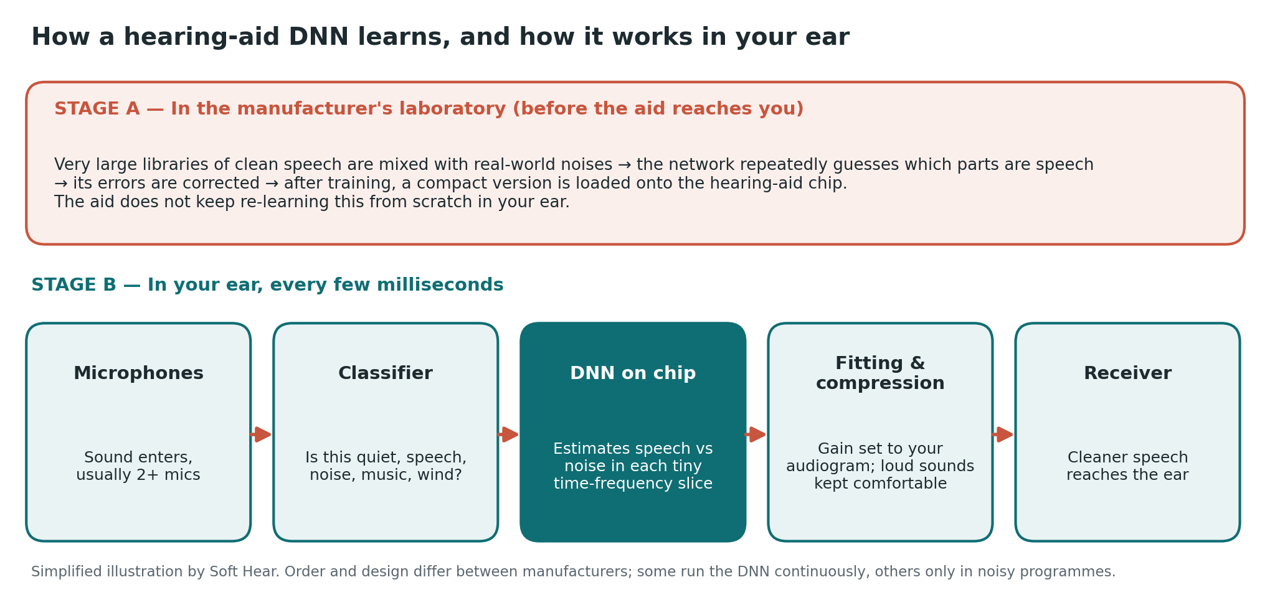
Stage A — training in the laboratory
Engineers take large libraries of clean speech, mix them with many kinds of real-world noise, and let the network repeatedly guess which parts of the sound are speech. Wrong guesses are corrected during training. The trained model is then prepared for use in the hearing aid.
Stage B — working in your ear
After training, a compact version of the network is loaded onto the hearing-aid chip. Every few milliseconds it analyses incoming sound across time and frequency, estimates how much of each slice is speech, and reduces some of the remaining noise before applying the amplification fitted by the audiologist.
Put simply: conventional noise reduction is like a gatekeeper with a fixed list of rules. A DNN is like a gatekeeper who has met many different guests and recognises a voice even in a crowd.
Why this only became possible recently
In 2023, a research team reported that a deep-learning system could restore speech intelligibility for hearing-aid users in laboratory conditions, although the system ran on a laptop. The 2024 Phonak Audéo Sphere Infinio was described by Phonak as the first hearing aid with a dedicated AI chip. By 2026, other major brands had introduced their own DNN-based approaches.
Major technology launches compared
Each platform uses DNNs for different jobs, and that design choice shapes how the hearing aid behaves.
- Phonak Audéo EON Sphere: Uses DNN processing to separate speech from noise arriving from different directions.
- Phonak Roger On Sphere: Uses processing in a remote microphone so speech can be cleaned up close to the talker before transmission.
- Signia MaX: Uses task-specific DNNs for speech detection, own-voice detection, scene analysis and noise processing.
- Starkey Omega AI+: Applies DNN-based features including speech-in-noise processing and directionality-related functions.
- Oticon Reveal: Includes DNN-related scene analysis features according to launch materials.
- ReSound Sensa 9: Uses DNN speech-in-noise processing in its platform.
- Widex Allure AI RIC: Offers DNN-related processing in features such as Clarity Boost.
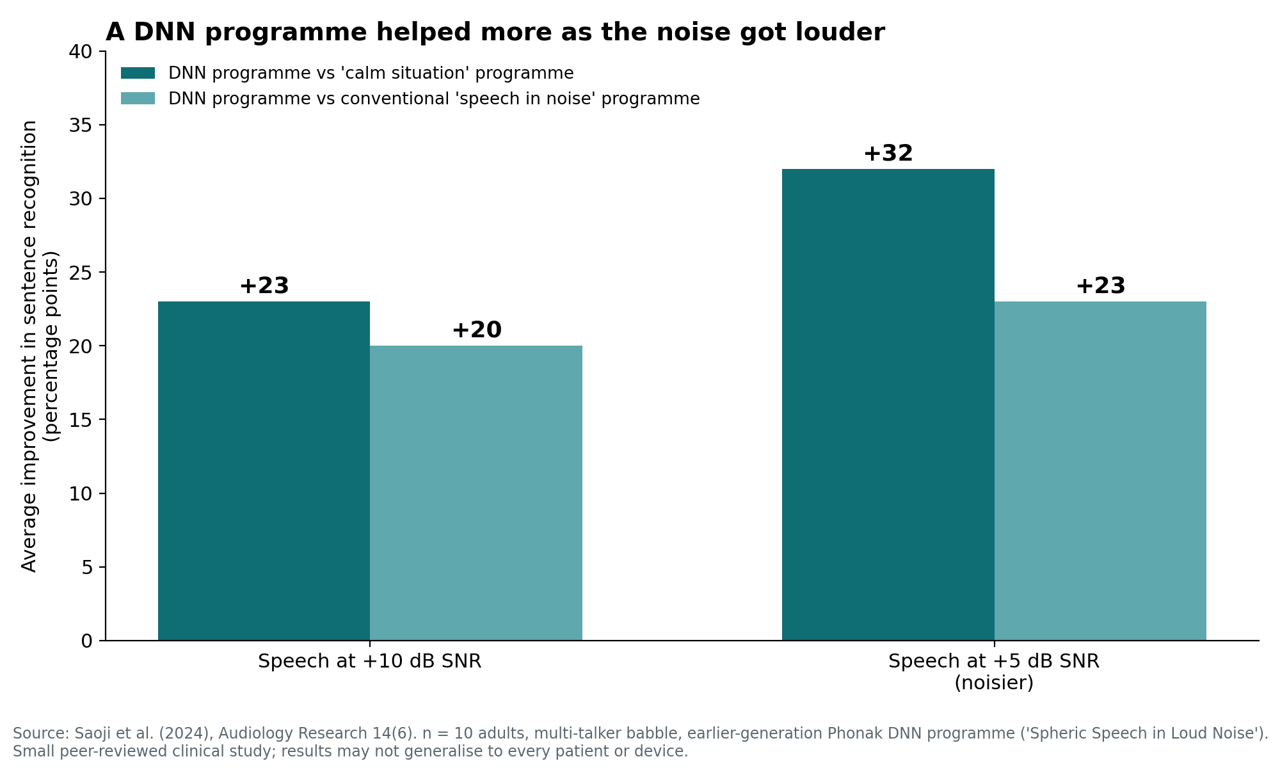
Manufacturer feature descriptions are not a direct ranking of sound quality or clinical performance. A blank feature cell means that the feature was not described as DNN-based in the material reviewed; it does not prove that the feature is absent.
What does the research show?
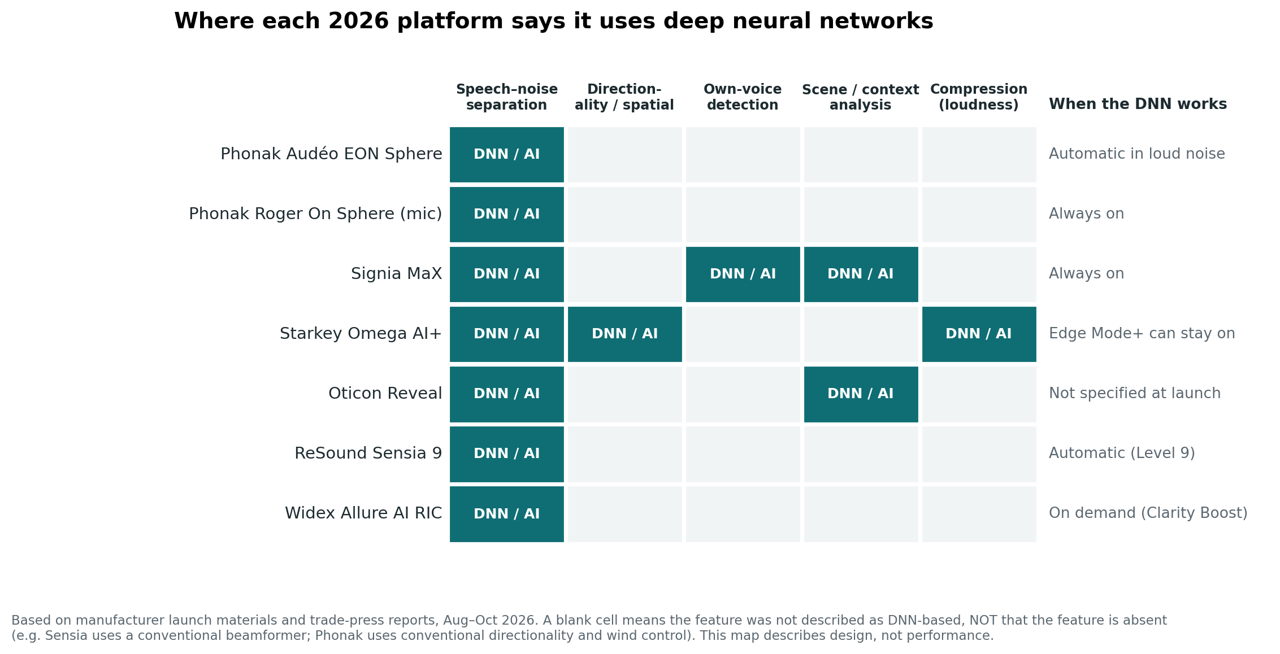
Research suggests that DNN-based processing may improve speech understanding in some noisy listening conditions. The size of the benefit varies by device, listening environment, test method and individual listener. Results from a small clinical study should not be assumed to apply equally to every person or hearing aid.
Where DNN hearing aids still fall short
DNN processing is not the same as understanding language. It does not guarantee that every word will be clear, and it cannot remove the need for an accurate hearing assessment, appropriate fitting and follow-up. Performance claims also differ in how they are measured, and manufacturer demonstrations are not always directly comparable with independent clinical studies.
Real-world outcomes depend on the listener’s hearing profile, the fit and settings of the device, the room acoustics, microphone placement and the type of competing noise.
What this means for you
DNN technology is a meaningful development in hearing aids, particularly for difficult speech-in-noise situations. But the best device is not simply the one with the most AI features. It is the one that matches your hearing test, listening needs, comfort and budget, and is fitted and fine-tuned by a qualified hearing-care professional.
If conversations are difficult in restaurants, family gatherings or other noisy environments, ask your audiologist to demonstrate the device in a realistic listening situation and explain what benefits you can reasonably expect.